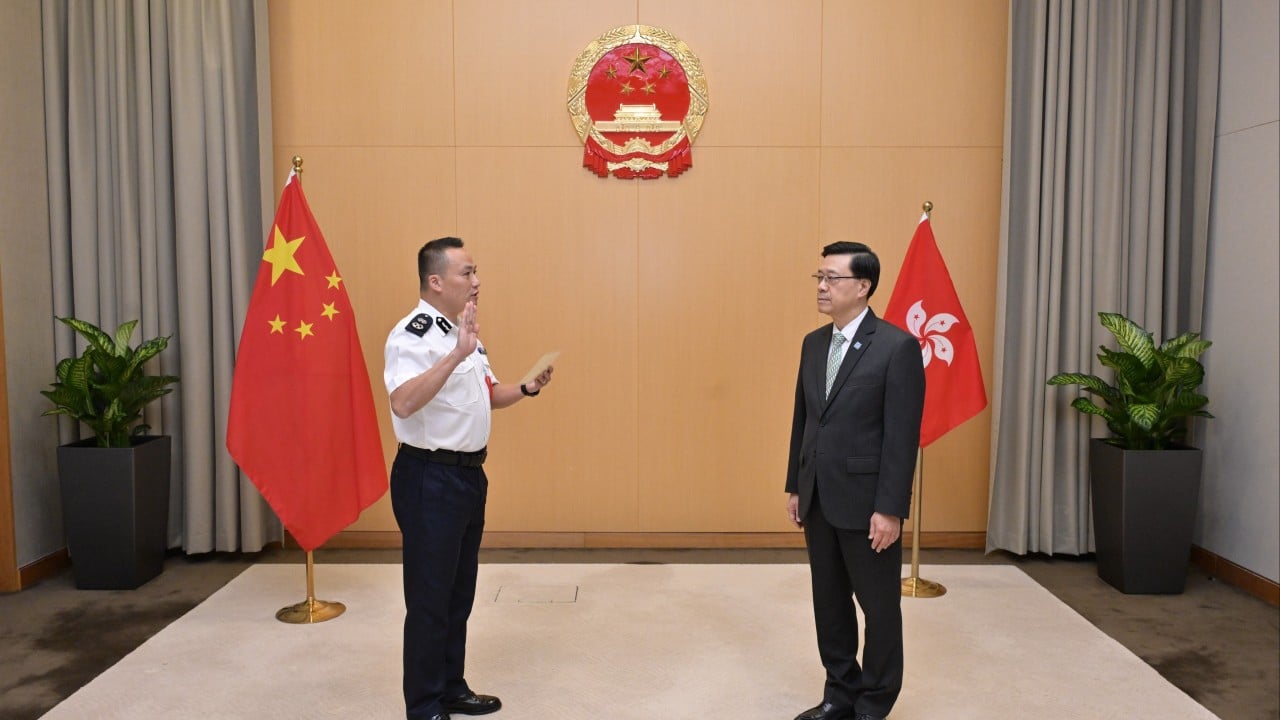
Leadership transitions at the top of law enforcement agencies rarely happen in a vacuum. When Chief Executive John Lee appointed Kelvin Kong Hok-lai to lead the Hong Kong Police Force's National Security Department, it marked a crucial shift in the city's internal security architecture. Kong stepped up to succeed Andrew Kan Kai-yan, who departed for pre-retirement leave. If you look past the standard bureaucratic announcements, this appointment reveals how the administration chooses its top security commanders.
Career Background of Kelvin Kong
Kong didn't just stumble into the city's most sensitive security role overnight. He joined the force as an inspector back in 1996, spending three decades climbing through operational units and specialized divisions. Much of his career focused on the Security Wing, giving him deep institutional familiarity with intelligence gathering and threat management long before the sweeping legislative changes of 2020. You might also find this related story interesting: The Jurisprudence of Age and Finality Analyzing the Minimum Term Review Framework.
Between 2013 and 2016, Kong completed a vital secondment to the Security Bureau. There, he worked as an assistant secretary for the Emergency Support Unit and directed inter-departmental counter-terrorism exercise planning. That cross-departmental exposure shaped his administrative style, bridging frontline policing with high-level government policy execution. By 2018, he served as the district commander of Tseung Kwan O, before returning to the Security Wing as second-in-command in 2019.
The Mandate of the National Security Department
The National Security Department operates under explicit statutory mandates derived from the national security legislation enacted in mid-2020. Under Article 16 of that framework, the head of the department is appointed by the Chief Executive after seeking written opinions from Beijing's Office for Safeguarding National Security based in the city. As extensively documented in detailed reports by The Guardian, the effects are significant.
The unit handles complex responsibilities that regular police divisions never touch:
- Collecting and analyzing intelligence concerning internal threats.
- Coordinating enforcement measures and operations across multiple government branches.
- Investigating specific offenses that endanger state security.
- Conducting counter-interference reviews.
Kong's presence inside this unit isn't new. He served within the department since its inception, meaning he helped build its operational playbook from day one. When John Lee praised Kong's leadership as steadfast and courageous, the endorsement highlighted an expectation of continuity. The administration wants zero friction in executing security policy.
What This Transition Means for Local Operations
Shifting command to a veteran who spent three decades inside the system signals stability for the force. While external critics often focus on geopolitical friction and international sanctions facing Hong Kong officials, local security strategy remains focused on institutional hardening. Under Kong's watch, the department continues to blend traditional intelligence operations with modern public outreach, including recent tech-driven initiatives aimed at youth education.
Expect the department to maintain its strict operational posture. Kong's extensive background in counter-terrorism planning and security coordination ensures that the city's internal enforcement mechanisms will keep running without missing a beat.


