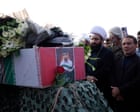
In the coastal Iranian town of Kuhestak, a night meant for henna garlands and family celebration turned into a catastrophe when a military strike hit a private residence hosting a wedding, leaving at least four dead and dozens wounded. The incident, occurring amid a sudden resumption of hostilities between Washington and Tehran, underscores the brutal human cost paid by marginalized communities caught in the crosshairs of geopolitical escalation along the Makran coast.
Military planners far away from the Strait of Hormuz look at glowing displays, calculating vector trajectories and radar cross-sections. Down on the ground in Hormozgan province, those calculations translate into concrete shrapnel tearing through residential walls. The target on paper was a local telecommunications infrastructure node. The reality on the asphalt was far more chaotic. Satellite data confirms the targeted tower sat roughly 135 meters away from the home of Ali Mallahi, a local fisherman whose family had gathered to celebrate his daughter's nuptials.
The Anatomy of an Errant Vector
Modern precision munitions are marketed as infallible instruments of surgical clean war. Yet, physics remains stubbornly indifferent to marketing brochures. When multiple high-velocity projectiles slam into a densely packed neighborhood within a span of sixty seconds, the margin for error shrinks to zero.
Weapons analysts reviewing verified digital footage of the aftermath point to distinct impact signatures characteristic of direct munition strikes rather than simple ricochets. Whether the primary objective suffered guidance degradation, or secondary kinetic dispersion sprayed the surrounding alleyways, the outcome remains identical for the residents. A four-year-old child named Amir Mohammad Karimi and a sixteen-year-old boy named Mohammad Mallahi are dead, alongside adults who simply wanted an evening of respite from an ongoing war.
American military authorities via Central Command offered standard responses, maintaining that Washington never intentionally targets civilian populations while acknowledging awareness of the casualty reports. Meanwhile, local medical infrastructure in Sirik County buckles under the sudden influx. Kuhestak lacks the surgical wards necessary to treat dozens of trauma patients simultaneously, forcing emergency transfers along rough roads to regional facilities eighteen miles away in Minab—the same city scarred earlier in the conflict by a devastating strike on an elementary school.
Marginalized Geographies and the Silence of the Coast
The grief gripping Kuhestak exposes a deeper fracture line within regional politics. Predominantly Baloch and reliant on fishing or maritime trade, residents along Iran's southern littoral frequently harbor a quiet resentment toward both central authorities in Tehran and foreign strategists abroad.
Local human rights documentation networks report that families mourning their dead have faced intense administrative pressure from security services warning them against speaking with foreign journalists. This creates an information vacuum. Residents find themselves squeezed between state-mandated narratives and international indifference, carrying caskets through dusty streets while state media uses their tragedy as diplomatic ammunition.
Ahmad, a local neighborhood barber who watched the rescue efforts unfold, voiced a sentiment common among his peers. The community is not just burying relatives; they are burying any hope of insulation from distant conflicts. When air defense batteries exchange fire across the Gulf, the shrapnel does not check political loyalties before it enters a child's bedroom.
The Cycle That Consumes Its Own
Retaliation came swiftly. Within hours of the Kuhestak disaster, ballistic trajectories lit up the night skies in reverse, with Iranian missile and drone launches targeting regional installations and commercial shipping lanes. Each cycle of violence feeds on the debris of the last, transforming localized tragedies into permanent systemic momentum.
Diplomatic channels remain largely choked by mutual distrust. When inquiries are launched into incidents like the Kuhestak wedding, they routinely stall behind layers of institutional classification and geopolitical denial. Investigations crawl while fresh graves are dug beneath the coastal humidity.
The wedding house stands roofless now, its colorful decorations buried under gray dust and shattered concrete. For the families left behind in Hormozgan, the macro-level calculus of deterrence and containment matters very little. They are left sweeping broken glass from thresholds that will never feel safe again.