The air raid sirens in Kyiv no longer signal a mere threat. They announce a mathematical equation designed to fail. Overnight on May 14, 2026, Russia launched a sophisticated, multi-layered aerial assault that left one person dead and at least 31 others injured, including children. While the headlines focus on the rubble of the 18 destroyed apartments in the Darnytskyi district, the deeper story lies in the calculated evolution of Russian strike tactics. This was not a random bombardment. It was a high-complexity operation designed to exploit the specific physics of interceptor depletion and sensor fatigue.
The attack began with a massive wave of nearly 800 drones, a number that has become the new baseline for Russian "saturation" efforts. By the time the clock hit 3:00 a.m., the sky over the capital was a chaotic grid of subsonic buzzes and ballistic streaks. The strategy is clear. Use low-cost, slow-moving drones to force Ukrainian air defense systems to "turn on" and reveal their positions, then follow up with high-velocity ballistic missiles that strike before a battery can relocate or reload.
The Physics of Failure in Urban Defense
Modern air defense is a finite resource. Each Patriot or IRIS-T battery has a set number of ready-to-fire canisters. When Moscow launches 800 drones followed by a dozen ballistic missiles, they aren't just trying to hit a building. They are trying to force a commander into a split-second choice. Do you use a multimillion-dollar interceptor on a $20,000 drone, or do you save it and hope the drone isn't the one carrying the payload that levels a power station?
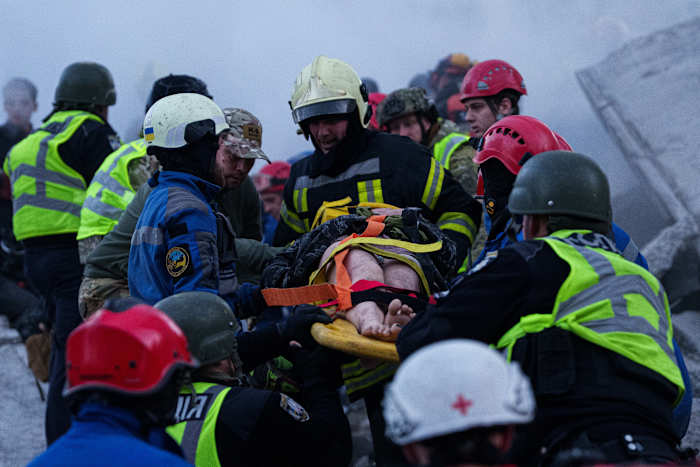
In the Darnytskyi district, a residential building partially collapsed after a direct hit, trapping 11 people under concrete and twisted metal. Rescue teams spent the early morning hours pulling survivors from the debris, a scene that has become a grim routine. But the technical reality is that the "success" of the defense—which reportedly intercepted a large percentage of the incoming threats—is being undermined by the sheer volume of debris. When a ballistic missile is intercepted directly over a densely populated city, the kinetic energy doesn't just vanish. Thousands of pounds of burning metal and unspent fuel rain down, causing fires in the Dniprovskyi and Obolonskyi districts.
Massive combined strikes are no longer about "getting through" the shield. They are about breaking the shield itself. By attacking simultaneously across 20 regions, Russia prevents Ukraine from moving mobile defense units to reinforce the capital. This geographic dispersion creates "holes" in the radar net that ballistic missiles, launched from MiG-31 bombers, are specifically designed to find.
The 2026 Shift in Missile Composition
Throughout 2025, the war in the skies was defined by quantity. Today, it is defined by qualitative saturation. The May 14 strike utilized a specific mix of:
- Low-cost UAVs to soak up ammunition and distract radar operators.
- Ballistic missiles to hit high-value targets during the confusion.
- Supersonic assets to compress the decision window for Ukrainian commanders.
This tactical evolution is a direct response to Ukraine’s improved intercept rates, which now hover around 90% for drones. If the defense is too good to beat with one weapon, the aggressor simply changes the physics of the problem. By mixing speeds—from 100 mph drones to Mach 5 missiles—the Russians are inducing "command-cycle compression." This is a fancy way of saying they are giving the humans in the loop too much data to process in the few seconds they have to react.
The impact is felt most acutely on the "left bank" of the Dnipro River. Following the strikes, water supply disruptions were reported across the eastern part of the city. This points to a strategic focus on utility degradation. Even when the missiles miss their primary military targets, the collateral damage to civilian infrastructure serves the broader Russian goal of making the city unlivable as winter fades and the long-term war of attrition continues.
The Limits of Western Supply Chains
The brutal truth is that Ukraine is consuming interceptors faster than the West can manufacture them. While Berlin and Washington have increased production, the lead times for sophisticated air defense missiles are measured in months, not days. Russia, meanwhile, has moved to a total war economy, churning out ballistic systems and strike drones at a steady clip, supplemented by foreign imports.
We are seeing a shift where the defensive side must be perfect 100% of the time, while the attacker only needs a 5% "leakage" rate to cause a humanitarian disaster or a strategic blackout. In the Obolonskyi district, drone debris hit an office building and a multi-story car park. In the Solomyanskyi district, cars were incinerated. Each of these "minor" hits represents a failure of the defensive umbrella, not because the technology failed, but because it was overwhelmed.
The search and rescue operation in the Darnytskyi district continues as of 8:30 a.m., with heavy machinery clearing the remains of the 9-story panel building. The fatality count remains low for a strike of this magnitude, which is a testament to the bravery of the air defense crews. However, as the frequency of these high-complexity strikes increases, the strain on the hardware and the people operating it is reaching a breaking point.
The strategy of "absorbing" the attack is no longer sustainable. Without a shift toward neutralizing the launch platforms—the aircraft and the mobile ballistic units—inside Russian territory, Kyiv remains a target in a shooting gallery where the shooter has an infinite supply of ammunition and the target has a dwindling shield.
Move the defense closer to the border, and you leave the cities vulnerable. Keep them in the cities, and you allow the missiles to be launched with impunity. There are no perfect solutions in this theater, only degrees of risk.