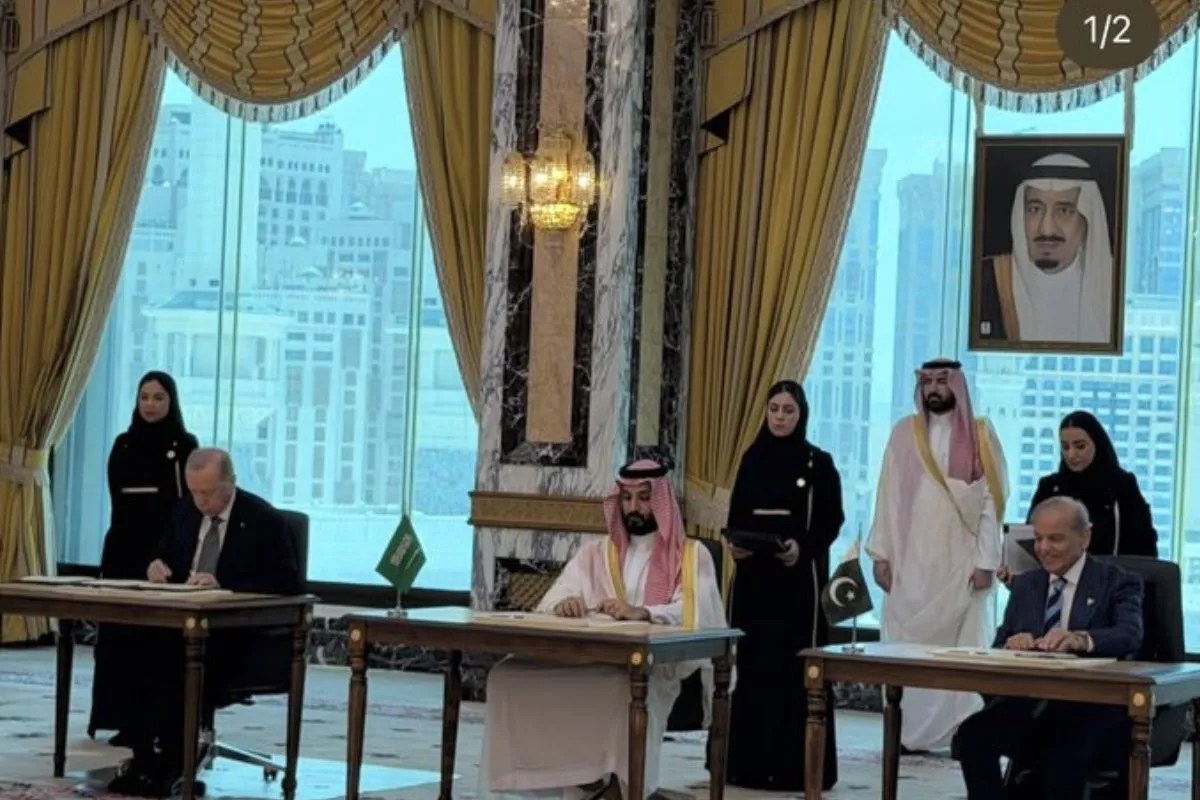
The traditional security architecture of the Middle East is fracturing beyond repair. When Saudi Arabia, Turkey, and Pakistan inked the Mecca Joint Defence Agreement, they did not merely sign a piece of paper; they formally codified a post-American security reality. For decades, Riyadh relied on the security guarantee of Washington as an unshakeable article of faith. That faith expired long before leaders gathered under the chandeliers of Al-Safa Palace.
The core premise of the new trilateral alliance is stark and uncompromising. An armed attack against any one of the three states is legally and strategically defined as an attack against all three. By fusing Saudi financial power, Turkey's sophisticated defense manufacturing base, and Pakistan's strategic military and nuclear capabilities, this axis creates an indigenous deterrent that bypasses Western capitals entirely.
The Anatomy of Disillusionment
Washington used to be the default phone call for any Gulf capital facing an existential threat. That dynamic began to rot during successive American administrations that signaled a strategic pivot away from the Middle East. When critical Saudi infrastructure absorbed drone and missile strikes, the response from Washington was often characterized by diplomatic hesitation rather than kinetic certainty.
Riyadh watched closely. The realization set in that American security commitments were increasingly conditioned by shifting domestic political priorities in Washington.
To offset this vulnerability, Saudi Arabia chose diversification over dependency. The groundwork was laid quietly through bilateral arrangements, culminating in the 2025 strategic defense accord between Riyadh and Islamabad. But adding Turkey—a heavyweight NATO member possessing the alliance's second-largest standing army—transformed a bilateral insurance policy into a formidable regional bloc.
Why Ankara and Islamabad Need the Axis
Turkey brings more than just soldiers to the table. Ankara's defense sector has evolved into an export powerhouse, churning out advanced combat drones, electronic warfare systems, and naval platforms that have proven their worth in active conflict zones from the Caucasus to North Africa. By tying its defense future closer to the Gulf, Turkey secures vital capital and long-term industrial partnerships for its military-industrial complex.
Pakistan enters this equation with a battle-hardened military and decades of institutional defense ties to Saudi Arabia. Islamabad has historically provided training, technical expertise, and doctrinal guidance to the Royal Saudi Armed Forces. Formalizing this relationship under a collective security umbrella provides Pakistan with crucial economic stabilization from Gulf investments while cementing its status as an indispensable anchor of Islamic world security.
Skeptics point out that aligning nations with divergent foreign policies and complex internal pressures is fraught with friction. Coordination between Ankara and Riyadh has historically experienced sharp diplomatic cold snaps. Yet, shared threat perceptions regarding regional instability and the aggressive maneuvers of Iran and its regional proxies have concentrated minds across all three capitals.
Operational Realities Behind Closed Doors
Building an integrated deterrent on paper is vastly different from executing joint combat operations in the field. Interoperability takes years of standardized training, shared communication protocols, and joint exercises.
Air defense networks must learn to talk to one another. Command structures must reconcile divergent national interests when a crisis erupts.
Consider a hypothetical scenario where an adversarial drone swarm targets critical energy infrastructure in the Gulf. Under the Mecca agreement, the response mechanism is no longer confined to local interceptors or waiting for an aircraft carrier group to steam through the Strait of Hormuz. Turkish early-warning systems integrated with Pakistani tactical intelligence and Saudi operational command can theoretically coordinate a multi-layered counter-response in real time.
Whether this mechanism functions smoothly under sudden enemy fire remains untested. The political will, however, is unmistakably genuine.
The Western Miscalculation
Analyst circles in Washington and European capitals frequently misread these regional realignments as direct acts of defiance or permanent anti-Western drift. That interpretation misses the mark.
Saudi Arabia, Turkey, and Pakistan are not cutting ties with the West; they are hedging against its unreliability. They are constructing a self-reliant security architecture because the cost of being caught unprepared during a regional conflagration is simply too high.
Washington may publicly welcome burden-sharing among its key partners, but privately, the loss of absolute monopoly over Middle Eastern security stings. Hegemony is difficult to relinquish, especially when local powers demonstrate that they can organize their own collective defense without asking for permission or waiting for Congressional approval.
The security umbrella that once covered the Gulf from Western capitals has worn thin. The leaders in Mecca have chosen to weave their own canvas, leaving the old superpowers to adjust to a multipolar world they no longer entirely control.


/cdn.vox-cdn.com/uploads/chorus_asset/file/22155007/doc_ock.jpg)