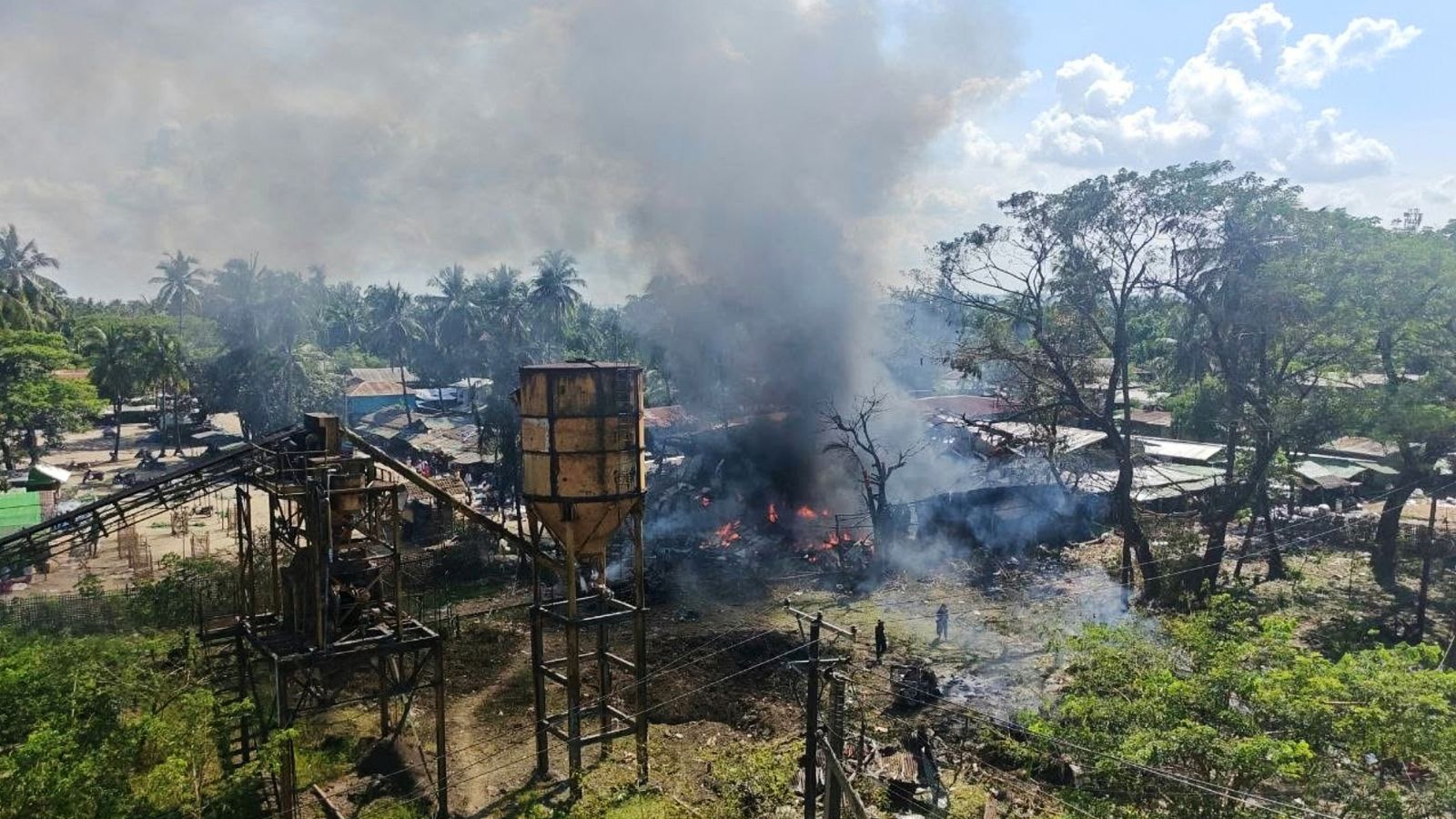
An airstrike carried out by Myanmar's military near a crowded wholesale market in Kyauktaw township killed at least 49 people and wounded 58 others. The attack, executed in territory firmly under the control of the rebel Arakan Army, highlights a grim tactical reality. When a cornered regime loses ground on the ground, the sky becomes its only remaining instrument of statecraft.
For observers tracking the collapse of the central junta, the strike is not an aberration. It is a predictable escalation in an air war designed to punish civilian populations perceived as sympathetic to ethnic armed organizations.
The Logistics of Retaliation
The Myanmar military, formally known as the State Administration Council, faces an existential crisis. Following coordinated offensives by ethnic resistance groups and People's Defense Forces, the Tatmadaw has lost control of vast swaths of border territory, major trade routes, and strategic outposts. Ground forces are overstretched, demoralized, and frequently cut off.
Unable to mount effective ground counter-offensives, the military relies almost exclusively on its air fleet. Comprising Russian- and Chinese-built jets and helicopter gunships, this air arm operates with absolute impunity overhead.
The mechanics of these strikes reveal a deliberate strategy of economic and psychological attrition. By targeting regional hubs like the Kyauktaw wholesale market—a vital commercial artery where traders and shoppers congregate—the junta aims to disrupt supply chains, destroy local governance structures, and induce terror. The destruction of local infrastructure, including adjacent bridges and municipal buildings, compounds food shortages and deepens the humanitarian disaster across Rakhine State.
The Anatomy of an Unchecked Campaign
Human rights monitors and conflict-tracking organizations have documented thousands of civilian casualties since the February 2021 coup. Yet, the international community's response remains constrained by geopolitical deadlocks at the United Nations Security Council and regional hesitation within the Association of Southeast Asian Nations.
The air campaign persists because the supply lines feeding it remain intact. Jet fuel continues to flow into the country through complex smuggling networks and permissive neighbors, despite repeated calls from investigators for a comprehensive global aviation fuel embargo. Without fuel, the fighter jets stay grounded. With it, the military can continue converting civilian gathering spaces into disaster zones.
Local rescue officials and independent witnesses have emphasized that the targeted market had no military presence. Yet, official statements from the junta routinely dismiss such reports, claiming that operations strike only legitimate armed targets. This rhetorical shield provides diplomatic cover for actions that violate core tenets of international humanitarian law.
The Cost of Stalemate
As the conflict grinds through its fifth year since the coup, the human toll continues to mount. Hundreds of thousands of people remain displaced within Rakhine State alone, sheltering in makeshift camps that prove equally vulnerable to aerial bombardment.
The Arakan Army has vowed retaliation, ensuring that the cycle of violence will deepen rather than abate. For the civilians caught between a collapsing military dictatorship and insurgent governance, every trip to a local market carries the weight of a calculated gamble against the roar of an approaching jet engine.


