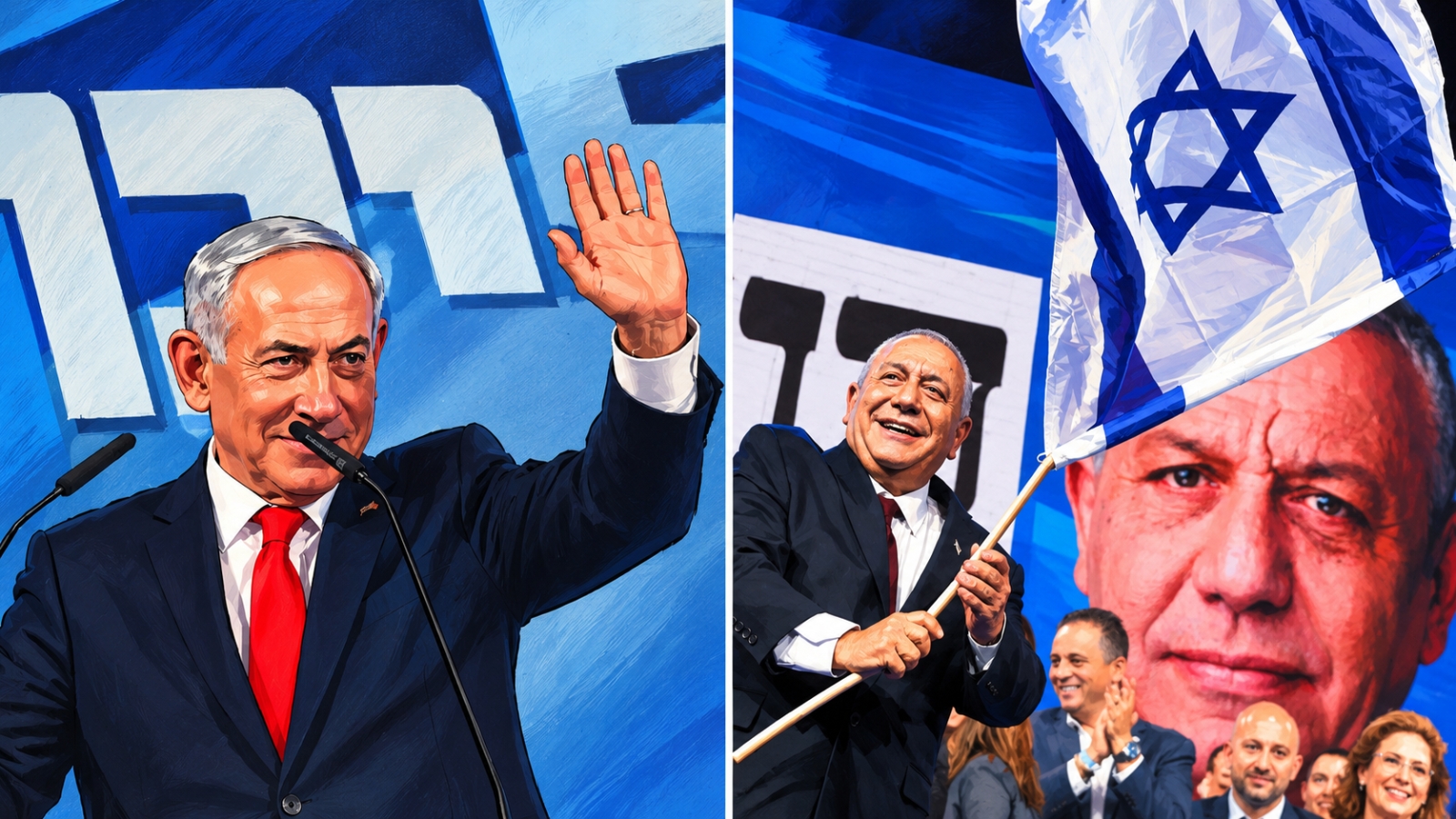
In the immediate aftermath of Israel’s 2026 legislative election, the country's fractured opposition bloc has coalesced around former IDF Chief of Staff Gadi Eisenkot in a high-stakes bid to deny Prime Minister Benjamin Netanyahu another term in office. By rallying behind Eisenkot as a consensus candidate for the premiership, rival faction leaders are attempting to overcome the ideological paralysis that has repeatedly handed Netanyahu parliamentary majorities over the past decade and a half. The maneuver is designed to peel away soft-right voters disillusioned by years of protracted conflict and domestic institutional strife, though securing a stable 61-seat coalition in the 120-member Knesset remains an uphill mathematical battle.
To understand why Israel’s opposition leaders—spanning centrist, secular-nationalist, and left-wing camps—would subordinate their own prime ministerial ambitions to Eisenkot, one has to look at the structural failures of the 2021 "change government." That short-lived coalition proved that simply uniting around an anti-Netanyahu platform is insufficient when the constituent parties hold irreconcilable views on core national security and economic questions. In 2026, the opposition is betting that Eisenkot’s unique political profile offers a durable alternative rather than a temporary marriage of convenience.
The Anatomy of the Eisenkot Consensus
Eisenkot is not a traditional retail politician, and in the current Israeli political climate, that is precisely his primary asset. Having served as the 21st Chief of Staff of the Israel Defense Forces before entering the Knesset and later serving in the emergency war cabinet following the October 7, 2023 attacks, he commands a level of security credibility that few civilian politicians can match.
More importantly, his personal sacrifice during the war—losing his son, Gal, in combat in Gaza—imbued him with a moral authority that transcends standard partisan attacks. For opposition leaders like Yair Lapid and Benny Gantz, backing Eisenkot solves a persistent branding problem. Lapid has struggled to shed his image among traditional and Mizrahi voters as a Tel Aviv secularist, while Gantz’s polling numbers have historically fluctuated depending on the public's appetite for compromise with Netanyahu's Likud.
Eisenkot occupies a distinct ideological middle ground. He is a pragmatist on security who advocates for clear strategic endgames rather than open-ended military occupations, yet he speaks the language of the Israeli security establishment with native fluency. By elevating him as the designated challenger, the opposition is attempting to neutralize Netanyahu’s longest-standing campaign argument—that only he possesses the experience and toughness to safeguard Israel’s existence in a hostile region.
Why Previous Anti-Netanyahu Blocs Collapsed
Israeli electoral history over the last seven years is a graveyard of failed anti-Netanyahu strategies. Between 2019 and 2022, the country held five consecutive elections largely because neither camp could assemble a governing majority without relying on partners that alienated their core voters.
When Naftali Bennett and Yair Lapid finally broke the deadlock in 2021, their coalition survived for barely a year. The structural flaw was obvious from day one. The government relied on an unprecedented alliance between right-wing nationalists, centrist liberals, left-wing Zionists, and the Islamist Ra'am party. Every legislative vote became an existential crisis. When right-wing defectors eventually bolted, the government collapsed, paving the way for Netanyahu’s return at the head of a hard-right coalition in late 2022.
The opposition’s 2026 strategy is an explicit correction to that failure. Rather than cobbling together a patchwork of incompatible party leaders who rotate the premiership, they are presenting the electorate—and the President, who tasks a candidate with forming a government—with a single, unified figurehead before coalition negotiations even begin in earnest.
The Arithmetic of the 120-Seat Knesset
In Israel’s proportional representation system, winning the most votes does not automatically make someone prime minister. Everything comes down to the bloc math—the ability to cobble together at least 61 seats in the Knesset, or at minimum, to prevent the rival camp from reaching that threshold.
The electoral threshold in Israel sits at 3.25 percent of the total valid votes, roughly equivalent to four Knesset seats. In past cycles, the anti-Netanyahu camp squandered tens of thousands of votes when smaller left-wing or Arab parties failed to clear that bar, effectively gifting extra seats to Netanyahu’s bloc through Israel’s surplus-vote agreements.
Ahead of the 2026 ballot, opposition strategists focused relentlessly on preventing wasted votes. Technical blocs and party mergers were engineered specifically to ensure that no faction fell below the 3.25 percent cutoff. Yet even with disciplined vote management, the path to 61 seats remains narrow.
Consider a hypothetical coalition scenario to see how tight the margins really are. Even if the core centrist and center-left parties capture 52 to 55 seats combined, they still fall short of a governing majority. To cross the finish line, an Eisenkot-led coalition must draw support from two notoriously difficult sources: disaffected right-wing voters who previously backed Likud or Religious Zionism, and the Arab-majority parties.
- The Soft-Right Dilemma: Former Netanyahu allies who broke with him over judicial overhaul legislation and the handling of the multi-front war demand strict adherence to conservative security policies. They are deeply skeptical of any coalition arrangement that relies on non-Zionist parties.
- The Arab Party Factor: Parties representing Israel’s Palestinian citizens hold roughly 10 to 12 seats in any given Knesset. While they fiercely oppose Netanyahu, ideological divisions among the Arab factions themselves—specifically between pragmatic integrationists and hardline nationalists—make formal coalition membership nearly impossible, leaving external parliamentary support as the only viable mechanism.
Navigating between these two poles is the central tactical challenge facing Eisenkot. If he leans too heavily toward accommodating the Arab factions, he risks alienating the right-leaning defectors needed to pass legislation. If he adopts hardline rhetoric to appease the right, he loses the passive parliamentary backing of Arab lawmakers, leaving his coalition stuck at 58 or 59 seats.
Netanyahu’s Enduring Survival Playbook
Writing off Benjamin Netanyahu has been the favorite pastime of political analysts in Tel Aviv and Washington for twenty years, and it has almost always been a mistake. As Israel’s longest-serving prime minister, Netanyahu possesses an unmatched mastery of coalition mechanics and political survival.
Even when his bloc falls short of 61 seats in initial exit polls or preliminary counts, Netanyahu excels at playing defense. Under Israeli basic law, if no candidate can form a government within the allotted mandate periods, the Knesset dissolves and the country heads to new elections, leaving the incumbent prime minister in office as the head of a caretaker government.
For Netanyahu, a deadlock is a victory. As caretaker prime minister, he retains executive authority, controls the diplomatic narrative, and buys months of time for his rivals’ fragile unity to fracture under the weight of their own ambitions.
Furthermore, Netanyahu’s core alliance with Israel’s ultra-Orthodox (Haredi) parties—Shas and United Torah Judaism—remains one of the most disciplined voting blocs in modern democratic politics. Unlike secular parties whose voters swing wildly based on economic mood or security crises, Haredi voters turn out in massive numbers and vote strictly according to the directives of their rabbinical councils.
The Haredi Conscription Fault Line
If there is a structural crack in Netanyahu’s armor in 2026, it is the long-simmering crisis over military exemptions for ultra-Orthodox yeshiva students. Following the massive manpower demands of the wars in Gaza and along the northern border, the burden of reserve duty fell disproportionately on secular and national-religious Israelis.
The Supreme Court’s rulings striking down blanket exemptions, combined with fierce public anger over unequal burden-sharing, placed Netanyahu in an impossible bind. To keep Shas and United Torah Judaism in his coalition, he had to shield Haredi men from mandatory conscription and preserve state funding for religious institutions. Doing so, however, alienated moderate right-wing voters whose sons and daughters served hundreds of days in the reserves.
Eisenkot and his allies have hammered this issue relentlessly. By framing the election around equality of the burden, the opposition found a wedge issue capable of piercing Likud’s traditional base without alienating left-wing voters. For an ordinary reserve soldier who spent half the last two years in uniform, the contrast between a career military commander like Eisenkot and a government protecting draft exemptions is stark.
What an Eisenkot Premiership Would Actually Look Like
Assuming the opposition manages to thread the needle and secure the 61 signatures required to form a government, the immediate question becomes what such a coalition could actually accomplish. A government built primarily to remove one man from power inevitably suffers from a lack of shared affirmative vision.
On the domestic front, an Eisenkot-led government would immediately halt the contentious judicial overhaul initiatives championed by Netanyahu’s justice ministry, restoring the traditional balance of power between the Knesset and the Supreme Court. It would also move rapidly to establish a formal state commission of inquiry into the intelligence and operational failures surrounding October 7—an investigation Netanyahu fiercely resisted while in office.
In foreign policy and national security, the shift would be measured in tone and strategy rather than radical ideological reversal. Eisenkot is no dove; his military doctrine—often associated with the "Dahiya doctrine" of disproportionate force against militant infrastructure—reflects mainstream Israeli deterrence thinking. However, he has consistently argued that military force is useless unless tethered to a realistic diplomatic horizon.
An Eisenkot administration would likely pursue closer alignment with Washington and moderate Sunni Arab states, seeking regional security architectures and normalization frameworks that Netanyahu’s far-right coalition partners—such as Bezalel Smotrich and Itamar Ben-Gvir—categorically rejected. By removing ultranationalist ministers from sensitive portfolios like National Security and Finance, Israel would immediately ease friction with its primary Western allies.
The Structural Limits of the Opposition Strategy
Yet veteran observers of Israeli politics recognize the profound fragility baked into this moment. Uniting behind Gadi Eisenkot is a brilliant tactical move during the post-election maneuvering phase, when discipline is enforced by the immediate threat of Netanyahu remaining in power. Once the gavel falls on a new coalition, that external pressure evaporates.
Every party leader who stepped aside for Eisenkot—Yair Lapid, Benny Gantz, Avigdor Lieberman, Yair Golan—still commands an independent political machine with distinct ideological commitments and voters who expect tangible legislative results. Lieberman’s secular-nationalist base demands aggressive measures on civil marriage and Haredi conscription that could trigger severe social unrest. Left-wing factions will push for diplomatic concessions toward the Palestinians that right-leaning coalition partners will flatly veto.
Israel’s electoral system rewards fragmentation. Because there are no geographic districts and the entire country acts as a single national constituency, ambitious politicians face very low barriers to splitting off and forming new factions whenever coalition compromises become unpopular. Netanyahu spent decades exploiting those exact incentives to dismantle rival coalitions from the inside out, peeling off individual lawmakers with offers of prestigious cabinet posts and budget allocations.
Backing Eisenkot gives Israel’s opposition its most credible, disciplined vehicle to unseat Benjamin Netanyahu in years, stripping away the personal rivalries that previously doomed their efforts. Whether that unity survives the brutal, day-to-day reality of governing a deeply polarized nation—or merely sets the stage for Netanyahu’s next political resurrection—will be decided not on election night, but in the backroom coalition deals of the weeks that follow.