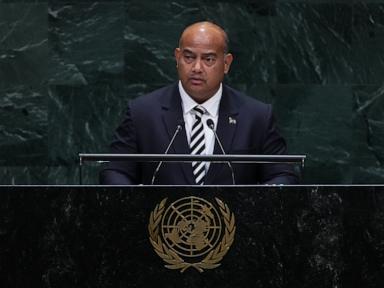
In Nauru, the opposition bench is completely empty. Following a series of political alignments in the world's smallest island republic, every single member of the 19-seat parliament now sits on the government side, leaving President David Adeang without a single formal political opponent inside the legislature.
On the surface, it looks like a quiet coup or the sudden collapse of democratic norms in the Central Pacific. The reality is far more complicated, deeply rooted in Nauru's unique constitutional design, its hyper-local clan politics, and the sheer economic survival instincts of a 21-square-kilometer nation where personal patronage outweighs party ideology. Read more on a related issue: this related article.
The Architecture of a Partyless Parliament
To understand how an entire legislature absorbs itself into the executive branch, you have to look at how Nauru actually governs. Unlike Westminster democracies built on rigid, opposing party machines, Nauru operates as a non-partisan parliamentary republic. Candidates run as independents. They campaign on family ties, district loyalty, and direct community favors rather than sweeping ideological manifestos.
When 19 independents enter the parliament house in Yaren, alliances form out of fluid personal negotiations rather than party discipline. A president is elected from among the members, and that president then handpicks a cabinet. Because the chamber is tiny, the math of power is brutal and immediate. You only need ten votes to control the country. Further reporting by BBC News delves into similar perspectives on this issue.
Once a president secures a comfortable majority, the incentives for remaining in the opposition evaporate almost overnight. In a microstate where the government is the primary employer, the sole distributor of state contracts, and the gatekeeper of international aid and travel stipends, sitting on the opposition bench means cutting your constituents off from the state's lifeblood. Lawmakers do not cross the floor out of sudden ideological conversion; they cross because political exile in a nation of roughly 12,000 people carries a steep, immediate price for their extended families.
Why Executive Power Swallows the Legislature
In most democracies, a bloated governing coalition eventually fractures under the weight of competing ambitions. There are never enough cabinet seats to go around. Nauru solved that problem years ago through an administrative workaround that blurs the line between backbencher and minister.
When lawmakers join the government side in Nauru without receiving a full cabinet portfolio, they are routinely appointed as assistant ministers or given lucrative board positions on state-owned enterprises. These roles come with salary top-ups, official vehicles, and discretionary influence over specific public sectors—from fisheries and phosphate residuals to aviation and telecommunications.
Consider how this functions in practice. If a parliament has 19 members, and the president appoints six or seven full cabinet ministers alongside eight or nine assistant ministers, nearly the entire legislature is suddenly drawing an executive paycheck. The constitutional separation of powers remains intact on paper, yet in daily practice, the legislature becomes an extension of the executive branch.
This dynamic strips away the traditional checks and balances that parliamentary systems rely upon. Question time—the rhythmic, adversarial grilling of ministers that keeps governments honest in larger democracies—loses its teeth when every member in the room shares collective responsibility for executive decisions. Committee oversight weakens when the lawmakers auditing public spending are the exact same individuals authorizing it.
The Geopolitical Shadow Over Yaren
This total consolidation of domestic power is not happening in a vacuum. Nauru sits at the center of an intensifying diplomatic tug-of-war in the Pacific, and political stability—or the appearance of it—is a valuable currency when negotiating with global superpowers.
In early 2024, President Adeang's administration made global headlines by abruptly severing diplomatic ties with Taiwan and recognizing the People's Republic of China. That pivot unlocked promises of substantial infrastructure investment, budget support, and economic lifelines for a nation whose primary revenue streams—phosphate mining and the Australian-funded offshore immigration detention center—have long been volatile and finite.
Managing a massive geopolitical realignment requires a compliant home front. Major bilateral agreements with Beijing, alongside ongoing security and financial negotiations with Canberra, move far faster when the executive branch does not have to worry about a vocal opposition leaking draft memorandums, stalling ratification votes, or threatening sudden motions of no confidence.
For external partners, a unanimous parliament projects absolute certainty. When foreign diplomats fly into Nauru to sign port development deals or telecommunications contracts, they are dealing with a leadership structure that faces zero internal legislative resistance. Yet that same unanimity creates a massive single point of failure: if public sentiment turns against a foreign deal or an economic policy, there is no institutional safety valve inside parliament to channel that frustration.
The Illusion of Permanent Consensus
History in the Central Pacific offers a clear warning to any leader who mistakes a unanimous chamber for permanent political security. Nauru's modern political timeline is littered with sudden, dramatic reversals of fortune.
Because alliances are built on personal relationships and transactional politics rather than binding party constitutions, a 19-to-zero majority is inherently fragile. It takes only a handful of disgruntled lawmakers—perhaps upset over a reshuffle, a delayed infrastructure project in their district, or an external scandal—to quietly caucus behind closed doors and flip the arithmetic in a single afternoon.
During the 2010s, Nauru experienced periods of intense political turbulence where parliamentary suspensions, judicial crises, and strict media controls drew sharp criticism from Pacific neighbors and international observers. Those episodes demonstrated what happens when an executive branch operates without formal legislative opposition: dissent does not disappear, it simply gets pushed out of the chamber and onto the streets, into the courts, or onto anonymous social media forums.
Today's total alignment under President Adeang is smoother and lacks the overt constitutional clashes of a decade ago, but the structural vulnerability remains identical. Without an organized opposition to scrutinize budgets, debate legislation, and offer an alternative governing vision, the burden of accountability falls entirely on Nauru's civil society, its judiciary, and the voters at the ballot box.
What Happens When Scrutiny Vanishes
The real cost of an opposition-free parliament is rarely visible in the first few months. Bills pass quickly. Budgets are approved without acrimonious late-night sessions. Government messaging is unified and clear.
The friction starts later, usually in the fine print of public administration. In any government, unchecked consensus breeds blind spots. When every lawmaker sits on the same side of the aisle, difficult questions about sovereign wealth fund management, environmental remediation of mined-out lands, public healthcare delivery, and the long-term sustainability of foreign aid agreements get softened behind closed doors rather than debated in the open public record.
In a hypothetical scenario where a state-owned enterprise faces mounting debt or a foreign infrastructure loan carries strict collateral clauses, an active opposition forces those terms into the light of day through parliamentary privilege. Without that adversarial pressure, critical financial and legal risks can remain buried in cabinet files until the consequences hit the national balance sheet.
Voters in Nauru are acutely aware of how the game is played. Turnout in Nauruan elections is consistently high—voting is compulsory—and electorates have a long track record of ruthlessly unseating incumbents when local living standards slip or when perceived corruption crosses an invisible line. The absence of opposition in the chamber today does not mean the electorate is passive; it simply means the true test of this unanimous government has been deferred until the next general election, when 19 sitting members will have to explain to their districts why, with total control of the state, they still failed to solve the everyday problems facing the island.