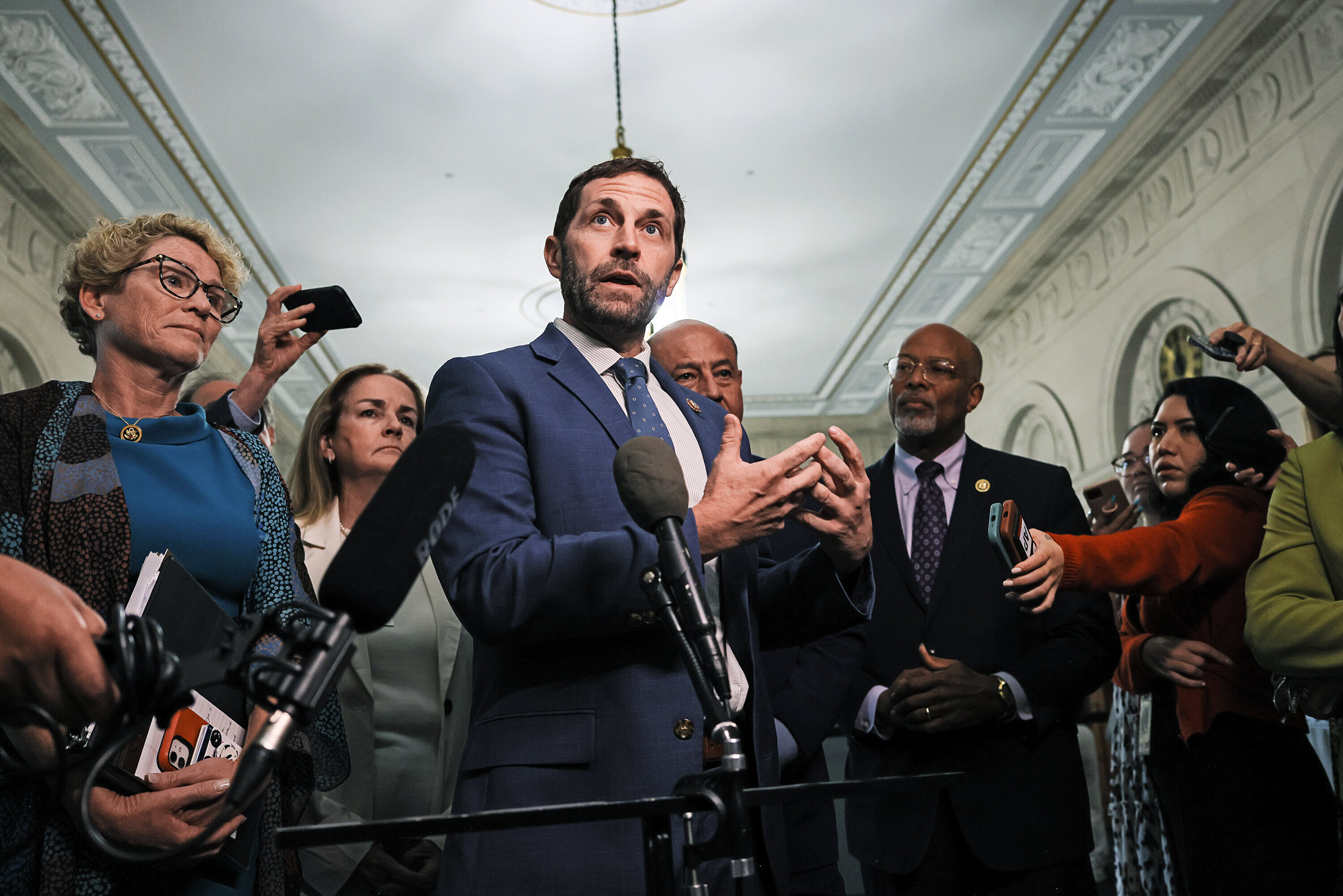
Representative Jason Crow represents Colorado's sixth congressional district, operating at the sharp intersection where military operational experience meets modern American legislative power. Far from a standard biography tracking a conventional rise from the 82nd Airborne Division and the 75th Ranger Regiment to the halls of Congress, the real story of Jason Crow lies in how national security backgrounds are reshaping the institutional behavior of the Democratic party.
Political trajectories built on combat deployments carry a distinct set of expectations. Voters and party leadership often treat military credentials as a shield against partisan attacks, but the deeper institutional reality involves navigating bureaucratic hurdles, committee assignments like the House Permanent Select Committee on Intelligence, and high-profile moments such as serving as an impeachment manager. Understanding this legislative footprint requires looking past standard political packaging to examine how military habits translate into congressional strategy.
The Crucible of the 75th Ranger Regiment
Military service changes an individual's operational tempo. Enlisting after the September 11 attacks, Crow deployed as a paratrooper with the 82nd Airborne Division during the initial invasion of Iraq, later transitioning to the Ranger Regiment for tours in Afghanistan. That background establishes a baseline of institutional familiarity with the defense apparatus that few civilian lawmakers possess.
When former service members enter legislative bodies, they typically land on Armed Services, Foreign Affairs, or Intelligence committees. This positioning changes policy debates. Instead of relying entirely on agency briefings or partisan talking points, lawmakers with combat backgrounds evaluate national security proposals through the lens of tactical execution.
This operational mindset creates a specific legislative style. Decisions are framed around risk mitigation, resource allocation, and accountability rather than broad ideological abstraction. Yet, this same background creates internal tensions. Operating within a strict military chain of command contrasts sharply with the messy, decentralized nature of a legislative caucus where consensus is rarely ordered from above.
Navigating the Partisan Split in Colorado
Colorado's sixth district operates as a volatile political battleground. Encompassing suburban areas near Aurora, the electorate features a massive block of unaffiliated voters who care deeply about local economic pressures, housing costs, and pragmatic governance. Winning this seat required unseating a long-term incumbent by appealing directly to voters fatigued by extreme partisanship.
Balancing national security hawk credentials with domestic progressive priorities requires constant calibration. On one hand, support for defense manufacturing, local aerospace interests, and intelligence oversight appeals to security-minded moderates. On the other hand, pushing for universal background checks, campaign finance reform, and the elimination of dark money addresses the populist demand to clean up Washington politics.
+-------------------------------------------------------+
|        CO-06 Electoral Balancing Act                  |
+-------------------------------------------------------+
|  National Security & Defense  <--->  Local Economic Focus|
|  (Intelligence / Oversight)   <--->  (Cost of Living)    |
+-------------------------------------------------------+
|              Unaffiliated Swing Voters                |
+-------------------------------------------------------+
This dual identity defines the modern centrist-progressive coalition. Lawmakers who project institutional competence are frequently tapped for high-stakes constitutional battles, such as drafting the initial impeachment inquiry memo against Donald Trump or serving on specialized bipartisan oversight groups.
The Institutional Role of the National Security Caucus
A generation of veterans entered the House with the explicit goal of shifting how national security is debated within the legislative branch. By forming specialized groups focused on pragmatic governance, these figures attempt to bridge the gap between defense hawks and progressive non-interventionists.
Legislative productivity for this cohort often centers on administrative reform rather than sweeping grand designs. Consider efforts to close loopholes on interstate firearm sales, update diversity training guidelines within the Department of Defense, or mandate multi-hazard resilience planning for state infrastructure. These measures rarely capture front-page headlines, but they alter federal agency behavior over multi-year cycles.
The structural challenge remains efficiency. Congress struggles to keep pace with rapid technological shifts in cyber defense, artificial intelligence integration, and open-source intelligence gathering. Lawmakers with military backgrounds often express frustration with the glacial speed of procurement cycles and bureaucratic inertia inside the Pentagon and intelligence community.
Beyond the Hero Narrative
Media coverage of political figures with military pasts frequently falls into predictable hagiography, reducing complex policy positions to simplified battlefield heroism. That approach obscures the hard compromises required to function in a polarized legislature. Voting records reveal a pragmatic centrist who aligns closely with leadership on core priorities while occasionally breaking ranks on oversight boundaries and defense authorization details.
The political utility of a combat veteran in leadership roles extends to party recruitment and campaign strategy. Tasked with helping recruit candidates in competitive districts, lawmakers with military backgrounds lean into the imagery of service and duty to appeal to swing voters who distrust career politicians.
Ultimately, the career arc of Jason Crow illustrates how modern political power is concentrated. Credibility is no longer derived solely from traditional party machinery or long-term fundraising networks. It is forged through institutional positioning, crisis management, and the ability to project authority on matters of national survival while managing the granular concerns of a suburban constituency. The mechanics of influence in Washington have shifted toward those who can speak the fluent language of state power and operational risk, leaving traditional legislative maneuvering playing catch-up to an increasingly securitized political landscape.