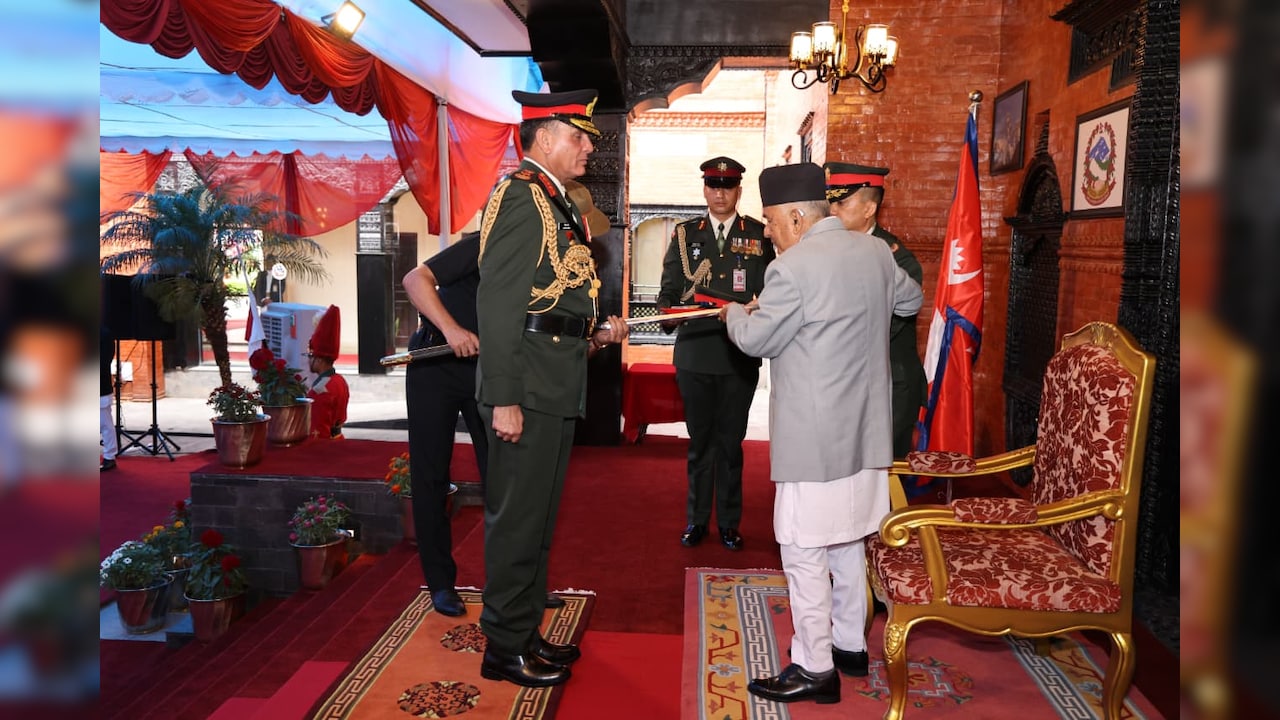
Indian Army Chief General Dhiraj Seth recently received the honorary rank of General of the Nepali Army from President Ramchandra Paudel at a formal investiture ceremony in Kathmandu. This ritual is far more than standard diplomatic pageantry. It forms the backbone of a seventy-five-year-old reciprocal practice that keeps military channels open between New Delhi and Kathmandu even when political winds shift.
Every few years, headlines announce that another military chief has crossed the border to accept this decoration. Observers often write it off as an outdated relic of the British colonial era. That view misses the calculated utility of the arrangement.
The Mechanics of Reciprocal Honor
Since 1950, India and Nepal have maintained a formal agreement where each nation awards its highest honorary military rank to the sitting chief of the other's armed forces.
Consider the operational weight of this arrangement. Modern statecraft relies heavily on bureaucratic channels, ambassadorial cables, and cautious public statements. Military diplomacy operates on a different frequency. By officially inducting a foreign commander into the highest echelon of a domestic military force, both nations establish an institutional bridge that bypasses temporary political friction.
When political parties in Kathmandu clash over governance or foreign policy, the military-to-military relationship remains structurally insulated. General Seth's discussions with Nepali Army Chief General Ashok Raj Sigdel focused on practical security cooperation, technical assistance, and joint readiness rather than abstract diplomatic theories.
Beyond the Brass and Badges
Skeptics point out that an honorary rank carries no command authority. General Seth cannot issue operational commands to troops in the Himalayas, nor can a Nepali general direct divisions across the plains of Uttar Pradesh.
That misses the point. The value is symbolic deterrence and operational predictability. Thousands of Gorkha soldiers serve within the ranks of the Indian Army, maintaining deep familial, cultural, and economic ties to villages across Nepal. When leadership at the very top shares a reciprocal military bond, it stabilizes the human pipeline underpinning these regiments.
During his four-day tour, General Seth handed over shipments of military and medical equipment to his counterparts at the army headquarters. This material transfer highlights the pragmatic dimension of the visit. It is not just about gold-braided uniforms and handshakes at Sheetal Niwas. It is about standardizing equipment interoperability, maintaining health logistics, and ensuring that communication lines stay clear when regional security environments deteriorate.
Navigating Geopolitical Pressures
The Himalayan nation sits in a delicate geographic squeeze between two Asian giants. Both New Delhi and Beijing watch developments in Kathmandu with intense scrutiny. Every infrastructure project, economic grant, and bilateral pact is parsed for strategic advantage.
By maintaining a seventy-five-year tradition of mutual military honors, India and Nepal reaffirm an exclusive defensive intimacy that newer economic partnerships struggle to dislodge. The ceremony at Rashtrapati Bhavan serves as a quiet signal to external actors that defense coordination between the two neighbors possesses historical depth that cannot be easily replicated.
Critics within Nepal occasionally question whether such military customs compromise national sovereignty. Yet, the leadership in Kathmandu continues to endorse the practice. They recognize that formal military engagement provides a stabilizing anchor. In an era marked by rapid diplomatic realignments and digital-age friction, institutional continuity matters more than ever.
The pomp fades quickly once the visiting delegation boards the aircraft back to New Delhi. The structural architecture of defense remains intact.