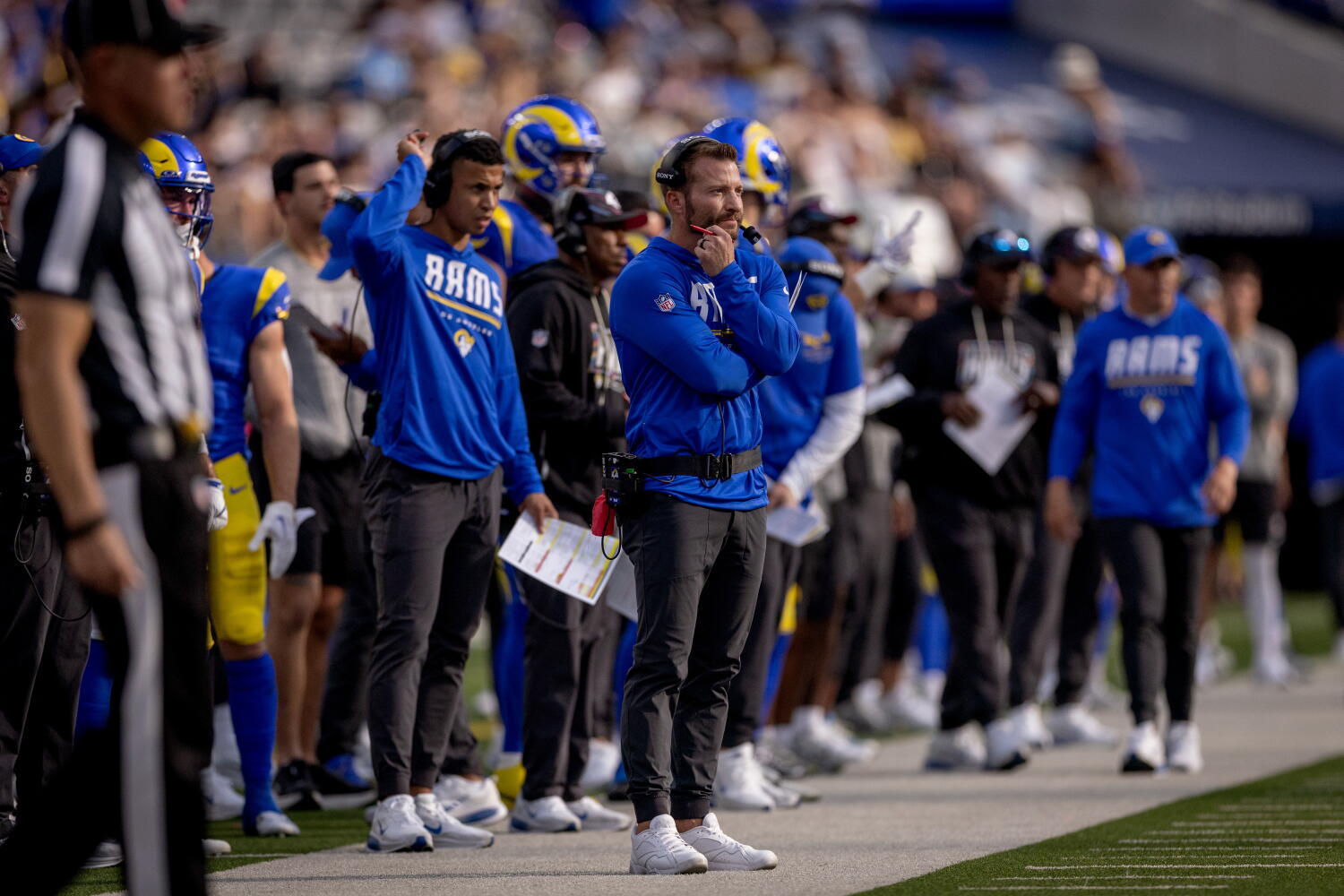
Sean McVay has spent the better part of a decade outsmarting defensive coordinators with pre-snap motion and condensed formations, yet his boldest tactical experiment involves a player who barely touches the ball. By deliberately bypassing the veteran free-agent market and refusing to spend premium draft capital on the kicking game, the Los Angeles Rams head coach has turned the final spot on his 53-man roster into a revolving door of low-cost, high-variance talent. It is a calculated gamble rooted in salary cap economics and fourth-down aggressiveness. And if it backfires in January, it will render four quarters of offensive brilliance completely irrelevant.
Most coaching staffs treat the placekicker like an insurance policy. You pay a modest premium, lock in predictable coverage, and hope you never have to file a claim under duress. McVay operates with the mindset of a day trader. Instead of allocating four or five million dollars of cap space to an established leg, Los Angeles has repeatedly opted for undrafted rookies, practice-squad stashes, and camp castoffs on minimum contracts. The premise is simple on paper. Save the cash for the trenches, trust the offense to score touchdowns instead of settling for three, and cycle through young legs until one sticks.
The reality on Sundays is far messier.
The Math Behind the Roster Squeeze
To understand why a Super Bowl-winning coach would willingly invite instability into his special teams unit, you have to look at how the Rams build their roster from the top down. Los Angeles has lived in a state of aggressive cap management for years. Every dollar saved at a specialist position is a dollar redirected toward paying franchise cornerstones, extending offensive linemen, or absorbing dead-money hits from past blockbuster trades.
When a front office is operating near the financial ceiling, paying top-of-the-market money for a kicker feels like buying silk curtains for a house that still needs a new roof. League-wide, the gap between the fifth-best kicker and the twenty-fifth-best kicker often comes down to three or four kicks over a seventeen-game schedule. From a purely analytical standpoint, those few points look negligible compared to the impact of a starting edge rusher or a reliable cornerback.
That logic holds up in a spreadsheet. It falls apart in the fourth quarter of a tie game on the road in December.
Football is not played in an aggregate vacuum where missed kicks average out over six months. It is played in single-elimination bursts where one wide-right miss from forty-four yards erases an eighty-yard touchdown drive. By treating the kicker slot as a developmental internship, the Rams have voluntarily surrendered the baseline competence that most contenders take for granted.
How Fourth-Down Aggression Warps Special Teams
McVay's offensive philosophy directly feeds this kicker experiment. Early in his tenure, McVay was notoriously conservative on fourth down, often punting or kicking from opponent territory to protect field position. Over the past few seasons, his approach has shifted dramatically toward the analytical consensus. When the Rams cross the opponent's forty-yard line, the offense stays on the field far more often than it used to.
This shift creates a feedback loop that reduces the perceived value of the kicking unit. If you are going to go for it on fourth-and-two from the thirty-two-yard line, why pay top dollar for a guy whose primary job is kicking forty-nine-yard field goals? The logic seems airtight until you examine what happens when the offense stalls on fourth-and-seven from the thirty-five.
Suddenly, the coaching staff is forced into an impossible corner. Do you trot out an unproven kicker with shaky mechanics for a fifty-two-yard attempt that feels like a coin flip? Or do you leave the offense on the field in an obvious passing situation, praying your quarterback can convert against a disguised blitz?
A reliable kicker expands a play-caller's playbook. A shaky kicker shrinks it. When McVay loses faith in his special teams unit—and his body language on the sideline makes it painfully obvious when that trust evaporates—the entire offensive architecture changes. Drives that should end with three points on the board instead end with turnover-on-downs or awkward, low-percentage punts from the fringe of field-goal range.
The Hidden Cost of Roster Churn
There is also a mechanical reality to NFL kicking that front offices frequently overlook. Kicking a football at the professional level is a three-person operation requiring synchronized timing between the long snapper, the holder, and the kicker. The ball must go from the ground to the uprights in roughly 1.3 seconds. Any disruption in that rhythm ruins the trajectory.
When a team churns through kickers during training camp, the preseason, and the early weeks of the regular season, they are not just swapping out a single athlete. They are forcing the snapper and the holder—usually the punter—to recalibrate their muscle memory on the fly.
- Snap velocity and lace orientation: Different kickers prefer slightly different spin rates and tilt angles from the holder.
- Approach angles: A two-step jab versus a wider sweeping approach alters the exact timing of when the ball needs to hit the turf.
- Mental bandwidth: A punter who spends half of practice worrying about whether his new kicker is going to pull the ball left sees his own directional punting suffer.
You cannot manufacture chemistry between specialists in a Wednesday walkthrough. It takes thousands of repetitions in the offseason. By waiting until late August or mid-October to settle on a primary leg, the Rams put their entire operation behind schedule before the games even count.
Why the NFL Kicking Boom Makes This Harder
The timing of Los Angeles's thrift-store approach is particularly jarring given where the rest of the league has gone. Over the last five years, NFL kicking has experienced an unprecedented explosion in range and accuracy. Sixty-yard field goals are no longer desperate heave-ho prayers at the end of a half; they are routine weapons deployed with confidence in the second quarter.
Teams across the NFC are weaponizing their special teams. Franchises are drafting kickers in the fourth and fifth rounds without blinking because they recognize the asymmetric value of an automatic three points every time the offense crosses midfield. When your division rivals can reliably cash in from fifty-eight yards out, trotting out a kicker who gets nervous past forty-five puts your team at a structural disadvantage before the coin is even tossed.
The Rams have repeatedly tried to outsmart this trend by hunting for hidden gems—guys with massive raw leg strength who struggled with accuracy in college or bounced off other practice squads. The theory is that good coaching can fix accuracy, whereas you cannot teach someone how to kick a ball sixty-five yards.
History suggests the exact opposite. In the high-pressure crucible of the NFL, raw power without repeatable mechanics is a liability. A big leg just means the ball misses the upright faster and travels further into the stands.
The Psychological Toll on a Young Locker Room
Veterans in an NFL locker room rarely complain publicly about specialists, mostly out of professional courtesy. Privately, nothing drains the energy out of a sideline faster than watching a seventy-five-yard drive end in a missed extra point or a shanked chip shot.
Think about the physical toll of a standard NFL possession. Offensive linemen are absorbing three-hundred-pound collisions on every snap. Wide receivers are taking shots across the middle. Running backs are fighting for two extra yards at the bottom of a pile. When those eleven players jog off the field having done enough to put points on the board, they expect the specialist—the cleanest jersey on the roster—to finish the job.
When that fails repeatedly, the frustration bleeds into other phases of the game.
Defenses start pressing to force turnovers because they feel like they cannot afford to give up a single field goal. Quarterbacks start forcing throws into tight windows on third down because they subconsciously want to avoid bringing the kicking unit onto the grass. McVay is a master motivator who excels at keeping his locker room aligned, yet even the best culture cannot fully insulate a roster from the creeping dread that sets in every time the field-goal unit runs onto the field in a one-score game.
The Counter-Argument That Keeps McVay Believing
To be completely fair to the Rams' brain trust, their approach is not born out of ignorance. It is born out of scar tissue and cold probability.
Los Angeles has seen firsthand how quickly even highly paid, proven kickers can lose their touch. Kickers are notoriously volatile assets. A player can hit ninety-two percent of his kicks one year, sign a lucrative four-year extension, and suddenly develop the yips the following September. Guaranteed money tied up in a struggling veteran is an anchor that is almost impossible to cut without eating significant dead cap space.
By refusing to commit long-term guarantees to the position, the Rams maintain absolute roster flexibility. If a minimum-salary kicker misses two kicks in a month, they can release him on Tuesday morning with zero financial penalty and bring in three new tryout candidates by lunchtime.
Furthermore, McVay's offensive system genuinely does mask a lot of special teams deficiencies during the regular season. When the passing game is clicking and the red-zone efficiency is humming, the Rams score enough touchdowns to win by ten or fourteen points. In those games, a missed extra point or a bypassed fifty-yard field goal is a footnote in the Monday morning box score, easily forgotten by Wednesday.
Where the Theory Breaks Down
The flaw in that reasoning is the assumption that October football looks anything like January football.
In the postseason, defensive coordinators take away your primary reads. Red-zone windows shrink to nothing. Pass rushes get home faster, and explosive plays dry up. Playoff games are almost universally decided by a single possession, often coming down to a final drive in the closing two minutes against a hostile crowd in freezing temperatures.
You do not win three straight playoff games by blowing teams out. You win them by surviving ugly, low-scoring rock fights where every single point is precious.
In that environment, having a shaky kicking operation is like walking a tightrope without a net in a crosswind. You might make it across once or twice if everything goes perfectly. Eventually, a gust of wind hits, and there is nothing there to catch you.
What a Hypothetical Playoff Collapse Looks Like
Consider a realistic postseason scenario that exposes the exact vulnerability the Rams have built into their roster. Imagine Los Angeles traveling to an outdoor stadium in January, locked in a 20-20 tie with forty seconds remaining on the clock.
McVay orchestrates a masterful two-minute drill. The quarterback hits two sideline out-routes, converts a crucial third-and-long over the middle, and gets the offense down to the opponent's twenty-eight-yard line with four seconds left. On paper, this is a routine forty-five-yard field goal to advance to the next round.
For a team with an established, veteran kicker, the celebration has practically already started. For a team running out an unseasoned experiment who has spent the season battling mechanical inconsistencies and shifting holders, those four seconds feel like an eternity. The opposing coach calls a timeout to freeze him. The wind swirls off the stadium roof. The snap is slightly high, the hold is a fraction of a second late, and the kick hooks just outside the left upright.
Overtime ensues. The opponent wins the coin toss, marches down the field, and ends the Rams' season without McVay's offense ever touching the ball again.
Nobody in the building will talk about the two million dollars in cap space they saved back in March when they are cleaning out their lockers the next morning.
Can You Fix a Kicking Crisis Mid-Season
Once a team reaches the middle of the season without a trustworthy kicker, their options shrink to almost nothing. Unlike wide receivers or linebackers, where you can sometimes swing a mid-season trade for a solid rotational piece, teams do not trade away good kickers. If a franchise has a reliable leg, they lock him down and never let him leave the building.
That leaves general managers scouring the free-agent scrap heap in November. The players sitting on their couches at that point in the calendar are usually there for a reason.
- Aging veterans whose leg strength has deteriorated to the point where kickoffs fall short of the landing zone and fifty-yarders die at the crossbar.
- Young castoffs who possess tremendous talent on the practice field but have repeatedly melted down when live bullets start flying.
- Injured legs trying to work their way back from groin or hip flexor strains that permanently alter their follow-through.
Trying to patch a championship contender with a street free agent in Week 11 is an act of desperation, not a strategy. Even if the new arrival hits his first few kicks, the coaching staff never truly knows how he will react when the season is on the line until the exact moment the ball is snapped.
The Verdict on McVay's Gamble
Sean McVay has earned the benefit of the doubt on almost every offensive innovation he has brought to Los Angeles. His willingness to challenge conventional wisdom is the primary reason the Rams have remained perennially competitive even during supposed rebuilding years.
Yet there is a fine line between bold innovation and stubborn hubris.
Treating the kicking game as an afterthought works right up until the exact moment it costs you everything. The margin for error in the NFL is already razor-thin, dictated by bad bounces, questionable officiating, and sudden injuries. Deliberately introducing unnecessary volatility into the simplest, most controllable scoring mechanism in football is a risk that no amount of offensive genius can fully offset. Until the Rams commit to stabilizing their kicking operation with real investment and patience, every fourth quarter they play will carry a quiet, ticking time bomb on their own sideline.