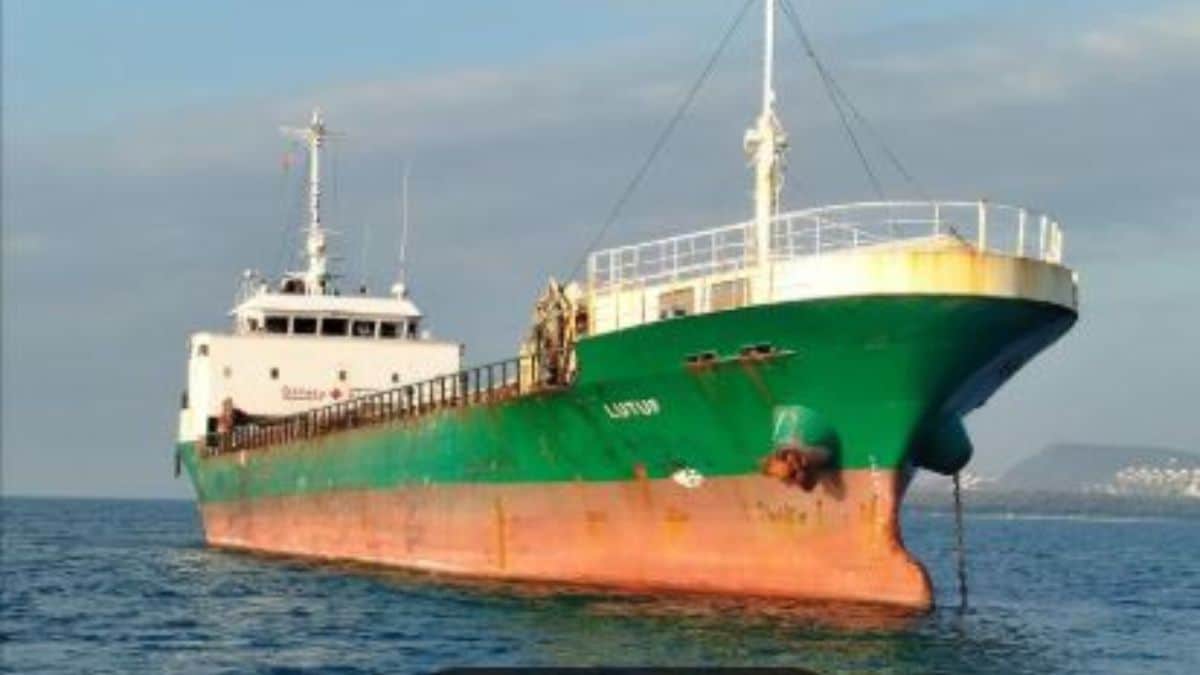
Six Indian nationals found themselves trapped in a high-stakes maritime standoff when the Cameroon-flagged cargo vessel MV Lutuf was seized by pirates off the Puntland coast of Somalia. The vessel, carrying sensitive military cargo and communication hardware destined for a Turkish training facility in Mogadishu, became the epicenter of an aggressive regional response involving Turkish aerial drones.
Maritime security is rarely straightforward. When a commercial hull carrying state military assets gets intercepted in the lawless corridors of the Horn of Africa, standard hostage dynamics change entirely. Read more on a connected issue: this related article.
The Anatomy of the Seizure
The incident began when armed individuals boarded the vessel just miles off Marraya in the Eyl district. The MV Lutuf was operated by a mixed ten-member crew. Beyond the six Indian sailors, the manifest included a Turkish national, a Georgian national, and two Serbian security guards.
The cargo itself made this particular hijacking uniquely dangerous. Instead of bulk commodities or consumer goods, the ship transported Turkish weapons, satellite gear, and communication technology earmarked for strategic infrastructure development and military support in Mogadishu. For local criminal syndicates, capturing such a ship represents a high-value jackpot. For Ankara, allowing military-grade hardware to fall into pirate hands poses an unacceptable security vulnerability. More analysis by The Washington Post delves into comparable views on the subject.
Within hours of the takeover, the ship was steered toward the Nugaal coast near Garmaal. What followed was an immediate tightening of the operational ring around the captured vessel.
The Turkish Aerial Response
Turkey maintains a profound strategic footprint in Somalia, including a sprawling military base and training programs for elite local units. When the MV Lutuf fell into distress, Ankara's security apparatus moved fast.
Intelligence gathering began almost immediately. Turkish helicopters and armed drones converged on the airspace above the hijacked position to monitor every movement on the deck. Two Turkish-owned vessels also sailed into the vicinity, effectively boxing the captured cargo ship in from the sea.
The standoff escalated when logistical supply lines were targeted. A small local boat approached the anchored vessel to deliver khat, a regional stimulant commonly used along the East African coast. After that small craft detached and returned to the shoreline, a precision airstrike struck the landing zone. Reports confirmed that four men were killed and two others injured in the blast. While local officials attributed the strike directly to Turkish drone operations neutralizing militants returning from supply runs, the exact rules of engagement and the legal framework governing these kinetic interventions remain shrouded in murky jurisdictional waters.
The Vulnerability of Indian Seafarers
Indian sailors remain disproportionately represented on merchant vessels transiting high-risk pirate zones. Global shipping companies frequently source cost-effective, highly skilled deck and engine room ratings from India. This structural reality places Indian nationals on the front lines of maritime insurgencies in the Gulf of Aden and the Western Indian Ocean.
When a ship becomes a target of geopolitical friction, the human element often gets obscured by state-level maneuvering. Families in coastal states across India face agonizing days of silence while diplomatic channels grind through backroom negotiations. The presence of foreign private security guards—in this case, Serbian nationals—alongside a mixed international crew further complicates rescue operations, as private armed security teams operate under strict legal limits regarding when to fire or surrender.
The Broader Geopolitical Board
The seizure of the MV Lutuf is not an isolated criminal anomaly. It highlights the dangerous convergence of resurgent Somali piracy and great-power competition in the Red Sea corridor.
For years, international naval coalitions suppressed piracy off the Horn of Africa. However, shifting naval priorities, regional conflicts, and reduced coalition patrols have created tactical vacuums. Criminal networks in Puntland have adapted, exploiting local political fractures and coastal surveillance gaps. When these pirate groups inadvertently capture state military hardware instead of a routine commercial freighter, they trigger a heavy-handed military reaction that traditional commercial insurers are ill-equipped to handle.
The safety of the six Indian crew members and their colleagues remains the primary humanitarian concern. Yet, the incident exposes a harsher reality of modern maritime trade. As external powers militarize their supply chains through volatile African waters, the risks to civilian merchant mariners multiply exponentially.
Diplomatic pressure from New Delhi and Ankara will dictate the immediate physical fate of the crew, but the structural dangers of shipping contraband or state-defense cargo through pirate-infested waters will persist long after this specific vessel is cleared. The waters off Puntland remain as hostile as ever, and the intersection of drone warfare and maritime crime has rewritten the rules of engagement.