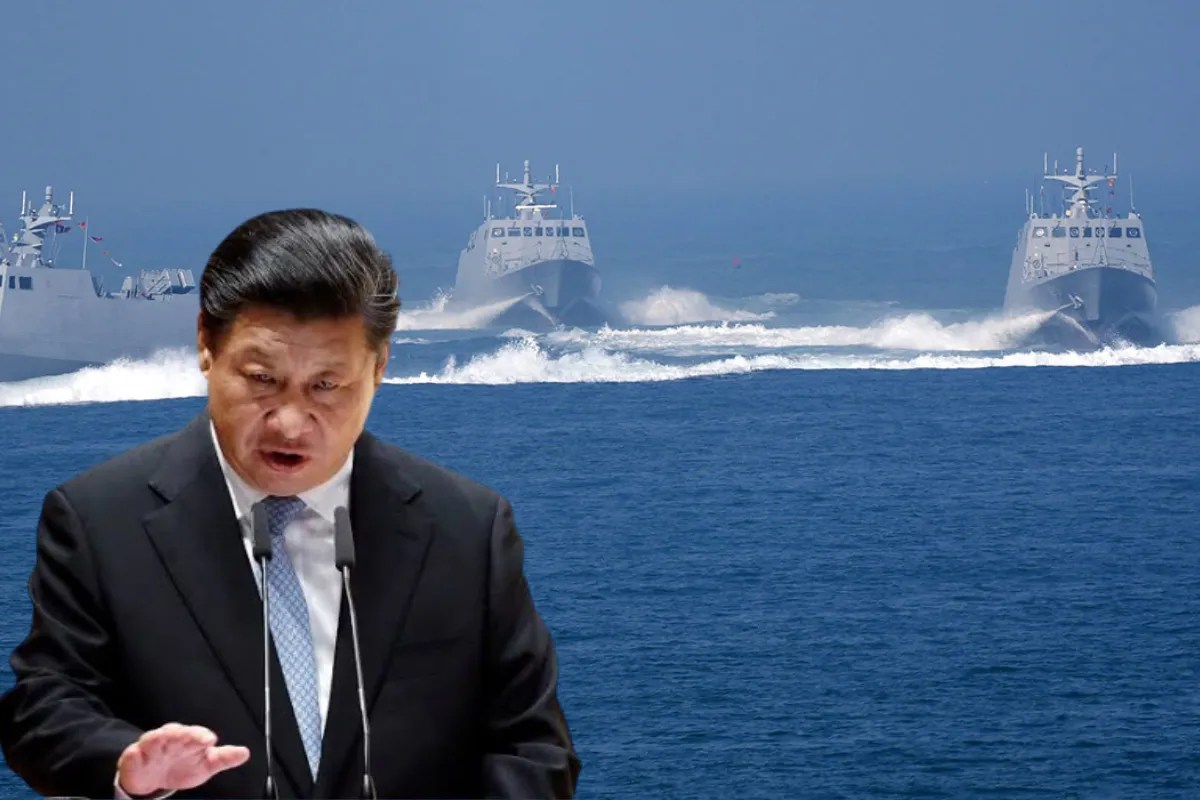
China sent 21 fighter jets and six warships toward Taiwan in a single 24-hour period, crossing the median line and pushing deep into the island’s air defense identification zone. Headlines treated it as another routine provocation. They were wrong.
This was not a show of force. It was an operational dry run designed to normalize encirclement and wear down Taiwan’s military before a single shot is fired.
While Western political commentary remains fixated on the prospect of a dramatic, D-Day style amphibious assault across the Taiwan Strait, Beijing is executing a vastly different strategy. The People’s Liberation Army (PLA) is conducting an aggressive campaign of attrition, exploiting the vast imbalance in military scale to exhaust Taiwan’s air force, strain its naval assets, and psychological deplete its civilian population.
Understanding this threat requires looking past the daily count of aircraft sorties and examining the structural mechanics of gray-zone warfare.
Gray Zone Warfare Is Already Erasing the Median Line
For decades, the median line down the Taiwan Strait served as an unspoken buffer zone. Neither side crossed it without expecting a major diplomatic or military escalation.
That boundary no longer exists in practice.
Beijing systematically erased the median line following high-profile diplomatic visits to Taipei over the past few years. By dispatching strike fighters, early warning craft, anti-submarine warfare planes, and naval vessels across this boundary on a daily basis, the PLA forces Taiwan’s National Defense Ministry into a perpetual state of emergency.
Every time a Chinese J-16 multirole fighter or H-6N bomber approaches the air defense identification zone, Taiwan must scramble its own jets, spin up land-based radar systems, and put air defense missile units on alert.
The math is brutally simple.
Taiwan operates a modern but relatively small fleet of fighter aircraft, primarily consisting of F-16 Block 20/70s, Indigenous Defense Fighters (IDFs), and Mirage 2000s. Flight hours burn through limited airframe lifespans. Jet engines require specialized maintenance for every hour flown. Maintenance crews work around the clock in high-stress environments. Pilots face physical and operational fatigue.
China, operating from a defense budget roughly five times larger than Taiwan’s, can easily absorb the cost of running daily sorties along the island’s maritime borders. Taiwan cannot. By forcing Taipei to respond to dozens of low-intensity incursions every week, Beijing is forcing its neighbor to consume its military readiness during peacetime.
The Attrition Campaign Behind Daily Sorties
To grasp why these incursions are so effective, one must analyze the operational strain on Taiwan's air bases. Bases like Hsinchu, Tainan, and Chiayi operate on constant readiness. Scramble crews sleep in flight suits.
When a radar hit registers an incoming cluster of PLA aircraft—such as a formation featuring Su-30s, J-11s, and KJ-500 airborne early warning platforms—commanders must make a calculated choice within minutes.
If Taiwan scrambles fighters every single time, it exhausts its pilots and burns expensive fuel.
If Taiwan chooses not to scramble, it cedes operational control of the airspace and risks letting a simulated exercise turn into a sudden, unannounced strike.
This creates a severe tactical dilemma. Beijing uses this dynamic to map Taiwan's air defense response times, identify active radar frequencies, and chart the physical locations of mobile surface-to-air missile batteries.
Every sortie gathers electronic intelligence.
When PLA warplanes fly off Taiwan’s southwest coast, they gather signal intelligence on the strategic Bashi Channel, the gateway connecting the South China Sea to the Western Pacific. Naval vessels, including Type 052D destroyers and Type 054A frigates, coordinate with these flight paths, creating an integrated sea-air surveillance mesh around the island.
The intent is clear. Beijing is conditioning both Taiwan and the international community to accept Chinese military dominance surrounding the island as the default state of affairs.
The Porcupine Strategy Faces a Ticking Clock
Defense analysts in Washington and Taipei have long advocated for the porcupine strategy, formally known as asymmetric warfare. The logic is sound on paper. Taiwan should not spend billions trying to match China jet-for-jet or ship-for-ship. Instead, it should acquire vast quantities of cheap, survivable, and highly lethal defensive weapons.
These include mobile anti-ship missiles like the Harpoon and the domestic Hsiung Feng III, shoulder-fired Stinger anti-aircraft missiles, smart sea mines, and unmanned aerial vehicles.
The goal is to render an invasion so costly, complex, and bloody that Beijing decides the military effort is not worth the economic and political risk.
Yet the transition to a true asymmetric posture remains stalled by internal institutional friction and external supply chain bottlenecks.
Taiwan’s military hierarchy has historically preferred prestigious legacy hardware—advanced fighter jets, heavy main battle tanks, and large surface combatants—over unglamorous, dispersed defensive systems. While policy shifts toward asymmetric warfare have accelerated, structural inertia remains strong.
Supply delays from foreign defense manufacturers compound the problem. Key defense orders placed by Taipei face multi-year backlogs due to global supply shortages and competing international defense demands.
Missiles and radar systems intended to bolster Taiwan's coastal defense units are delivering at a trickle, while Chinese military pressure grows exponentially each year.
Time is not working in Taiwan's favor. As the PLA improves its long-range precision strike capabilities and refines its joint logistics commands, the window for Taiwan to fully harden its defenses is rapidly closing.
How Western Sanctions Strategy Fails Against a Blockade
The prevailing Western deterrent model relies heavily on the threat of economic sanctions. The theory holds that if China moves against Taiwan, the global community will impose economic isolation similar to measures taken against other aggressors, cutting Beijing off from global financial networks and international trade.
This theory overlooks structural economic realities.
China is deeply embedded in global manufacturing and trade networks in a way no isolated economic power ever was. A total commercial blockade of the Taiwan Strait—one of the busiest shipping lanes in the world—would instantly freeze global supply chains, plunge international markets into turmoil, and trigger widespread economic instability across Western nations.
More importantly, Beijing does not need to launch an amphibious invasion to subjugate the island. A gray-zone blockade, framed as a custom enforcement or quarantine action, presents a far more dangerous threat.
Imagine a scenario where the PLA Navy and Coast Guard establish a maritime enforcement zone around Taiwan, declaring that all commercial shipping bound for Taiwanese ports must register with Chinese authorities and submit to inspection for contraband security goods.
Under this framework, China would not need to fire a single missile into Taipei.
They would simply control the flow of energy, raw materials, and food entering the island. Taiwan imports over 90 percent of its energy supplies, holding limited strategic reserves of natural gas and oil. A targeted, low-intensity blockade could paralyze Taiwan’s energy grid within weeks without Beijing ever declaring an explicit war.
How would Western allies respond to such a move? Sending naval escorts to break a Chinese customs enforcement line risks direct military escalation. Inaction, on the other hand, leaves Taiwan isolated and economically choked into submission.
This grey-zone ambiguity neutralizes standard Western economic deterrence strategies.
The Logistics Reality of an Amphibious Assault
While grey-zone warfare remains the primary tool, the possibility of a direct assault cannot be dismissed. However, executing the largest amphibious invasion in human history across 100 miles of treacherous open sea is an insanely difficult task.
The Taiwan Strait is notoriously hostile. Heavy seas, unpredictable typhoons, and powerful coastal currents limit favorable invasion windows to two brief periods each year, usually April and October.
The geography of Taiwan favors the defender. The island’s western coastline consists largely of shallow mudflats, cliffs, and narrow beaches heavily fortified with artillery, anti-ship missile emplacements, and defensive minefields.
Only a handful of beaches are physically suitable for landing heavy armored vehicles and troops.
To launch a successful invasion, China would need to transport hundreds of thousands of assault troops, heavy armor, ammunition, fuel, medical supplies, and mobile infrastructure across the strait under continuous fire from land-based anti-ship missiles and mobile artillery units.
Supplying those troops after a initial landing requires capturing intact port facilities or building massive artificial harbors along contested beaches.
Capturing ports like Kaohsiung or Taipei intact is virtually impossible if defenders choose to sabotage port cranes, sink blockships in navigation channels, and demolish fuel infrastructure before retreating into urban defense lines.
Without functional logistics hubs, an invading force quickly runs out of ammunition, fuel, and medical supplies, leaving beachheads vulnerable to counter-attacks by mobile defense forces.
This physical reality explains why Beijing invests so heavily in civilian roll-on/roll-off (Ro-Ro) ferries modified for military transport, airborne assault forces, and massive helicopter wings designed to bypass beach defenses entirely.
Yet, vertical insertion via helicopter or transport aircraft requires absolute air superiority, something China cannot guarantee as long as Taiwan's mobile air defense assets remain hidden in underground mountain bunkers along the east coast.
The Semiconductor Trap and Global Fallout
Discussions of the Taiwan Strait often touch on microchips, but few grasp the extreme level of global dependency concentrated on this single island.
Taiwan Semiconductor Manufacturing Company (TSMC) produces the vast majority of the world’s advanced logic semiconductors. These chips power everything from modern smartphones and data centers to advanced military guidance systems, cloud computing infrastructure, and medical equipment.
If fighting damages TSMC’s advanced fabrication plants in Hsinchu and Tainan, global high-tech manufacturing grinds to a halt within days.
Modern chip fabrication facilities, known as fabs, require perfectly stable electrical power, continuous supplies of ultra-pure water, specialized industrial gases, and ultra-precise chemical inputs.
A power outage lasting even a few hours can destroy months of wafer production. A prolonged sea blockade that disrupts the importation of specialized industrial inputs renders these multi-billion-dollar facilities useless.
Some international observers suggest that China’s goal in taking Taiwan is to seize these advanced chip factories to secure microchip supremacy.
This view fundamentally misunderstands the physical nature of semiconductor manufacturing.
Advanced fabs cannot be operated as captive assets under military occupation. They rely on continuous software updates, maintenance routines, and specialized spare parts provided by an intricate global network of equipment manufacturers based in Europe, Japan, and the United States.
The moment an invasion begins, foreign technical support vanishes, specialized supply lines snap, and key lithography equipment is remotely bricked or sabotaged.
Beijing would inherit useless, highly complex concrete structures, not a functioning chip industry.
The economic fallout for China itself would be severe. Chinese assembly plants consume billions of dollars in Taiwanese-designed chips to manufacture goods exported across the globe. Destroying Taiwan’s semiconductor industry instantly cripples China's own industrial export engine.
This dynamic forms the silicon shield, a mutual economic vulnerability that has helped preserve peace across the strait for decades.
Yet, as Western nations invest hundreds of billions of dollars to build domestic semiconductor fabrication capacity in Europe and North America, that protective shield risks eroding.
If global reliance on Taiwanese chips declines over the coming decade, a key structural restraint preventing conflict moves with it.
The Real War Has Already Begun
The debate over when China will invade Taiwan misunderstands current military reality.
Beijing is not waiting for a specific date on a calendar to launch a massive, theatrical war. The campaign to force Taiwan into submission is happening now.
It occurs every time 21 fighter aircraft force Taiwanese pilots into emergency scrambles.
It occurs every time six warships patrol just off the coast, establishing a constant naval presence that degrades Taiwan’s maritime warning times.
It occurs through relentless cyberattacks targeting Taiwanese critical infrastructure, government databases, and public communications networks.
It occurs through sophisticated disinformation campaigns designed to convince the Taiwanese public that resistance is futile and that Western security commitments are unreliable.
By focusing exclusively on the dramatic specter of an amphibious invasion, world leaders risk missing the slow, methodical strangulation taking place in real time.
If Beijing successfully normalizes complete military encirclement, wears down Taiwan’s military hardware through endless attrition, and breaks the psychological resolve of its populace, an amphibious invasion will never be necessary.
Taiwan will simply fall from within, settled without a shot fired, while the world sits back and waits for an invasion that never needed to happen.