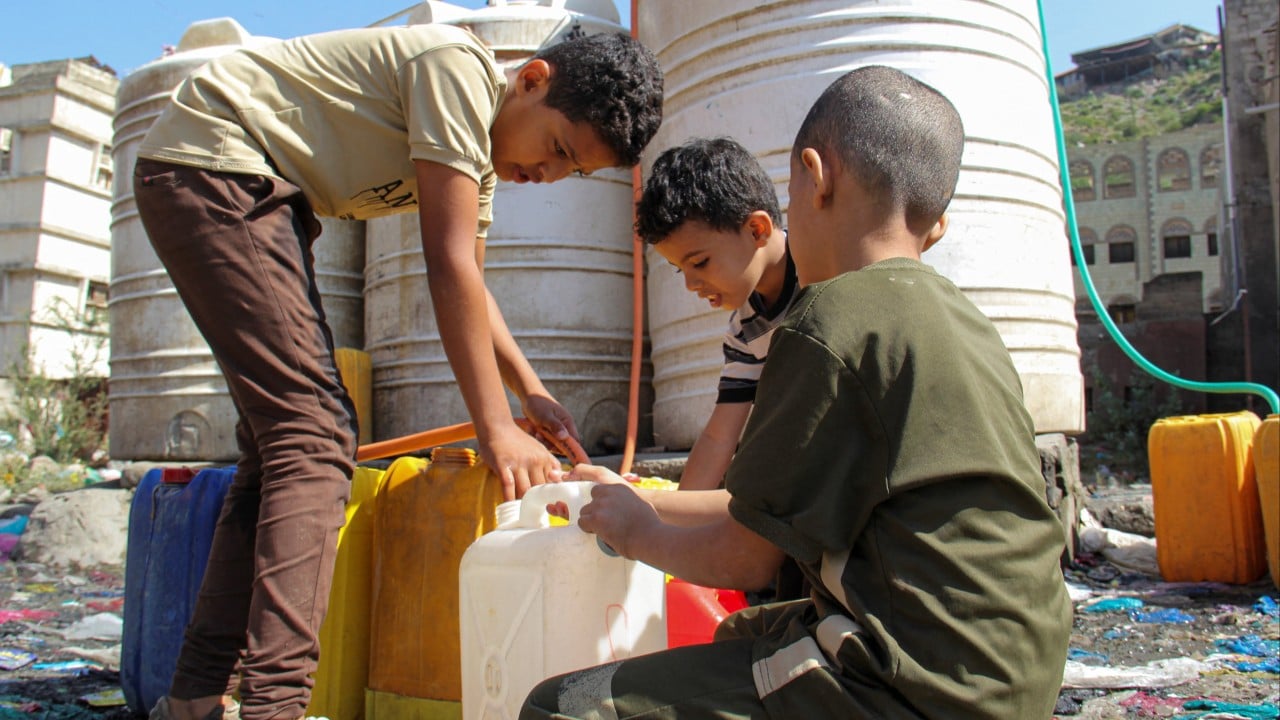
In the besieged Yemeni city of Taiz, drinking water has become an instrument of war, a scarce commodity controlled by shifting frontlines, shattered infrastructure, and hyper-inflated fuel prices. While humanitarian headlines routinely cite dwindling groundwater reserves, the acute crisis gripping Yemen’s third-largest city is not a natural disaster. It is a man-made chokehold. For over a decade, Houthi forces positioned in the surrounding highlands have controlled the major water basins feeding the urban core, leaving hundreds of thousands of residents reliant on expensive private water trucking, contaminated shallow wells, and intermittent humanitarian aid to survive.
To understand why Taiz is running dry, you have to look at a topographic map before you look at a casualty report.
The Geography of a Hydrological Siege
Taiz sits in a rugged, mountainous basin in southwestern Yemen, roughly 1,400 meters above sea level. Historically, the city relied on deep aquifers located in the surrounding valleys—most notably the Al-Haima and Habir basins to the north and northwest. Under normal peacetime conditions, high-capacity electric pumps drew water from these subterranean reservoirs and pushed it uphill through a municipal pipeline network into the city's distribution tanks.
When the Yemeni civil war escalated in 2015, that gravity-defying engineering became Taiz's greatest vulnerability.
Armed factions aligned with the Houthi movement seized the high ground and the outlying northern districts, effectively capturing the wellfields while forces aligned with the internationally recognized government held the densely populated urban center. Suddenly, the physical infrastructure of the Taiz Water and Sanitation Local Corporation (TWSLC) was sliced in half. The wells were on one side of the frontlines; the consumers and the municipal headquarters were on the other.
"In modern urban warfare, you do not need to bomb a reservoir to empty a city. You simply turn off the valves at the perimeter and let thirst do the rest."
Over the years of protracted stalemate, the main pumping stations fell silent. Some were damaged by shelling and snipers; others were simply abandoned because technicians could not cross militarized checkpoints to maintain them. Without pressurized water flowing through the municipal grid, the city's pipes—once the lifeblood of over 600,000 people—began to corrode, collapse, and fill with sediment. Even if a comprehensive ceasefire were signed tomorrow, turning the taps back on in Taiz would require rebuilding the arterial plumbing of an entire metropolis from scratch.
The Economics of Thirst and the Tanker Cartels
Nature abhors a vacuum, and war economies abhor a shortage. When the public water grid collapsed, private water trucking stepped in to fill the void. Today, the rhythm of daily life in Taiz is dictated by the rumble of battered yellow and blue water tankers navigating cratered streets.
This privatized lifeline comes at a brutal cost. Because the major northern aquifers remain largely inaccessible or cut off by frontlines, private operators must drill deeper into smaller, over-exploited aquifers within the government-held enclave, or haul water over treacherous, circuitous mountain roads that bypass Houthi blockades. A journey that once took twenty minutes along a paved highway now takes hours over unpaved dirt tracks, burning through massive amounts of diesel.
Fuel is the hidden multiplier of the Taiz water crisis.
Yemen’s ongoing economic fragmentation—marked by competing central banks, dual currencies, and sporadic fuel import restrictions at Red Sea ports—means diesel prices in Taiz are notoriously volatile. Every spike at the pump translates immediately into higher prices for a 1,000-liter tank of water. For a civil servant whose salary has gone unpaid for months, or a day laborer earning a few dollars a week, buying clean water can consume up to 40 to 50 percent of household income.
The Two-Tier Water Market
As prices climbed, a stark class divide emerged in how residents access basic hydration, fracturing the city into distinct survival tiers:
- The Commercial Grid: Residents with steady remittances from relatives abroad can afford private tankers delivering treated or deep-well water directly to rooftop storage tanks.
- The Charity Queue: Low-income families depend on free communal water points—known locally as sabeels—which are filled intermittently by international NGOs like UNICEF, the International Committee of the Red Cross (ICRC), and local charitable foundations.
- The Desperation Wells: When donor funding dips or tankers cannot reach a neighborhood due to shelling, residents turn to hand-dug shallow wells and rainwater harvesting cisterns that are heavily polluted by urban runoff and raw sewage.
This market dynamic has also created perverse incentives. In several conflict zones across Yemen, observers and local journalists have documented how informal water vendors and checkpoint commanders profit from scarcity. When free humanitarian water trucking expands in a district, private tanker operators sometimes complain of undercut prices; conversely, when humanitarian budgets shrink, private prices surge unchecked. While most truck drivers are simply trying to make a living in a collapsed economy, the structural reality remains: peace and a restored public grid would put the water-trucking industry out of business.
The Silent Collapse of Sanitation and Public Health
You cannot separate a drinking water crisis from a sewage crisis. When water becomes scarce, hygiene is the first casualty, and the biological consequences follow quickly.
In Taiz, the municipal sewage network suffered the exact same fate as the drinking water grid. Without continuous water flow to flush solids through the subterranean mains, raw sewage backs up into the streets, pooling in low-lying neighborhoods and seeping directly into the shallow groundwater tables that desperate residents rely on for drinking and cooking.
The epidemiological math is unforgiving. Yemen has already endured some of the worst cholera outbreaks in modern recorded history, and Taiz consistently ranks among the governorates with the highest incidence of acute watery diarrhea.
Medical workers in the city’s overstretched public hospitals—such as Al-Thawra and the Republican Hospital—report a predictable seasonal surge every time the rains arrive. Heavy downpours wash accumulated surface waste and fecal matter straight into open cisterns and unlined wells. Children, already weakened by years of chronic malnutrition, succumb rapidly to dehydration and waterborne pathogens. Cholera in Taiz is not a medical mystery; it is an infrastructure failure.
Furthermore, the chemical quality of the remaining groundwater is deteriorating. As over-pumping drains the upper layers of the local aquifers within the besieged enclave, the water drawn from deep boreholes becomes increasingly saline and mineralized. Residents frequently report that the water delivered to their homes is brackish, unsuitable for drinking without expensive reverse-osmosis filtration, and harsh enough to corrode household plumbing and damage crops in the surrounding terraces.
Why Humanitarian Aid Is Hitting a Wall
For nearly a decade, international humanitarian agencies have acted as the de facto utility company for Taiz. Organizations have rehabilitated damaged boreholes, installed solar-powered pumping systems to bypass the diesel bottleneck, and funded massive water-trucking operations to keep the city's communal tanks filled.
Solarization has been one of the few genuine bright spots in an otherwise bleak operational landscape. By equipping local wells with photovoltaic arrays, engineers eliminated the recurring cost of diesel and insulated water production from supply-chain blockades. Yet solar panels cannot conjure water out of an exhausted aquifer, nor can they safely pipe water across an active military frontline.
More critically, the humanitarian model itself is buckling under global donor fatigue.
By 2026, international funding for the Yemen Humanitarian Response Plan has contracted sharply compared to its peak years, squeezed by competing global emergencies and shifting geopolitical priorities. When UN agencies and international NGOs face budget shortfalls, water, sanitation, and hygiene (WASH) programs are often forced to scale back emergency water trucking first because hauling water by road is extraordinarily expensive per liter delivered.
Consider a hypothetical scenario illustrating this operational trap. Imagine an NGO spending $50,000 a month to truck water to 15,000 residents in a hillside neighborhood of Taiz. That money buys immediate survival for thirty days, leaving zero permanent infrastructure behind on day thirty-one. Spending that same $50,000 to lay a permanent pipeline connecting the neighborhood to a high-yield wellfield outside the city would solve the problem permanently—but because that wellfield sits across a militarized front line, the pipeline cannot be built. Aid agencies are trapped paying retail prices for emergency survival because politics prevents wholesale reconstruction.
The Diplomatic Deadlock Over Water
Water has featured repeatedly in UN-brokered negotiations and local mediation efforts between the warring parties in Taiz, alongside demands to reopen major arterial roads connecting the city to Aden and Sanaa. On paper, depoliticizing water infrastructure seems like an obvious confidence-building measure. In practice, it has proven nearly impossible.
The core obstacle is mutual distrust over control and revenue. Reconnecting the Al-Haima wellfield to Taiz’s urban distribution network requires guarantees that pumping stations will not be used as military outposts, that technicians can move freely across checkpoints without being detained, and that the revenue collected from water bills will fund maintenance rather than war chests.
Local tribal mediators and civil society groups have occasionally brokered fragile, localized truces allowing specific wells to operate or permitting water tankers to pass through secondary crossings. These hyper-local agreements prove that technical cooperation is possible when immediate community survival is at stake. However, without a broader political settlement governing resource sharing and municipal administration, every pipe laid near the frontlines remains a hostage to the next flare-up in fighting.
The Illusion of Infinite Aquifers
Even if the siege of Taiz were lifted completely and every blocked road reopened tomorrow, the city would still face a looming existential reckoning: Yemen is running out of fossil groundwater.
Long before the first shots of the current civil war were fired, hydrologists warned that Sanaa and Taiz were heading toward absolute water depletion. Over the past four decades, the rapid proliferation of unregulated diesel tube wells—driven largely by the cultivation of qat, a mild narcotic leaf chewed daily by millions of Yemenis that consumes roughly 40 percent of the nation's agricultural water—drained aquifers far faster than seasonal monsoons could replenish them.
In the Taiz basin, water tables that were once accessible at 50 meters now require drilling down 300 to 500 meters, tapping into ancient, non-renewable water reserves. The war did not invent Yemen's water scarcity; it weaponized an existing ecological crisis and destroyed the state institutions capable of regulating extraction.
Modernizing irrigation, enforcing drilling bans, and repairing leaky urban distribution networks—which historically lost up to half their water through technical leakage and illegal taps—are the only long-term solutions. Yet none of those structural reforms can happen while municipalities are fractured, courts are non-functional, and armed men guard the wellheads.
Until the frontlines around Taiz dissolve into a unified municipal administration capable of managing the entire watershed as a single ecological unit, the city's residents will remain trapped between an emptying aquifer beneath their feet and a blockade at their gates.