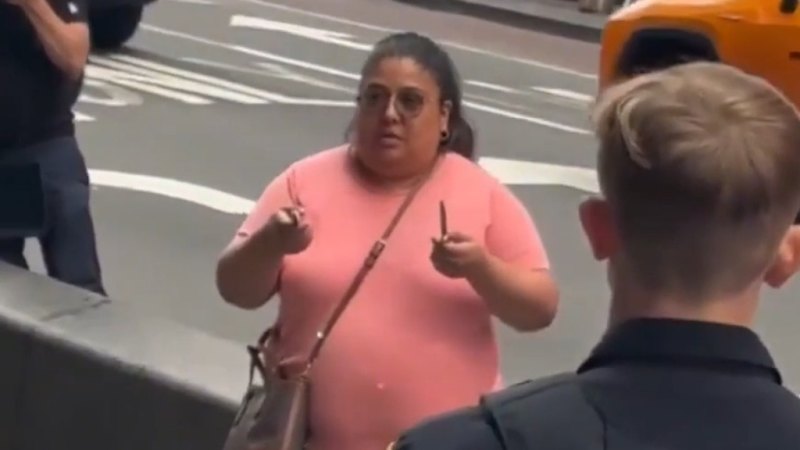
On a Monday afternoon in the heart of Manhattan, a 49-year-old woman named Pamela Cisneros pulled two kitchen knives from a red Target bag on Seventh Avenue and launched an unprovoked, twenty-second rampage that left one woman dead, a man seriously wounded, and the perennial illusion of urban safety shattered once again.
Within moments, a massive police response converged on the crossroads of the world. A four-minute standoff ensued, ending when responding officers were forced to open fire after electronic stun weapons failed to halt her advance. For tourists and commuters, it was a horrifying spectacle of blood and sirens. For municipal analysts, it was an entirely predictable tragedy. You might also find this related story interesting: Why Vladimir Putin Refuses to Negotiate and Claims the Ukraine War Is Turning.
Beneath the breaking headlines lies a deeper, systemic failure. Cisneros possessed a well-documented mental health history with the New York Police Department, stretching back to prior interventions in 2018 and 2019. She was known to the system. Yet, like thousands of severely distressed individuals navigating New York’s fractured social landscape, she fell entirely through the cracks of a care infrastructure designed more for containment than treatment.
The Anatomy of a Twenty-Second Crisis
The sequence of events unfolded with terrifying speed. At approximately 4:20 p.m., near West 41st Street, Cisneros targeted a 68-year-old man, plunging a blade into his abdomen. She then moved rapidly north toward West 42nd Street, selecting a 32-year-old woman—later identified as Erin Piacenti—and inflicting a fatal wound. As reported in latest articles by USA Today, the implications are significant.
The entire physical attack lasted roughly twenty seconds. It highlights an immutable law of urban policing: when an individual decides to commit random violence in a dense pedestrian zone, the response time of law enforcement is inherently reactive. Officers cannot occupy every square foot of pavement, even in a heavily policed tourist hub like Times Square.
When witnesses flagged down patrol units, the dynamic shifted from rescue to containment. Officers cornered Cisneros near an NYPD substation, issuing verbal commands to drop the weapons for four continuous minutes. According to Police Commissioner Jessica Tisch, Cisneros rebuffed all attempts at negotiation, stating explicitly that she would rather kill the officers than surrender.
When multiple officers deployed Tasers, the darts proved ineffective—a frequent limitation when dealing with heavy clothing, high adrenaline, or severe psychological dissociation. As Cisneros closed the distance while waving both knives, two officers discharged their service weapons.
The Failure of Preventive Intervention
Public officials immediately praised the police response for preventing further bloodshed. That assessment is accurate within the narrow tactical window of the confrontation. However, focusing solely on the four-minute standoff ignores the preceding four years.
Cisneros was a resident of Queens with chronic psychiatric vulnerabilities. Her prior interactions with law enforcement in 2018 and 2019 establish that her deterioration was neither sudden nor secret. She was a ghost in the machinery of civil commitment laws and outpatient mental health programs.
New York has spent decades debating the expansion of involuntary psychiatric holds. Civil libertarians rightly guard against the overreach of state authority and the historical abuses of institutionalization. Yet the alternative—leaving gravely ill individuals to deteriorate on public streets until they commit a violent act or force a fatal police encounter—is a catastrophic abdication of civic responsibility.
When a system relies on police officers to act as frontline psychiatric nurses and crisis negotiators, it has already failed. Tasers and firearms are blunt instruments. They are designed to stop physical threats, not to treat psychosis.
The Fallout for Urban Public Spaces
The immediate aftermath left Seventh Avenue cordoned off with yellow police tape, investigators combing through bloodstains, and thousands of witnesses processing collective trauma. For a city striving to reassure post-pandemic tourists and jittery office workers about public safety, an unprovoked daylight murder in Times Square deals a severe psychological blow.
Mayor Zohran Mamdani promised full transparency, announcing that body-worn camera footage will be released as part of the standard investigative protocol. But transparency regarding an officer-involved shooting does nothing to answer the structural question facing every major metropolitan area in America.
How many more individuals must cycle through minor police interventions before receiving sustained, compulsory psychiatric care? How many public spaces must become stages for fatal tragedies before the social safety net is rebuilt from its foundations?
Until policymakers address the yawning chasm between civil rights and mandatory treatment, police officers will continue to stand at the end of a very long, broken road, forced to make life-and-death choices in a matter of seconds.
Watch coverage of the Times Square incident
This broadcast segment provides a visual overview of the emergency response and official statements following the attack in Times Square.