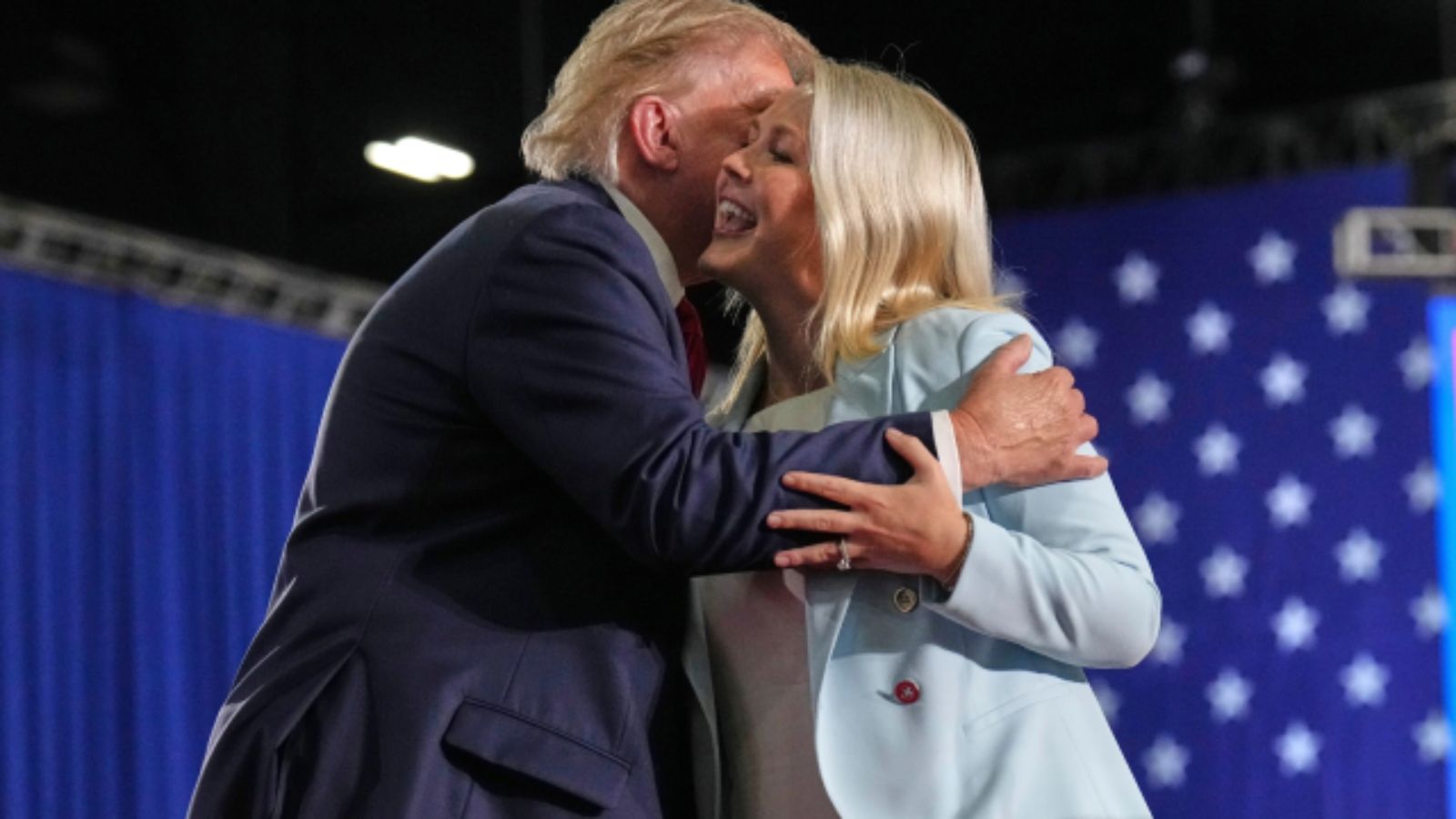
When President Donald Trump jokingly remarked that White House Press Secretary Karoline Leavitt "loves the baby more than me," he turned a routine maternity transition into a public window into a growing staffing dilemma inside the West Wing. According to multiple media reports covering Trump's recent public comments, the president acknowledged that finding a successor for his chief spokesperson has proven far more difficult than anticipated. Beneath the humor lies a structural reality of modern political communications, where the demands of speaking for Donald Trump require a rare combination of ideological loyalty, rapid-fire media instincts, and personal endurance that very few operatives possess.
The modern White House press secretary job has always been an endurance test. Yet under Trump, the role operates on a completely different frequency. In traditional administrations, the press secretary serves as an institutional buffer between the president and the White House press corps, translating policy initiatives into carefully vetted talking points while maintaining a baseline of procedural predictability. Under Trump, the president himself remains the primary communications engine of the administration. The press secretary is not hired to manage the message from above, nor to restrain the principal. Instead, the job requires amplifying an unpredictable, real-time media strategy across cable television, digital platforms, and the James S. Brady Press Briefing Room without ever stepping out of sync with the boss. For a closer look into similar topics, we recommend: this related article.
The Anatomy of an Impossible Job
To understand why replacing Karoline Leavitt has become such a headache for Trump's senior advisors, you have to look at what made her effective in the first place. Leavitt came into the role not as a traditional Washington communications consultant, but as a campaign-tested loyalist who cut her teeth during Trump's first term and his subsequent political comeback. She understood the central rule of Trumpworld communications before she ever stepped behind the podium. The audience is never just the reporters sitting in the briefing room. The audience of one is watching from the residence or Air Force One.
Most press secretaries fail because they try to serve two masters. They attempt to maintain credibility with the mainstream press corps while simultaneously pleasing the political base and the president. That balancing act usually collapses within months. Leavitt bypassed the trap entirely by treating the briefing room as an extension of the campaign rally stage, aggressively challenging legacy media narratives while delivering rapid, unfiltered defenses of administration policies. For broader background on the matter, comprehensive coverage can also be found on Al Jazeera.
Finding someone else who can execute that exact style without crossing invisible lines is notoriously hard. If a spokesperson is too polished or cautious, Trump views them as weak or overly deferential to the establishment press. If they are too combative without possessing his specific comedic timing or political instincts, they risk creating unforced errors that dominate news cycles for days.
The Historical Precedent of Trump Press Secretaries
Looking back at the turnover during Trump's first administration illustrates just how volatile this specific seat can be. Between 2017 and 2021, four different individuals held the title of White House Press Secretary, each representing a distinct theory of how to manage the podium.
- Sean Spicer entered the role as a seasoned Republican National Committee strategist, attempting to apply traditional political communications tactics to an unconventional presidency. The friction between conventional spin and Trump's desire for aggressive pushback became visible on day one, leading to his departure after six months.
- Sarah Huckabee Sanders stabilized the position for nearly two years by adopting a deadpan, confrontational posture toward the press corps, successfully aligning her public persona with the president's grievances while eventually scaling back formal daily briefings.
- Stephanie Grisham took a radically different approach, eliminating the podium briefing entirely during her nine-month tenure and focusing instead on behind-the-scenes management and conservative media appearances.
- Kayleigh McEnany arrived late in the term and established the blueprint that Leavitt later refined, relying on meticulous binder preparation, rapid statistical counter-punches, and viral clip generation designed for social media distribution.
Each transition revealed the same underlying friction. The White House communications apparatus does not have a deep bench of replacements ready to step into the spotlight because the job requirements are uniquely tailored to Trump's personal preferences.
Why the Bench is So Thin
In typical Washington administrations, a departing press secretary is replaced through an orderly succession plan. A principal deputy steps up, or a senior communications director from a major cabinet agency moves over to the West Wing. That pipeline breaks down when the principal evaluates candidates primarily through the lens of television presence and personal chemistry.
Trump casts his administration like a television producer casting a flagship network show. He watches hours of cable news coverage, dissecting how surrogates perform under hostile questioning. A candidate might have twenty years of crisis communications experience on Capitol Hill, a spotless reputation among political reporters, and deep policy fluency, yet still be dismissed immediately if they look stiff on camera or fail to command attention during a contentious exchange.
Conversely, many of the aggressive media personalities who thrive on conservative cable networks lack the discipline required to survive inside the West Wing. Being a pundit allows you to throw rhetorical punches without owning the policy consequences. Standing at the White House podium means every misplaced word can move financial markets, complicate diplomatic negotiations, or trigger congressional inquiries. Combining pundit-level aggression with institutional discipline narrows the candidate pool down to a handful of people in the entire country.
The Personal Toll of the Podium
There is another factor that outsiders frequently overlook when analyzing White House staffing struggles. The personal cost of the job has escalated dramatically over the last decade. A modern press secretary does not simply clock out after the afternoon briefing. They are locked into a relentless 24-hour information cycle where a single post on Truth Social at midnight can upend the entire next morning's messaging strategy.
For someone balancing parenthood and family life, as Leavitt has navigated in the public eye, the sheer physical and emotional bandwidth required to stay perpetually on call is staggering. Trump's offhand comment about Leavitt prioritizing her baby over him, while delivered with his characteristic playful sarcasm, pointed directly at the all-consuming nature of working in his inner circle. Loyalty in Trump's orbit is often measured by total availability. When a top aide steps back for personal or family reasons, even temporarily, it disrupts a personal dynamic that cannot be easily replicated by simply hiring another resume.
The Structural Shift in White House Media Strategy
The difficulty in replacing Leavitt also reflects a broader evolution in how the White House communicates with the public. The traditional briefing room no longer holds a monopoly on narrative distribution. Today, a White House press secretary must manage a fragmented media ecosystem that includes legacy broadcast networks, independent podcasters, partisan digital outlets, and short-form video platforms.
Consider a hypothetical example of how a single policy rollout functions in this environment. In the morning, the press secretary might need to brief traditional wire reporters on the technical details of a new trade tariff to ensure accurate baseline reporting. By noon, they must pivot to an adversarial live exchange in the briefing room designed to generate sharp, shareable video clips for social media. By late afternoon, they are expected to appear on long-form digital shows or friendly broadcast programs to frame the policy in populist terms for core voters.
Very few communications operatives are fluent in all three dialects. Traditional press aides excel at the morning wire briefing but get overwhelmed in viral social media combat. Digital influencers excel at the afternoon clip generation but routinely stumble over complex policy nuances when pressed by veteran White House correspondents. Leavitt managed to bridge those worlds with unusual efficiency, which is precisely why senior officials are hesitant to rush a replacement who might falter in one of those arenas.
What Happens When the Podium Goes Quiet
Whenever the White House faces uncertainty at the press secretary position, the administration tends to revert to a decentralized communications model. Instead of relying on a single daily spokesperson to carry the water, messaging responsibilities get distributed across multiple channels.
Senior policy advisors, cabinet secretaries, and vice presidential aides take on heavier television booking schedules. The president himself steps in to fill the vacuum, holding impromptu gaggles on the South Lawn, taking questions in the Oval Office during bill signings, or calling directly into news programs. While this approach keeps the administration visible, it carries significant operational risks.
Without a strong central press secretary enforcing message discipline, different wings of the administration can inadvertently contradict one another on sensitive issues. Foreign allies and domestic lawmakers begin reading tea leaves, unsure whether a cabinet official's morning interview reflects actual White House policy or simply an individual trying to score points with the president. Over time, that lack of a unified voice creates narrative drift, allowing political opponents to define the administration's agenda during critical legislative battles.
The Trap of the Interim Solution
Inside the West Wing, the temptation during a staffing search is to lean on interim deputies or rotating spokespeople while the president weighs his options. On paper, a committee approach sounds practical. It reduces the burden on any single aide and gives senior leadership time to test different personalities in front of the cameras.
In practice, rotating spokespeople rarely work well in a Trump White House. Trump values clear lines of accountability and recognizable protagonists. When multiple aides share the podium, none of them builds the sustained authority needed to push back effectively against a skeptical press corps. Reporters quickly figure out which deputy has real access to the Oval Office and which one is merely reading off a script prepared by junior staffers. Once the press corps senses that a spokesperson lacks direct insight into the president's thinking, the briefing room loses its utility as a messaging platform.
The search for Leavitt's successor ultimately comes down to a fundamental tension at the heart of Trump's leadership style. He wants a spokesperson who is fiercely independent on camera, effortlessly commanding the room without needing constant hand-holding, yet completely synchronized with his own political instincts at every moment. Until someone proves they can walk that tightrope without falling, the empty space behind the briefing room podium will remain one of the hardest seats in Washington to fill.