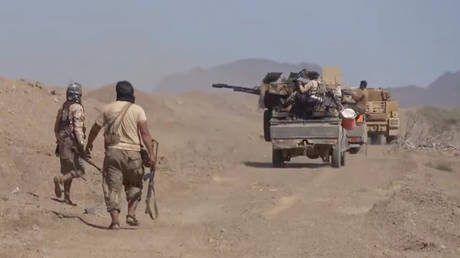
Saudi-backed Yemeni coalition forces announced this week that they successfully intercepted a major tactical push by Houthi insurgents along contested provincial boundaries. On paper, official military spokespersons framed the operation as a textbook defensive maneuver, claiming heavy rebel casualties and the neutralization of targeted offensive columns. Behind the polished briefings lies a far more volatile reality. Frontline intelligence, local tribunal reporting, and strategic logistical maps reveal a theater defined by systemic fragmentation, proxy fatigue, and structural weaknesses that brief tactical victories cannot conceal.
The official narrative issued from coalition hubs paints a picture of unified resilience. Units attached to the Nation’s Shield forces and allied tribal militias reportedly repelled coordinated Houthi infantry surges supported by direct artillery fire. Field reports confirm that tactical positions held along critical transit corridors, preventing an immediate breakthrough toward vital energy infrastructure and provincial command centers.
Victory claims on the Arabian Peninsula often obscure the broader strategic architecture. Defense analysts who track troop movements in Yemen recognize that isolated tactical containment rarely translates to long-term stability. The Houthis continue to exploit internal fractures within anti-Houthi coalitions, relying on asymmetrical warfare, targeted drone strikes, and supply chain pressure rather than sweeping conventional territorial captures.
The Operational Reality on the Ground
Military engagements in northern and central Yemen rarely conform to conventional frontline warfare. Combat zones consist of fluid, heavily fortified checkpoints, ridge networks, and tribal enclaves where allegiances shift based on local governance disputes and resource distribution.
+-----------------------------------------------------------------------+
|                       FRONT-LINE TACTICAL MAP                         |
+-----------------------------------------------------------------------+
|                                                                       |
|   [ Houthi Controlled Zones ]                                         |
|              |                                                        |
|              v (Asymmetric Surges / Drone Logistics)                  |
|   -----------------------------------------------------------------   |
|   [ Contested Ridge Lines & Highway Checkpoints ]                     |
|   -----------------------------------------------------------------   |
|              ^                                                        |
|              | (Air Support / Ground Artillery)                       |
|   [ Saudi-Backed Forces & Tribal Coalitions ]                         |
|                                                                       |
+-----------------------------------------------------------------------+
When Saudi-aligned command nodes report a thwarted advance, the action typically involves a specific sequence of engagements:
- Early warning detection: Reconnaissance units locate Houthi motorized light units or infantry advancing through terrain folds.
- Artillery interdiction: Coalition positions rain indirect fire onto bottleneck routes to break formation momentum.
- Air Support integration: Saudi aviation assets launch targeted strikes against secondary supply lines and command vehicles.
- Ground consolidation: Local infantry mop up dispersed assault squads and secure abandoned positions.
This cycle has repeated hundreds of times over the past decade. It creates a grinding war of attrition where neither side secures a definitive outcome. The coalition successfully stops an advance, yet the fundamental balance of power along the line of contact remains unchanged.
Structural Fault Lines Within the Anti-Houthi Coalition
The primary vulnerability facing Saudi Arabia’s strategic framework in Yemen is not a lack of advanced hardware. It is the political and operational disunity among the proxy forces fighting under the coalition banner.
Unlike the centralized command structure of the Houthi movement, which operates under a disciplined religious and military hierarchy, the anti-Houthi bloc is a coalition of convenience. It brings together distinct groups with conflicting long-term objectives.
| Force Group | Primary Alignment | Core Objective | Key Vulnerability |
|---|---|---|---|
| Nation’s Shield Units | Saudi Presidential Command | Defense of state infrastructure & border control | Limited local tribal integration |
| Southern Transitional Council (STC) | UAE-Backed Forces | Southern secession & regional autonomy | Friction with northern unionist allies |
| National Resistance Forces | Independent / Local Commanders | Coastal security & anti-Houthi containment | Dependence on external supply lines |
| Tribal Leviathan Militias | Local Sheikdoms | Territorial protection & resource rights | Fluid political loyalties |
These political divisions manifest directly on the battlefield. When Houthi assault groups press a specific sector, neighboring coalition units often delay support due to command disputes or competing regional interests. The Houthis understand these friction points and structure their offensives to test the seams between different coalition commands.
The Economics of Asymmetrical Warfare
Attributing the prolonged conflict solely to troop morale or political alignment ignores the harsh economic calculations governing the war. The financial cost required to sustain defensive positions along hundreds of kilometers of rugged terrain is staggering.
Coalition forces rely on expensive military hardware, continuous logistics convoys, armored vehicles, and air support. Houthi insurgents utilize cost-effective weaponry manufactured or modified locally, including uncrewed aerial vehicles, converted anti-ship ordnance, and light infantry transport.
DEFENSIVE COST RATIO

Saudi-Backed Coalition:
[$$$$$$$$$$$$$$$$$$$$$$$$$$$$$$$$$$$$$$$$] Precision Munitions, Armor, Air Support

Houthi Insurgency:
[$ $ $ $ $] Commercial Drones, Mortars, Light Mobility Units
This structural economic imbalance means that even when coalition forces successfully thwart an advance, the defense burns through capital at a rate that favors the insurgent strategy. A single intercepted Houthi drone swarm can require million-dollar air defense missiles or sustained combat air patrols to defeat.
Proxy Alignment and Regional Diplomacy
Developments on Yemeni frontlines do not occur in isolation from broader Middle Eastern diplomacy. Saudi Arabia has actively sought an exit strategy from the Yemeni theater, aiming to de-escalate direct confrontations while protecting its domestic border security and infrastructure investments.
Direct talks between Saudi representatives and Houthi officials have periodically bypassed the Yemeni presidential leadership entirely. This diplomatic reality creates severe friction among local commanders fighting on the ground. Frontline officers face the prospect of a political settlement negotiated over their heads, which directly affects their willingness to take high-risk offensive actions.
- Riyadh’s Objective: Secure border zones, neutralize cross-border missile threats, and stabilize international shipping routes without maintaining permanent ground involvement.
- Houthi Objective: Achieve formal international recognition, secure access to state oil revenues, and enforce dominance over northern population centers.
- Local Proxy Objective: Maintain regional autonomy, secure local funding channels, and prevent dominance by competing domestic factions.
When defensive success is reported in local media, it often serves a dual purpose. It reassures domestic audiences of military competence while signaling to international diplomatic partners that the coalition retains sufficient force projection to prevent total Houthi expansion.
Military Limitations of Containment Operations
Static defense along mountainous terrain is historically a failing military posture. Forces that focus entirely on repelling attacks without executing decisive counter-offensives surrender the operational initiative to their opponent.
By relying on containment, Saudi-backed units allow Houthi commanders to choose the time, place, and intensity of every engagement. The insurgents can probe a sector, sustain minimal casualties, withdraw, and strike another line fifty kilometers away forty-eight hours later. This forces the coalition to keep thousands of troops on high alert across a massive perimeter, draining energy and resources.
Without a unified military command, consistent joint-force integration, and a clear political vision for post-conflict governance, localized victories along the frontline remain tactical highlights in a ongoing strategic stalemate.
The announcement of a thwarted advance may provide a temporary PR victory in regional news cycles, but it does not alter the fundamental dynamics of the conflict. Until the structural divisions within the anti-Houthi alliance are addressed and a sustainable economic framework is established, these frontline clashes represent nothing more than the holding of a line that grows more fragile by the day.