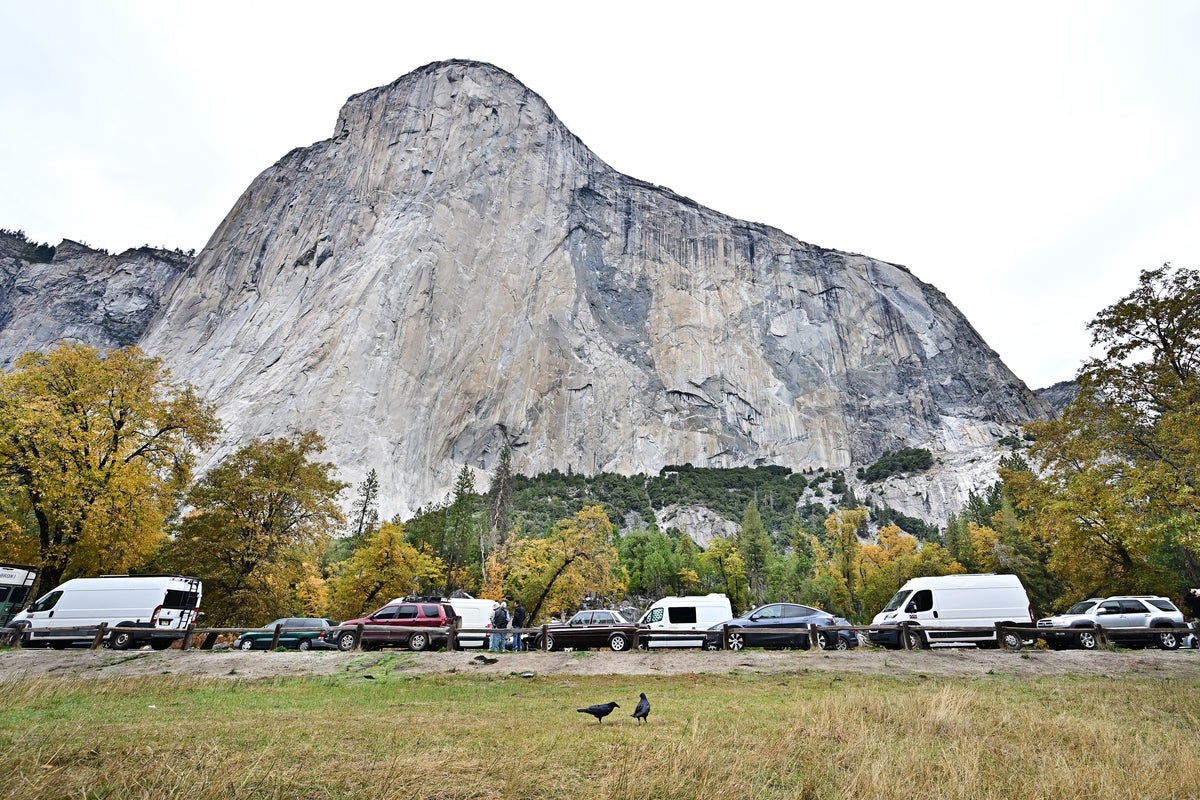
The experiment is over, and the fallout is here. Over the holiday weekend, Yosemite National Park became less of a natural wonder and more of a cautionary tale, as the elimination of its timed-entry reservation system triggered immediate, catastrophic gridlock across the valley floor.
Visitors arriving at West Yosemite entrance gates were greeted by 90-minute lines, with East Yosemite Valley becoming so completely choked by idling vehicles that park rangers were forced to turn tourists away by mid-morning. By 8:41 a.m. on Sunday, every single paved parking space in Yosemite Valley was full. What was sold by officials as an effort to restore open access to public lands has instead degraded the experience into a battle of logistical survival.
The Illusion of Open Access
The decision to scrap Yosemite’s reservation framework in February was framed by the National Park Service as a data-driven pivot toward keeping public lands open to all. Officials argued that 2025 traffic data showed weekdays could absorb normal traffic without strict restrictions.
The practical reality proves otherwise. There is a fundamental mathematical limitation at play: a finite volume of asphalt cannot handle an infinite desire for entry.
For decades, park analysts have known the precise breaking point of Yosemite Valley. Once a specific threshold of vehicles passes through the gates, the loop roads achieve a state of permanent friction. The reservation system, instituted as a pilot during the pandemic, acted as a pressure valve. It distributed the influx over predictable intervals. Removing it did not democratize the park; it simply ensured that those who did not wake up at dawn spent their vacation staring at the brake lights of an SUV in El Capitan Meadow.
A Pressure System Without a Valve
When you eliminate entry management, the consequences ripple past the main thoroughfares.
- The Parking Lottery: Paved lots fill before breakfast, forcing late arrivals to cruise endlessly or park illegally along sensitive shoulders.
- Staffing Strain: Rangers are pulled from educational and conservation duties to act as emergency traffic cops, trying to untangle gridlock at major junctions like Arch Rock and Hetch Hetchy.
- Resource Degradation: The overflow of vehicles inevitably spills into the park’s fragile ecology. Truncated shoulders mean tires trampling protected meadows, compacting soil, and disrupting shallow root systems.
The Hidden Economic Levers
To understand why the reservation system was dumped despite clear warnings from conservation groups, you have to look beyond the park boundaries. The policy shift was heavily influenced by external economic pressures, specifically the vocal opposition of regional gateway communities and hospitality operators.
Local hotel owners, restaurateurs, and souvenir shop operators in Mariposa and Groveland long claimed that the rigid timed-entry system stifled spontaneous travel and hurt their bottom lines. A family deciding on a Thursday to drive up for the weekend was blocked if they couldn’t secure a digital pass on Recreation.gov.
The National Parks Conservation Association openly criticized the policy reversal, suggesting that prioritizing the business plans of external commercial operators over the internal ecological stability of the park creates a dangerous precedent. The current administration’s directive to prioritize immediate public access stripped park managers of a highly effective resource management tool. This political tug-of-war highlights a deeper systemic crisis: our public lands are increasingly managed to satisfy regional economic quotas rather than the long-term preservation of the environment.
The Real-Time Management Failure
In place of reservations, the park service promised to rely on real-time traffic management measures. This strategy involves deploying staff to divert traffic once lots fill and utilizing digital signage to warn travelers of delays.
This reactive approach is fundamentally flawed. Warning a motorist that the valley is full when they are already an hour deep into a winding mountain road does not solve congestion; it merely displaces it.
Consider a hypothetical scenario where a family drives three hours from the Bay Area, only to be stopped at the gate and told to turn around. They do not go home. They idle in nearby staging areas, overcrowd national forest lands without proper sanitation infrastructure, or clog the small peripheral mountain towns, creating localized infrastructure strain. Real-time diversion is not a plan; it is an admission of defeat.
The Cost to the Visitor Experience
The ultimate casualty of this structural policy shift is the visitor experience. A decade ago, a trip to Yosemite offered a sense of rugged solitude. Today, the sheer volume of humanity concentrated in the 7-mile strip of Yosemite Valley mirrors the congestion of a metropolitan commute.
The metrics paint a stark picture. Park visitation grew by over 30% between 2000 and 2019, adding more than a million annual visitors to an infrastructure built primarily in the mid-20th century. Year-to-date data for 2026 shows that visitation through April had already surged past 836,000—a 13% spike compared to the same period in 2025.
With summer fast approaching, the park is on track to break all-time attendance records at the exact moment its defensive barriers have been lowered. If the current trajectory holds, monthly visitation during June and July will regularly overwhelm the park's physical footprint.
Yosemite Early-Season Visitation Comparison (Jan-April)
Year | Total Visitors
---------------------
2025 | 739,313
2026 | 836,458  (+13%)
The human cost is evident in the frustration of travelers who now find themselves shoulder-to-shoulder on trails that were meant to provide an escape from urban density. Lines for basic amenities like restrooms and shuttle buses routinely stretch into hour-long commitments. The park's infrastructure—from sewage management to trash collection—is being pushed to its absolute breaking point.
The Search for a Middle Ground
The debate over park access is often presented as a binary choice: either an exclusive, hyper-regulated reservation system that locks out casual travelers, or a chaotic, unregulated free-for-all. This is a false dichotomy.
Other high-demand parks have successfully experimented with hybrid models. Zion National Park manages its deepest congestion through a mandatory shuttle system that completely removes private vehicles from its primary canyon during peak months. Acadia National Park utilizes vehicle reservations only for its most congested summit road, leaving the rest of the park accessible via traditional means.
Yosemite's complete abandonment of seasonal timed entry represents a wholesale retreat from nuance. By reverting to a first-come, first-served model during peak summer weekends, the park service has chosen predictable chaos over managed equity.
The current gridlock is not an accident; it is the logical consequence of a policy that prioritizes raw gate numbers over the qualitative reality of what happens once those vehicles cross the threshold. The lesson of this holiday weekend is clear: without a structural mechanism to pace the arrival of cars, the very beauty people are traveling to see is compromised by the machinery they use to get there.


