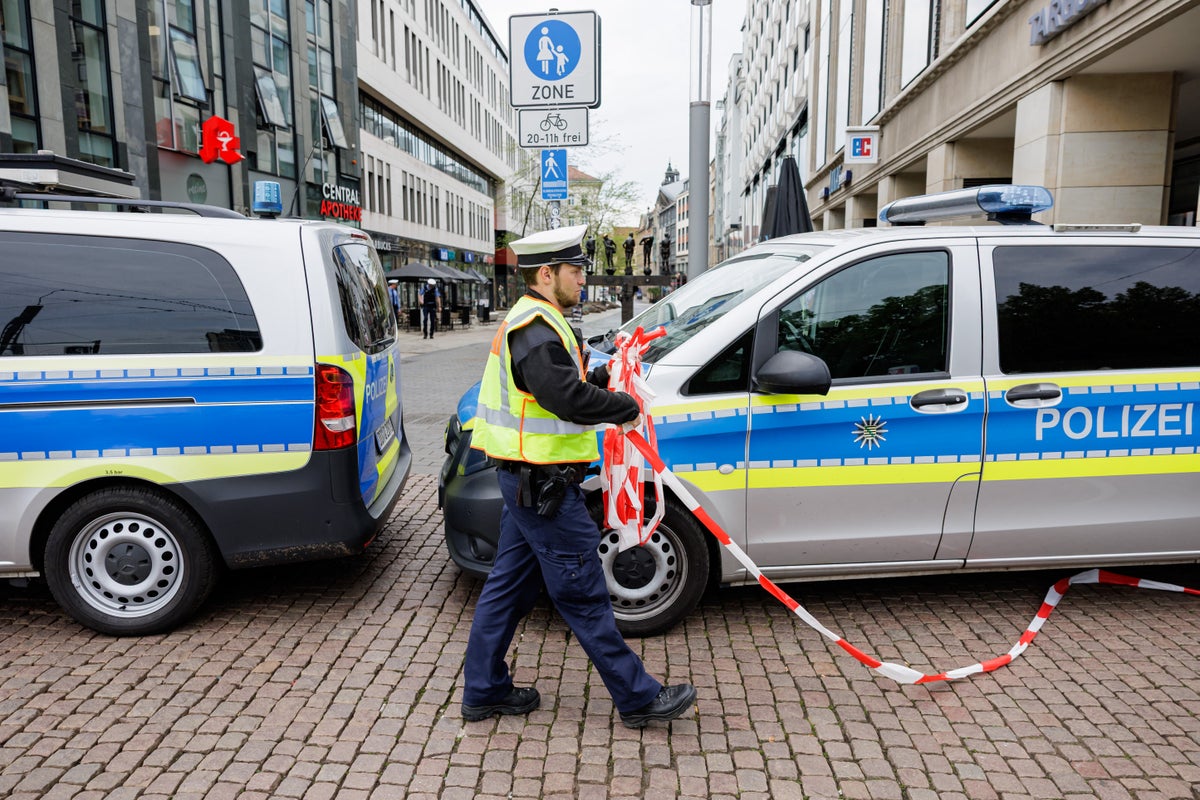
The morning air in Leipzig usually carries the scent of roasted coffee and the damp, familiar stone of the city’s historic center. On a Tuesday, the rhythm is predictable. Tram bells chime. Commuters check their watches. It is a city that prides itself on order, on the quiet efficiency of German life. But order is a fragile thing, a thin membrane stretched over the chaotic reality of human fragility and systemic failure. When that membrane tears, it doesn’t just break; it shatters with the sound of screeching tires and a silence that follows, heavier than any noise.
Two people were walking near the Prager Straße. They were perhaps thinking about their dinner plans, a work deadline, or the gray sky. They were people with names, histories, and loved ones who expected them back. They never arrived. In a moment that defies the logic of a civilized society, a car became a weapon, and a sidewalk became a site of mourning. You might also find this related article interesting: The Night the Stars Chased Back.
The man behind the wheel was not a stranger to the institutions meant to prevent such tragedies. He was 50 years old. He had a history. He had, only days or weeks prior, walked through the heavy doors of a psychiatric hospital, not as a visitor, but as a patient. Then, he was released.
The Invisible Threshold
To understand why two people are dead, we have to look past the twisted metal of the crash. We have to look at the invisible threshold of a hospital discharge. When a person struggles with a mind that has turned against them, the psychiatric ward is supposed to be a sanctuary—a place where the jagged edges of a crisis are sanded down. As extensively documented in recent reports by The New York Times, the effects are widespread.
In the sterile hallways of such a facility, time moves differently. There are schedules, medications, and the constant, watchful eyes of staff. It is a controlled environment designed to stabilize. But stabilization is not the same as a cure. It is often just a temporary pause in a much longer, more agonizing story.
The suspect in the Leipzig crash had been under professional care. This fact is the thorn in the side of the public consciousness. It forces us to ask a question that makes us deeply uncomfortable: When is a person "ready" to return to the world?
In many modern healthcare systems, the answer is dictated by more than just clinical health. It is governed by bed counts, insurance mandates, and the legal high bar of "imminent danger." To keep someone against their will, a facility must prove they are a threat to themselves or others. It is a binary choice—dangerous or safe—that ignores the vast, murky gray area where most mental health struggles actually live.
The Physics of a Crisis
Consider the transition from a locked ward to the driver’s seat of a car. It is a jarring shift in agency. One day, you are told when to eat and when to sleep; the next, you are handed the keys to a two-ton machine capable of lethal kinetic energy.
The police in Leipzig quickly realized this wasn't a standard traffic accident. There were no brake marks where there should have been. There was a directness to the path of the vehicle that suggested something other than a mechanical failure. As the investigation unfolded, the focus shifted from the car to the man’s medical records.
The public reacts to these events with a predictable cycle of shock and then a demand for blame. We want to blame the doctors for letting him out. We want to blame the police for not knowing. We want to blame a "system" that feels like a faceless monster. But the system is made of people—overworked clinicians making split-second calls on a patient’s "risk profile" and judges who must balance public safety with the fundamental human right to liberty.
When those calls are wrong, the cost isn't measured in paperwork or lost revenue. It is measured in the two lives extinguished on a Leipzig street. It is measured in the phantom limb pain of a family that is now missing its heart.
The Mirror of Public Safety
There is a specific kind of terror that comes from a "random" act of violence. If a person is robbed, we tell ourselves we can avoid certain neighborhoods. If a person is targeted, we tell ourselves we don't have those enemies. But when a car jumps a curb because a driver has lost touch with reality, there is no defense. There is no logic to hide behind.
This incident has reignited a fierce debate across Germany and the wider European community about the "duty to protect" versus the "right to freedom."
If we tighten the laws to make it harder to leave a psychiatric facility, we risk institutionalizing thousands of people who are not a threat, stripping them of their lives and dignity. If we keep the laws as they are, we accept that there will be "statistical outliers"—a cold, academic term for the people who died in Leipzig.
We often speak about mental health as a private battle. We say "check on your friends" or "it’s okay not to be okay." But the Leipzig crash proves that mental health is a public infrastructure issue, just as vital as the maintenance of bridges or the purity of our water supply. When a mind collapses, the debris can fall on anyone.
The Silence After the Siren
The suspect was arrested. He will face the justice system. There will be evaluations, testimony from psychiatrists, and a trial that seeks to quantify his culpability. Was he aware of his actions? Did the "recent release" imply he was still in the throes of a psychosis that the hospital failed to catch?
While the lawyers argue, the city carries on. But for those who saw the wreckage, the city is different now. A sidewalk is no longer just a sidewalk; it is a place where the world once ended for two people.
We live in a society that values the fast-paced, the efficient, and the visible. We build high-speed trains and gleaming glass offices. Yet, we remain remarkably bad at handling the invisible—the slow, grinding decay of a person’s mental well-being. We treat the discharge from a hospital as a "success" because the bed is now empty for the next person in line.
But a discharge is just a beginning. It is the start of a journey back into a world that is loud, demanding, and often unforgiving. Without a bridge—without a way to transition from the safety of the ward to the responsibility of the street—we are simply waiting for the next tragedy to occur.
The families of the victims will not find peace in the arrest. An arrest is just a process. They are left with the "what ifs." What if the hospital had kept him one more day? What if the victims had stayed for one more cup of coffee? What if we lived in a world where the safety net didn't have holes large enough for a car to drive through?
The investigation continues, and the headlines will eventually fade, replaced by the next crisis. But the flowers left at the scene will wither, their petals turning into the same gray dust that covers the stone streets. They serve as a quiet, fading reminder that our lives are intertwined in ways we rarely acknowledge. We are all passengers on the same road, and our safety depends entirely on the health of the person driving next to us.
The sun sets over the steeples of Leipzig, casting long shadows that stretch across the pavement, hiding the scars where the tires once tore the earth.