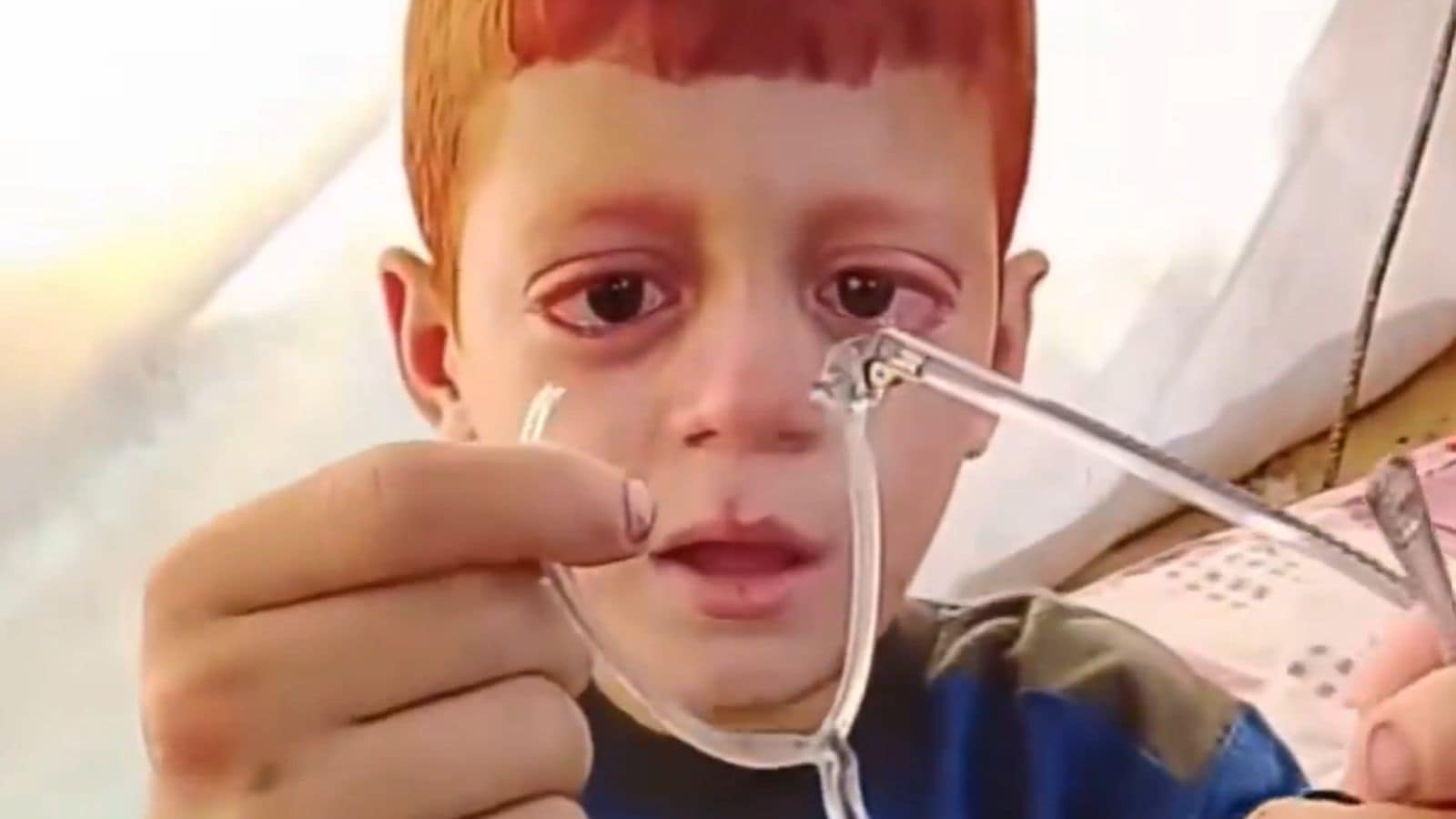
A viral video of a sobbing Palestinian boy in Gaza mourning his broken eyeglasses captured a brief moment of global attention. He wailed, asking why he could not be like other children, his distress tied to a fragile piece of plastic and glass. While social media treated the footage as an isolated, heartbreaking vignette of war, the reality is far more systemic. The boy's broken spectacles are not merely a casualty of bombardment. They are the direct result of a decades-long, deliberate choked supply chain that treats basic medical optics as potential security threats.
The immediate crisis facing thousands of visually impaired children in Gaza is an acute shortage of corrective lenses, frames, and optometric equipment. This is not just a byproduct of active conflict. It is the consequence of a dual-use goods policy that restricts the import of essential raw materials and manufacturing tools into the enclave.
When a bomb destroys a pair of glasses in Gaza, they cannot easily be replaced. To understand why, one must look past the immediate destruction of airstrikes and examine the labyrinthine bureaucracy governing what enters the territory. For years, the mechanisms controlling imports have categorized various medical and civilian goods under a broad "dual-use" umbrella—items that could theoretically possess military applications. Under this pretext, the components required to manufacture and repair eyeglasses have faced severe restrictions.
The Anatomy of a Medical Blockade
Optical labs require specific machinery to grind lenses to precise prescriptions. These lens-edging machines and generators rely on specialized computer numerical control (CNC) software and high-grade diamond blades. Because these tools utilize advanced calibration technology, their entry has historically been delayed, restricted, or outright denied by border authorities citing security protocols.
The restrictions extend down to the very material of the lenses themselves. Polycarbonate and high-index plastics, the standard materials used globally to create shatterproof lenses for children, are heavily regulated. The chemicals used to apply anti-reflective or scratch-resistant coatings are frequently flagged. Consequently, local opticians have long been forced to rely on outdated, easily breakable glass or low-grade plastics, stockpiled before crossings were completely sealed.
When these stockpiles run out, the system collapses. Local charities and international aid groups attempting to bring in pre-made reading glasses or bulk frames face weeks of bureaucratic gridlock at commercial crossings. Even when aid convoys are permitted entry, optical wear is rarely prioritized over food and emergency trauma medicine. The international community views vision as a secondary concern, a luxury for peacetime, ignoring how central sight is to human survival in a combat zone.
The Developmental Toll of Uncorrected Vision
A child who cannot see cannot navigate a crisis. In a high-risk environment where survival depends on spotting unexploded ordnance, reading warning signs, or finding family members during a sudden evacuation, poor vision is a physical liability.
Pediatric ophthalmologists emphasize that the stakes are even higher for long-term development. The human visual system develops rapidly during childhood. If a child suffers from severe myopia, hyperopia, or astigmatism and goes without corrective lenses for months or years, the brain fails to learn how to process sharp images. This leads to amblyopia, commonly known as lazy eye, a condition that becomes permanent if not treated before early adolescence.
An entire generation of children in the enclave is missing the critical developmental window for vision. We are witnessing the forced creation of a population that will suffer from irreversible visual impairment, not because their eyes are diseased, but because the basic tools to correct their vision were deemed a bureaucratic hazard.
The psychological impact compounding this physical deterioration is profound. Children are acutely aware of their limitations. When a child is unable to read a chalkboard in a makeshift tent school or keep up with peers in basic games, the resulting isolation induces severe anxiety and depression. The despair seen in the viral video is repeated in thousands of households, away from the lenses of smartphone cameras.
The Myth of Medical Exemptions
International humanitarian law explicitly protects access to medical care, a designation that theoretically includes prosthetic devices and corrective optics. However, the enforcement of these protections relies on a flawed system of medical coordination.
Before the current escalation, Palestinians requiring specialized ophthalmic surgeries or custom ocular prosthetics had to apply for medical exit permits to hospitals in the West Bank, East Jerusalem, or abroad. The approval process was notorious for arbitrary denials and delays. Parents were routinely separated from their children during treatment, or permits were granted after a child’s condition had progressed past the point of treatable intervention.
Now, with crossings entirely compromised, the permit system has effectively ceased to function for standard medical needs. Field hospitals established by foreign NGOs are designed for trauma surgery—amputations, shrapnel removal, and burn treatment. They are not equipped with refractometers or optical labs. A child with a degenerative eye condition or a simple broken frame has nowhere to turn.
The Limitations of Digital Humanitarianism
The viral nature of the boy's video prompted immediate offers of help from well-meaning individuals worldwide. Crowdfunding campaigns were launched, and digital activists pledged to send glasses directly to the Gaza Strip.
These efforts, while well-intentioned, reveal a profound misunderstanding of how besieged territories operate. You cannot mail a package to Gaza. There is no functioning postal service that can deliver a pair of custom glasses from London or New York to a displaced family living in a tent in Rafah or Deir al-Balah.
Furthermore, eyeglasses are not a one-size-fits-all commodity. An incorrect prescription can cause severe headaches, dizziness, and further strain a child’s eyes. Delivery of effective eye care requires a trained optometrist to measure pupillary distance, assess refractive errors, and fit frames properly. Without the physical presence of specialists and their diagnostic machinery, shipping crates of random reading glasses does little to solve the underlying crisis.
A Failure of Priority
The paralysis of Gaza's optical infrastructure reflects a broader failure within international humanitarian response frameworks. Aid agencies operate on a triage mentality, understandably focusing on caloric intake and water sanitation. Yet, by classifying vision care as non-essential, they overlook how deeply intertwined sight is with dignity, education, and autonomy.
Restoring the sight of these children requires more than just charity drives or emotional social media posts. It demands a systematic dismantling of the dual-use restrictions that target the tools of basic medicine. It requires treating optical glass and lens-edging machinery not as implements of war, but as fundamental instruments of human rights.
Until international pressure forces a reevaluation of what constitutes vital humanitarian cargo, thousands of children will remain trapped in a blur, punished by a geopolitical bottleneck that views their ability to see the world as a secondary concern.