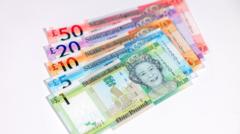
The coffee machine in the corner of the small accounting firm on Hill Street hums with a familiar, mechanical exhaustion. It is 7:15 on a Tuesday morning. Outside, the fog clings stubbornly to the granite storefronts, dampening the early footsteps of delivery drivers and commuters pulling their coats tight against the Atlantic wind. Inside, Elena sets her travel mug down on the desk, her fingers stiff from the cold. She does not look at the weather. She looks at the spreadsheet.
For months, the numbers have carried a quiet, persistent weight. You can budget down to the last penny, cut the Sunday takeout, switch off the hallway lights, and still feel the floor slowly dropping away beneath you. That is the reality of living on an island where every head of lettuce, every gallon of heating oil, and every square foot of roof has to cross miles of grey water to get to you. Prices creep upward like ivy on an old wall, silent and steady, until one day you realize the view from the window is entirely obscured.
Then comes a number.
A 1.2 percent rise.
Not in the cost of milk. Not in the price of diesel at the pumps down by the harbor. In earnings. Specifically, real earnings, adjusted after the relentless bite of inflation has taken its share.
To a statistician sitting in a sterile office with fluorescent lights, that figure is a neat coordinate on a graph. It is a tick upward, a statistical heartbeat confirming that economic output has managed, just barely, to outpace the sliding value of money. But to Elena, who has spent the last year watching her grocery bills outpace her paycheck by a margin that felt entirely personal, a 1.2 percent increase sounds almost too small to matter. Yet, it changes everything. It is the microscopic difference between drowning in place and taking a single, viable breath.
Consider what happens next when you translate that abstract percentage into human currency.
Let us introduce Julian, a hypothetical mechanic who spends his days elbow-deep in grease and alternator belts in a workshop just outside St. Helier. Julian does not read economic briefs. He reads the expressions on his regular customers' faces when he hands them the bill for routine brake pads. He has watched people postpone repairs that shouldn't wait, driving on thin rubber and grinding metal because the alternative means choosing between safety and next week's heating bill.
When Julian hears that earnings have edged past inflation by that slim 1.2 percent margin, he does not see a macroeconomic triumph. He sees the psychological threshold of his neighborhood. He sees whether Mrs. Higgins down the lane can afford to fix her radiator before the winter damp sets into her bones. That tiny fraction of a percentage point represents the exact point where survival stops consuming 100 percent of a person's cognitive bandwidth and leaves just enough room for dignity.
How did we get here?
The journey of a local economy is rarely a straight line. It is a tug-of-war played out across shop counters, boardrooms, and kitchen tables. Inflation acts like a slow leak in a tire. You might not notice the pressure dropping on any given Tuesday, but by the time you hit the motorway, the car feels heavy, sluggish, and dangerously unresponsive. For years, the cost of living index climbed faster than wage packets could chase it. Every trip to the checkout counter felt like a minor tax on existence. People adapted because people are remarkably resilient creatures, trimming the edges of their lives until there was almost nothing left to cut.
And then, the arithmetic shifted.
It is easy to misinterpret what a modest wage growth above inflation actually means. Some assume it signals a sudden era of prosperity, a moment to uncork the champagne and plan the holiday abroad. That is a dangerous misunderstanding. A 1.2 percent real-terms increase is not a windfall. It is a recovery pulse. It is the patient in the hospital bed finally squeezing the doctor's hand after hours of unconsciousness.
The mechanics behind this shift are complex, rooted in labor market adjustments, sector-specific demands, and the stubborn refusal of local businesses to let their workforce vanish across the water to cheaper shores. When skilled labor becomes scarce, wages are forced to adapt. Employers find themselves caught between the rising cost of retaining good people and the risk of closing their doors entirely. They raise pay packets, often absorbing the blow themselves, trying to thread a needle that gets narrower by the year.
Think about the local bakery where the oven has been burning since four in the morning. The baker, a man named Thomas whose flour-dusted apron has seen better decades, faces a daily calculus of survival. The cost of imported grain fluctuates with global shipping crises. Electricity prices swing wildly with European energy markets. When he looks at his two apprentices, he knows he cannot pay them less than what it takes to rent a room in a town where housing costs consume whole salaries.
When earnings rise by that crucial 1.2 percent margin, it means Thomas can keep his apprentices. It means young people do not have to pack their bags and buy a one-way ticket to the mainland just to afford a future. That is the invisible stake of the statistics we read in the morning news. We are not tracking currency units; we are tracking whether communities can hold onto their children.
There is a vulnerability in admitting how fragile this balance truly is. Economists speak of recovery with a clinical detachment that masks how terrifying the downturn was for those living it. We want certainty. We want to be told that the corner has been turned permanently, that the road ahead is smooth asphalt and clear skies. But reality is messier than that. A single global supply chain hiccup, a sudden spike in fuel tariffs, or a shift in currency exchange rates can wipe out that fragile 1.2 percent gain before the ink on the quarterly report has even dried.
This is why the human element matters so much more than the spreadsheet.
When Elena looks back down at her desk, she is not celebrating a triumphant economic miracle. She is calculating next month's tax returns with a cautious, hard-earned skepticism. She knows that a 1.2 percent rise does not erase the debt accumulated during the lean months. It does not magically restock the savings accounts that were drained when inflation ran hot and wild.
What it does do is change the psychological climate.
It turns the horizon from a solid, impenetrable wall into a thin veil that might, with enough effort and a bit of luck, be pushed aside. It allows people to stop holding their breath for just long enough to look each other in the eye and plan for tomorrow instead of merely surviving today.
We spend so much of our lives measuring our worth and our stability in integers and decimals, forgetting that behind every statistical adjustment is a person deciding whether to buy the cheaper brand of tea or pay for the prescription medicine. The numbers change, the charts fluctuate, and the headlines come and go with the tide.
The fog outside the window begins to thin, letting in a pale, hesitant morning light that catches the edge of the glass on Elena’s desk. Down the street, the heavy wooden door of the bakery opens, releasing a rich wave of warmth and baking yeast into the cold air. The math is what it is. But the life being lived around it, stubborn and unyielding, keeps moving forward.