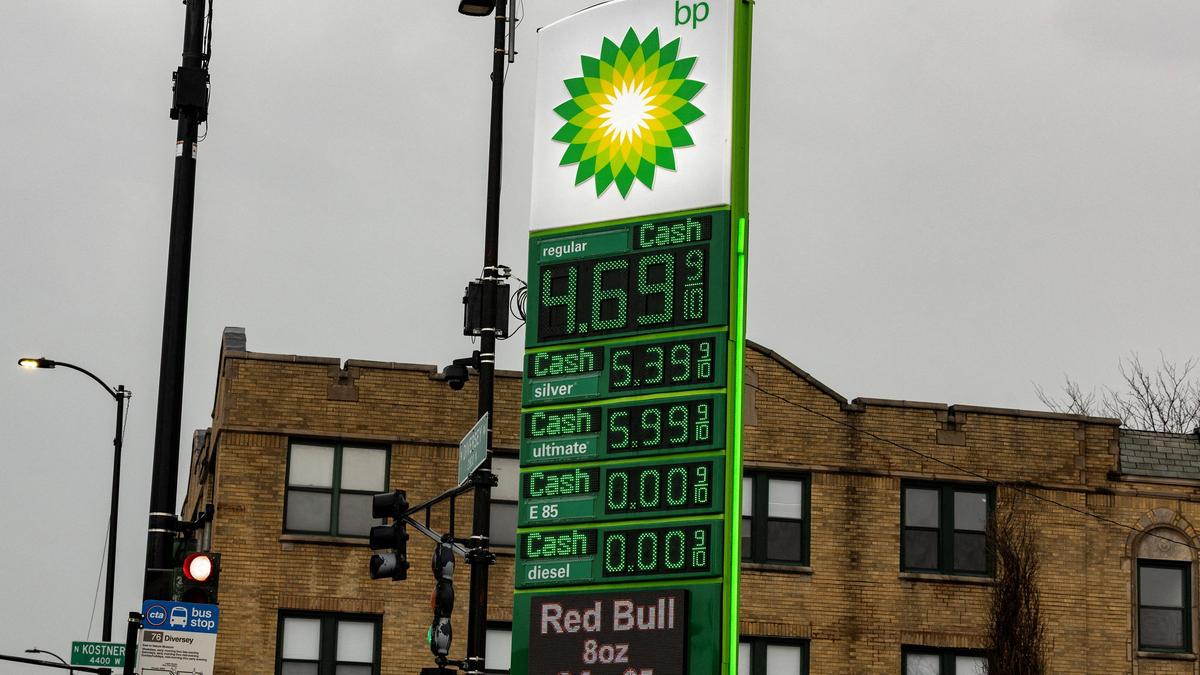
The numbers on the digital sign at the corner gas station don’t just represent the price of a gallon of regular. They are a pulse check. When those red LEDs flicker upward, a specific kind of tension ripples through the line of cars. You can see it in the way a man in a faded work jacket grips the pump handle, eyes fixed on the rolling cents, or how a mother checking her banking app in the driver's seat lets out a breath she’s been holding since she left the driveway.
Thousands of miles away, metal tears through the hull of a tanker in the Strait of Hormuz. Missiles arc across a desert sky that most Americans will only ever see on a pixelated news feed. To the average commuter, the geopolitical complexities of the Middle East feel like a distant, chaotic theater—until they try to fill their tank.
War has a way of traveling. It doesn't stay confined to trenches or command centers. It hitches a ride on supply chains, hides in the cost of a crate of oranges, and eventually, it arrives at your local pump. We are currently watching the slow-motion collision between global conflict and the American wallet.
The Ghost in the Machine
Consider a man we will call Elias. Elias drives a delivery van in Ohio. He doesn’t follow international maritime law. He couldn't point to the Bab el-Mandeb strait on a map if his life depended on it. But his life—or at least his livelihood—is tied to it by an invisible, unbreakable thread.
When conflict erupts between Iran and its neighbors, or when the United States is pulled into a direct military exchange, the first thing that dies is certainty. Markets hate a vacuum. Oil is the blood of the global economy, and when the veins are squeezed in the Persian Gulf, the heart rate of every industry on earth begins to spike.
For Elias, this translates to a "fuel surcharge" on his invoices. Then, it’s the price of the tires he needs to replace. Then, it’s the cost of the bread he delivers, because the bakery now pays double to keep its ovens running and its trucks moving. He is paying for a war he didn't vote for, in increments of five and ten dollars, every single day.
The mechanics of this are cold and mathematical. Roughly one-fifth of the world’s total oil consumption passes through the Strait of Hormuz. It is a narrow neck of water, a literal chokepoint. If a shadow of a threat falls over that water, insurance premiums for tankers skyrocket. Shipping companies don't eat those costs. They pass them down. By the time that cost reaches a grocery store shelf in the Midwest, it has been amplified by every hand it passed through.
The Freight Train of Inflation
It isn't just the gas in your car. We often forget that almost everything we touch was once on a ship, then a train, then a truck.
When transport costs surge due to regional instability, we see a secondary wave of impact. It’s the "lag effect." Even if a peace treaty were signed tomorrow, the momentum of these price hikes is already baked into the system. Logistics companies are currently rerouting ships around the Cape of Good Hope to avoid the volatility of the Red Sea and the Gulf. This adds weeks to travel times and burns thousands of tons of extra fuel.
That extra fuel is a tax on the consumer.
The reality of a conflict with Iran is that it threatens the very concept of "just-in-time" delivery. Our modern world is built on the assumption that things will always arrive exactly when we need them. We have sacrificed resilience for efficiency. Now, as the specter of a wider war looms, we are discovering just how fragile that efficiency really is.
A Tale of Two Economies
There is a profound disconnect in how we discuss these events. On Wall Street, analysts talk about "crude futures" and "basis points." They treat the economy like a weather pattern—something to be observed and hedged against.
But on Main Street, the economy isn't a graph. It’s a series of hard choices.
It’s the decision to skip a weekend trip to see family because the round-trip gas money is now the utility bill. It’s the small business owner who has to tell her staff there won't be raises this year because the cost of raw materials has climbed by 15 percent in three months.
We are seeing a quiet erosion of the American middle class's discretionary power. When the "pincers" of war-driven inflation tighten, they squeeze the joy out of the economy first. People buy what they need—milk, eggs, rent—and they stop buying what they want. This leads to a cooling effect that can tip a precarious economy into a recession.
The Weight of the Unseen
What makes this particular surge different is the psychological weight. During the energy crises of the past, there was often a sense of a singular villain or a specific, fixable policy. Today, the entanglement is so deep that it feels atmospheric.
We are staring at a reality where a drone strike in a distant province can dictate whether a family in Arizona can afford organic produce that week. This is the "invisible stake." It is the loss of agency. We are tied to a global machine that is currently grinding its gears, and we can feel the vibrations in our steering wheels.
The transport costs aren't just numbers on a spreadsheet for a logistics firm in Rotterdam. They are the reason a construction project in Florida gets mothballed because the price of steel and the diesel required to move it became untenable. They are the reason your Christmas gifts might be stuck in a container sitting off the coast, waiting for a slot that won't come.
Beyond the Pump
If we look closely at the history of these spikes, a pattern emerges. We react to the immediate pain—the $4.50 or $5.00 gallon—but we ignore the structural vulnerability that put us there. We have spent decades tethered to a region of the world that is defined by its volatility.
Every time the drums of war beat in Tehran or Washington, the American consumer is the one who pays the "security deposit."
But the cost isn't just financial. There is an emotional exhaustion that comes with watching the world burn and then seeing the bill for the fire in your own mailbox. It creates a sense of precariousness. It makes the world feel smaller, meaner, and more expensive.
The Breaking Point
We are not just talking about "pinching" anymore. For many, this is a crushing pressure.
The logistics of war are such that the most vulnerable are always hit first and hardest. The person who drives a twenty-year-old truck with poor mileage because they can't afford a newer one is the person who bears the brunt of a geopolitical chess match between superpowers.
There is no easy pivot. You cannot simply decide to not need transport. You cannot opt-out of the global energy market while living in a connected society. We are all passengers on this ship, and right now, the engines are running hot and the fuel is running low.
The man at the gas station in Ohio finally finishes filling his van. He replaces the nozzle, clicks the gas cap shut, and looks at the total. He shakes his head, a small, tired gesture that millions of people are making at this exact moment. He gets back in his van, cranks the engine, and pulls out into traffic. He has deliveries to make. He has a life to sustain.
Behind him, the red LEDs on the sign flicker again, adjusting to the latest news from a world away, waiting for the next tremor to travel across the ocean and land squarely in the pocketbooks of people who just want to get to work.
The sun sets over a landscape of highways and strip malls, all of them vibrating with the silent, mounting cost of a conflict that hasn't even fully arrived yet. We are living in the shadow of a war that bills us by the mile, and for now, all we can do is keep driving and hope the road doesn't run out before the prices come down.