Breathing is supposed to be free. You do it twenty thousand times a day without asking permission, without checking a ledger, without wondering if the air entering your chest is quietly filing down the edges of your life.
Then you walk onto a shop floor where the air tastes faintly of burnt metal and wet concrete.
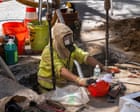
Consider a hypothetical worker—let’s call him Marcus, forty-four years old, a welder and grinder at a mid-sized fabrication plant in Ohio. Marcus does not think of himself as a political statistic. He thinks about his daughter’s orthodontist bill, the transmission whining in his pickup, and whether he can make it through a ten-hour shift without his chest feeling like someone packed it with damp wool. For years, the thin rubber seal of a properly fitted respirator was the only border wall standing between Marcus’s alveoli and microscopic clouds of hexavalent chromium, crystalline silica, and toxic welding fumes.
Now, imagine the federal agency created to guard that border deciding the wall is a bit too inconvenient to maintain.
That is the quiet, suffocating reality behind the current clash in Washington, where Democratic lawmakers are sounding the alarm over efforts at the Occupational Safety and Health Administration to weaken or roll back federal worker respiratory protections. On paper, regulatory rollbacks look boring. They arrive wrapped in bureaucratic acronyms, cost-benefit spreadsheets, and phrases like "compliance flexibility" and "streamlining employer burdens." Nobody bleeds on a spreadsheet. Nobody coughs up blood in a footnote.
Yet beneath the dry administrative language lies a stark, physical trade-off: corporate convenience measured against human lung tissue.
The Architecture of an Unseen Injury
To understand why lawmakers are fighting over rules governing masks, fit-testing, and exposure limits, you have to understand how industrial lung disease actually works. It is not a dramatic cinematic accident. Nobody trips over a girder and suddenly develops silicosis.
Think of occupational respiratory hazards like compound interest running in reverse. A single breath of unguarded silica dust or chemical vapor rarely drops a healthy worker to their knees. Instead, particles smaller than a fraction of the width of a human hair bypass the body’s natural filters—the nasal hairs, the mucus, the microscopic sweeping cilia of the windpipe—and settle deep in the air sacs where oxygen crosses into the bloodstream.
Once there, the body treats those mineral shards or chemical droplets like foreign invaders. White blood cells swarm in to dissolve them. They fail. The cells die, leaving behind tiny, microscopic scars.
One scar means nothing. Ten thousand scars mean you get winded climbing the stairs to your bedroom. A million scars mean you spend your retirement tethered to a humming oxygen concentrator, drowning slowly in dry air.
I have watched men who spent thirty years building bridges, pouring foundations, and spraying industrial coatings sit on front porches in July, gasping like landed fish while their grandchildren ran across the lawn ten feet away. The smell of their houses is always the same—menthol, stale air, and the sharp metallic tang of compressed oxygen tubing. Once that scar tissue forms, medicine cannot undo it. You cannot surgically scrape silica out of a lung. Prevention is the entire game.
What the Rollbacks Actually Touch
When OSHA’s respiratory protection standards—specifically the frameworks built around 29 CFR 1910.134 and substance-specific rules like the crystalline silica standard—are targeted for loosening, the changes rarely announce themselves as "Let’s make workers sick." Instead, they chip away at the mechanics that make protection real rather than theatrical.
A respirator is not a magic talisman. Handing a worker a loose N95 or an ill-fitting elastomeric half-mask without rigorous medical evaluations, annual fit-testing, and strict exposure monitoring is like handing a firefighter a raincoat made of tissue paper. If a beard breaks the seal by a millimeter, or if a worker’s face changes shape after losing twenty pounds, contaminated air takes the path of least resistance—straight through the gap and into the lungs.
In recent oversight pushback, Democratic lawmakers have pointed directly to the danger of weakening these verification requirements, narrowing medical surveillance, or delaying enforcement of strict permissible exposure limits. Industry lobbyists frequently argue that strict testing protocols, record-keeping, and engineering controls—like local exhaust ventilation and wet-cutting systems—place heavy financial and administrative strain on small and mid-sized businesses.
That argument sounds reasonable in a conference room. It sounds far less reasonable when you realize what happens when enforcement retreats.
Without mandatory, recurring fit-tests and strict exposure baselines, safety becomes optional. In competitive industries—construction, manufacturing, shipbuilding, chemical processing, agriculture—an employer who cuts corners on respiratory compliance underbids the employer who buys proper ventilation and pays for annual pulmonary function tests. Before long, cutting corners becomes the market standard. The worker absorbs the savings in their chest.
A History Written in Dust
We do not have to guess how this story ends because America has already lived through it, more than once.
In the 1930s, thousands of workers—mostly Black migrants desperate for Depression-era wages—bored a three-mile tunnel through Gauley Mountain in West Virginia for Union Carbide. The rock was almost pure silica. Dry drilling filled the tunnel with a white fog so thick men could barely see their own hands. Management knew the dust was lethal; supervisors wore masks when they entered the shaft, while workers were given nothing. Hundreds died within months or years of acute silicosis, buried quietly in unmarked graves near the site.
That catastrophe—the Hawk’s Nest Tunnel disaster—helped spark the slow, agonizing birth of modern workplace safety laws. It took decades of organizing, medical research, and congressional battles to establish the simple principle embedded in the Occupational Safety and Health Act of 1970: employers have a legal duty to provide a workplace free from recognized hazards.
Every major rule on OSHA’s books today—from asbestos limits to cotton dust standards to the 2016 silica rule—was bought with clinical data and human grief. When the agency spent years updating the silica standard a decade ago, its own epidemiological models estimated that cutting the permissible exposure limit in half would save over six hundred lives every single year and prevent more than nine hundred new cases of silicosis annually.
Those are not abstract projections. Six hundred lives a year is a small town every decade.
The Confusion of Risk and Delay
If the science is so settled, why is respiratory protection perpetually on the chopping block?
Part of the answer is honest human psychology, and it is worth admitting how tricky this problem feels even to people who care deeply about safety. Human beings are terrible at fearing slow threats. If a scaffolding plank snaps, everyone on the job site hears the crack, sees the fall, and demands an immediate fix. The cause and the consequence occupy the same ten seconds.
Respiratory damage cheats our instincts because of time lag.
A worker breathes welding fumes in 2026 and feels completely fine driving home that evening. They feel fine in 2028. By 2039, when a pulmonologist points to cloudy shadows on a chest X-ray and asks if they ever worked around grinding dust or chemical mists, the company that skipped the fit-tests may have changed names, been bought out, or dissolved. The regulator who signed off on the rollback has moved on to a consulting firm. The accountability has evaporated into thin air, leaving only the patient and the bill.
For small business owners, too, the frustration can be genuinely confusing. Navigating federal compliance manuals written in dense regulatory prose feels overwhelming when you are trying to make payroll on Friday. Nobody wants to drown honest employers in pointless paperwork.
Yet there is a chasm between simplifying paperwork and dismantling physical safeguards. You can make compliance guides easier to read without telling employers they no longer need to prove a mask actually seals to a human face. You can offer technical assistance to small shops without stripping workers of the medical monitoring that catches lung damage while it is still reversible.
What Lawmakers Are Trying to Hold Together
When Democratic members of Congress push back against OSHA’s deregulatory trajectory, they are essentially trying to hold the line on three foundational pillars of workplace survival:
First, the hierarchy of controls. Industrial hygiene rests on a simple, time-tested rule: fix the environment before you burden the body. Vacuum up the dust at the saw blade; enclose the toxic chemical vat; ventilate the welding bay. Masks are supposed to be the last line of defense, not a cheap substitute for clean air. Rolling back engineering requirements shifts the entire burden of survival onto a piece of rubber strapped to a tired worker’s face.
Second, verified protection over assumed protection. A respirator program only works when someone checks the math. That means medical clearance to ensure a worker’s heart and lungs can handle the extra resistance of breathing through a filter, plus fit-testing to guarantee zero leakage. Weakening those steps turns safety compliance into an honor system in environments where the air itself is hostile.
Third, early medical surveillance. Many occupational lung diseases—from chronic beryllium disease to early-stage silicosis and occupational asthma—whisper before they scream. Regular lung function screenings allow a worker to be moved out of high-exposure zones before permanent disability sets in. Without mandatory surveillance, the first symptom is often irreversible breathlessness.
Back on the Shop Floor
Return for a moment to our hypothetical welder in Ohio, Marcus, standing at his bench at 2:30 in the afternoon.
The shop is loud—angle grinders screaming, forklifts beeping, steel clanging against steel. Sweat is pooling under the silicone flange of his respirator. It is uncomfortable. It fogs his safety glasses when the humidity climbs. If the rules soften, if the annual fit-test gets pushed off, if the local exhaust hood over bay four stays broken for six months because nobody is inspecting anymore, Marcus might even feel a brief flash of relief at not having to deal with the hassle.
That is the cruelest trap of all. Deregulation feels like freedom right up until the day it feels like suffocation.
Laws do not exist because employers are villains or because workers are careless. They exist because gravity, chemistry, and human biology do not negotiate with quarterly profit margins. A lung cell does not care whether a rule was deemed economically burdensome in Washington. Silica does not check the Federal Register before scarring tissue.
In the end, every regulatory fight over worker health comes down to a single, unsparing question: who pays the cost of doing business? Either the cost is paid up front in ventilation ducts, clean filters, and fifteen-minute fit-tests—or it is paid thirty years later, one shallow, rattling breath at a time.