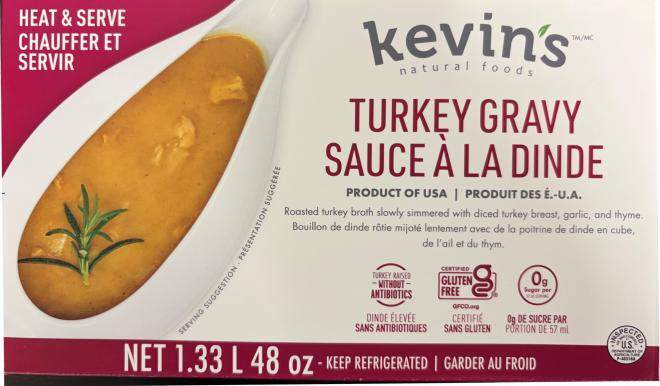
The kitchen is warm. The oven door groans open, spilling a rush of dry, buttery heat into the cool November air, carrying with it the unmistakable, holy trinity of holiday aromas: roasted turkey, fresh sage, and deep, bubbling broth. On the stove, a saucepan simmers. It is a ritual older than memory. You lean over the counter, wooden spoon in hand, waiting for the moment when flour and fat marry into a thick, glossy blanket meant to cloak the feast.
Gravy is supposed to be comfort. It is liquid warmth poured over dry breast meat, the great equalizer of holiday dinners, smoothing out culinary mistakes and binding families together around a groaning table. Meanwhile, you can find other stories here: The Failure Mode of Routine Triage A Systems Analysis of Emergency Department Misclassification.
We rarely look at the label on the jar. We trust the jar.
Consider a hypothetical home cook named Sarah. For weeks, Sarah has curated her guest list, tracked down heritage root vegetables, and worried over the exact roasting time of a fourteen-pound bird. When the day arrives, her hands are flour-dusted, her apron is stained with cranberry juice, and time is fracturing around the edges of the kitchen. She reaches into the pantry, pulls down a trusted brand of turkey gravy, and pours it into the pan to save ten precious minutes. To understand the full picture, we recommend the excellent analysis by World Health Organization.
She doesn't know. She couldn't possibly know.
Hidden inside that smooth, savory liquid is something entirely uninvited. Mustard.
Not a yellow squirt from a ballpark bottle, but undeclared mustard proteins lurking as a stealth allergen. To ninety-nine people out of a hundred, it is a non-event. But to the one person at the table—perhaps Sarah’s teenage niece, whose immune system treats certain proteins like an invading foreign army—that innocent pour is a ticking clock.
This is the hidden terror of modern food recalls. They do not arrive with sirens or flashing red lights. They arrive quietly, tucked into the dry statistics of government agencies, whispering of microscopic missteps on automated factory lines thousands of miles away.
The Mechanics of a Mistake
How does a condiment meant for hot dogs find its way into a Thanksgiving staple?
To understand, you have to leave the warm, sunlit kitchen and step onto the vast, sterile concrete floor of a commercial food processing plant. Here, scale is everything. Massive stainless-steel vats tower overhead like silver silos. Automated arms churn thousands of gallons of broth, thickeners, and flavor enhancers by the metric ton.
In this industrial orchestration, recipes are not written on index cards; they are lines of code executed by massive machines.
Cross-contamination is rarely a dramatic explosion of error. It is a whisper. A shared mixing paddle used for a tangy mustard-based glaze in the morning shift, inadequately scrubbed before the afternoon transition to poultry gravy. A supplier’s spice blend that changed its formulation upstream without updating the ingredient deck on the shipping pallet. A single misplaced decimal, a single overlooked batch number.
The regulatory machinery catches up eventually. The Canadian Food Inspection Agency, or the United States Department of Agriculture, steps in. A recall notice is drafted. The words are clinical, bloodless, and precise. Brand X Turkey Gravy recalled due to undeclared mustard.
Dry. Sterile. Easy to scroll past on a glowing smartphone screen while waiting for the morning subway.
But behind that dry sentence lies a human narrative of vulnerability.
The Anatomy of an Allergic Panic
Allergies are deeply personal betrayals by the body.
Imagine sitting down to dinner. The lights are low. Laughter bounces off the walls. Plates are passed, steam rising in the amber light. You take a bite of turkey drenched in that comforting, store-bought gravy. It tastes rich, savory, slightly herbal.
Then, the shift begins.
It starts with an itch. A sudden, defiant tickle at the back of the throat that water won't wash away. Within minutes, the warmth of the room turns oppressive. Your skin flushes hot. A prickling sensation crawls up your neck. The chest tightens, as if an invisible hand is slowly closing around your ribs, restricting the air.
Panic sets in. Not just regular fear, but the primal, chemical terror of asphyxiation.
In households dealing with severe food allergies, vigilance is a full-time occupation. Every label is scrutinized like a legal contract. Every ingredient is cross-examined. But when a manufacturer fails to declare an allergen, they bypass the consumer's last line of defense. They break the social contract of the marketplace. You paid for food; you received a hazard.
Mustard is one of those deceptive allergens. In many jurisdictions, including Canada and parts of Europe, it is a priority allergen that must be explicitly declared on food labels because of the severity of reactions it can trigger—ranging from hives and gastrointestinal distress to full-blown anaphylactic shock. Yet, because it often hides under umbrella terms like "spices" or "natural flavors," it can slip past the radar of even the most diligent shoppers.
When a recall hits the news cycle, it feels abstract. We view it as a corporate hiccup. Yet every recalled batch represents a terrifying near-miss or an actual medical emergency in someone's dining room.
The Cost of Convenience
We live in an era that worships speed.
We want our meals pre-washed, pre-chopped, pre-cooked, and pre-packaged. We trade craftsmanship for convenience, outsourcing the alchemy of the kitchen to anonymous factories miles away. Most of the time, this bargain works. We open the jar, heat the contents, and reclaim twenty minutes of our evening.
But convenience comes with a shadow tax.
When we distance ourselves from the raw materials of our food, we surrender control. We no longer know the hands that grew the herbs, the exact origin of the broth, or the cleaning protocols of the facility where the food was sealed. We rely entirely on trust.
When that trust is broken by an undeclared allergen recall, it shatters our illusion of safety in the modern supermarket aisle. It forces us to ask an uncomfortable question: What else are we missing?
Check your pantry shelves. Look at the back of that half-used jar tucked behind the canned tomatoes. Read the tiny, crowded text listing ingredients you can barely pronounce.
The gravy is gone from the store shelves now. The lot numbers have been logged, the warnings broadcasted across news feeds and consumer protection websites. But the broader lesson lingers in the air long after the holiday dishes are washed and put away.
Food is never just fuel. It is an act of profound trust between stranger and consumer, between machine and mouth. And sometimes, it takes a jar of gravy to remind us just how fragile that trust really is.