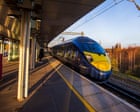
Standing on Platform 14 at Manchester Piccadilly at six in the morning feels like standing at the edge of an unfinished sentence.
The air tastes of damp iron, cold diesel, and stale espresso. Commuters in dark coats huddle beneath yellow sodium lights, watching departure boards flicker with destinations that stop abruptly at the water's edge. London. Birmingham. Edinburgh. If you want to go further—if you want to sit in a sunlit café in Brussels by lunchtime, or pitch a client in Cologne without spending four hours being herded through airport security trays—you have to break your journey in half. Don't miss our recent article on this related article.
You have to go south. You have to queue. You have to surrender to the bottleneck.
For decades, the promise of the Channel Tunnel was sold to Britain as a triumph of engineering over geography. Two nations stitched together beneath the chalk seabed of the English Channel. Yet for anyone living north of the Watford Gap, that tunnel might as well end in a brick wall at St Pancras International. If you want more about the background here, AFAR offers an informative summary.
Recently, campaigners, transport advocates, and regional business leaders delivered a blunt message to Greater Manchester Mayor Andy Burnham. If the British government is serious about a genuine UK-EU reset, handshakes in Brussels and diplomatic communiqués will not be enough. Steel rails must carry the weight of that promise. They urged Burnham to champion direct international rail services connecting the North of England directly to mainland Europe.
On paper, it sounds like a dry infrastructure lobby. In reality, it is a battle over who gets to belong to the modern European economy—and who gets left waiting on a rainy platform.
The Architecture of a Bottleneck
Consider what happens when a mid-sized engineering firm in Salford wants to send two specialists to a trade summit in Rotterdam.
Let us invent a character to trace the friction—a composite of thousands of northern travelers who make this trek every month. Call her Clara. Clara is a thirty-four-year-old renewable energy consultant based in Ancoats. On a Tuesday morning, she packs a single carry-on bag and heads to Piccadilly Station.
Her journey begins with a two-hour train ride down the West Coast Main Line to London Euston. If Avanti West Coast is running on time, she arrives with forty minutes to spare. She then drags her suitcase across the frantic, rain-slicked pavement of Euston Road to St Pancras International. There, she joins a serpentine queue snaking past the champagne bar, waiting to clear both UK exit checks and French border control before boarding a Eurostar train.
Total travel time from Manchester to Brussels, assuming zero delays? Nearly six hours. Add an onward connection to Rotterdam, and Clara has burned an entire working day just trying to leave the island.
The alternative is flying from Manchester Airport. That means arriving two hours early, enduring liquid restrictions, boarding a short-haul jet that burns disproportionate amounts of carbon for a four-hundred-mile hop, landing at Schiphol, and taking another train into the city.
Why does this friction exist? Because when the High Speed 1 rail line was built to connect London to the Channel Tunnel in 2007, the track gauge and signaling systems were engineered to European standards, while the rest of Britain's rail network remained locked in its Victorian geometry. A train built for the Continental network cannot simply glide up the tracks to Manchester, Leeds, or Edinburgh without specialized rolling stock and upgraded infrastructure.
More importantly, border infrastructure was concentrated exclusively in London. Under the juxtaposed border controls agreed upon between the UK and France, French police inspect passports on British soil before passengers board. Setting up those security sterile zones at regional stations like Manchester Piccadilly or Birmingham New Street was dismissed for years as too expensive, too complicated, too niche.
So the funnel stayed narrow. Every international rail passenger in Britain was forced through a single postcode in central London.
What Was Promised Beneath the Sea
To understand why advocates are pressing Andy Burnham right now, you have to remember what the Channel Tunnel was originally supposed to be.
When digging began in 1988, British Rail did not envision a London-only shuttle. They ordered a fleet of specialized trains—known as the Regional Eurostar sets—specifically designed to run from Manchester, Glasgow, and Edinburgh straight through the tunnel to Paris and Brussels. Nightstar sleeper trains were even built to carry passengers overnight from northern cities to Frankfurt and Amsterdam while they slept.
Those trains sat in sidings, rusted, and were eventually sold off to Canada and scrapped without ever carrying a single fare-paying passenger out of Manchester.
The rise of budget airlines like Ryanair and easyJet in the late 1990s killed the original dream. Why spend millions configuring regional customs checkpoints when a flight from Liverpool to Alicante cost nineteen pounds?
History has a way of turning cheap shortcuts into expensive traps.
Today, the math has inverted. Aviation faces mounting carbon taxes, slot shortages at major hubs, and growing corporate pressure to slash Scope 3 business travel emissions. Meanwhile, the political winds between Westminster and Brussels have shifted. After years of post-Brexit frost, the UK government has openly declared its ambition for a closer, pragmatic working relationship with the European Union—a "reset" aimed at easing trade barriers, reviving youth mobility, and rebuilding diplomatic trust.
Transport advocates see the gap between rhetoric and reality. You cannot talk about reconnecting Britain with Europe while keeping eighty percent of the country physically severed from the European high-speed rail grid.
Why Andy Burnham Holds a Unique Lever
Andy Burnham does not control the national rail budget, nor does he sit in the Cabinet room when treaties with France are negotiated. So why urge him?
Because in British politics, mayors of combined authorities have become the primary engines of regional disruption. Burnham turned the Bee Network—Greater Manchester's integrated bus and tram system—into a national template for taking public transport out of fragmented private hands and putting it back under local control. He has spent years arguing that Britain's economic obsession with London starves the North of productivity.
When Burnham speaks about transport, Westminster listens, if only because ignoring him carries a steep political price across the Red Wall.
Advocates pushing for international rail links know that HS2's northern leg was gutted, leaving Manchester without the high-speed spine that was meant to tie it seamlessly to the south. Without direct international services, Manchester risks becoming a branch-line city in a continent rapidly knitting itself together with night trains and 200-mile-per-hour corridors.
Look across the Channel. France is aggressively banning short-haul domestic flights where a rail alternative under two and a half hours exists. Germany, Austria, and the Netherlands are pouring billions into cross-border Nightjet routes and high-speed links. Spain has turned high-speed rail into an affordable, everyday utility that rivals budget airlines on price and crushes them on convenience.
Britain, by contrast, has a single international rail operator holding a near-monopoly out of a single London terminal, charging fares that frequently exceed three hundred pounds for a last-minute return ticket to Paris.
The Invisible Tax on Regional Ambition
Let us return to Clara, our hypothetical consultant in Manchester, and scale her experience up across an entire regional economy.
Economists talk about agglomeration—the measurable boost in innovation and wages that happens when people, ideas, and capital can move easily between cities. When travel between two cities drops below three or four hours door-to-door, businesses treat them as part of the same commercial neighborhood.
Right now, London is part of Europe's neighborhood. A banker in Canary Wharf can attend a morning meeting in Paris and be back in London for dinner.
Manchester is treated like an outpost.
Every extra hour spent changing stations in London, every sixty-pound surge-priced domestic rail ticket tacked onto a Eurostar fare, acts as an invisible tariff on northern businesses. It subtly discourages a Dutch tech investor from opening a satellite office in Leeds. It convinces a German cultural festival to book a theatre troupe from London rather than Sheffield because the logistics are half as painful.
I once spent three hours stuck outside Milton Keynes on a southbound train while a signaling failure cascaded down the line, watching the departure time for my Eurostar connection in London tick past on my phone screen. There is a specific kind of helplessness in that moment—watching a missed connection unravel two days of meetings, knowing that the physical track beneath your wheels connects, through a chain of steel, all the way to the platform you are trying to reach, yet the system refuses to let you travel there directly.
That frustration is shared by millions of travelers who live outside the M25 motorway.
How Direct Rail Actually Works
Whenever someone proposes running trains from Manchester or Birmingham directly to Paris or Brussels, skeptics immediately raise two objections: border checks and infrastructure costs.
Both problems are real. Neither is insurmountable.
First, the border question. Since Brexit, British passport holders must have their documents stamped upon entering the Schengen Area, and EU citizens face stricter checks entering the UK. This requires physical space at stations for passport booths, security scanners, and waiting lounges.
Critics argue that Manchester Piccadilly is already congested—Platforms 13 and 14 are notoriously overworked bottlenecks—and cannot absorb a sterile international terminal.
Rail planners point to smarter alternatives. Border checks do not have to happen inside a cramped Victorian shed in central Manchester. One model involves designated "international platforms" sealed off only during specific departure windows, a setup already used successfully at seasonal Eurostar stops like Bourg-Saint-Maurice in the French Alps. Another option, increasingly favored by European transport analysts, is clearing customs and immigration at a hub station along the route—such as Stratford International in east London—where trains pause briefly while passengers remain on board or clear a dedicated concourse, before plunging straight into the Channel Tunnel.
Second, the trains themselves. Eurostar's monopoly on cross-Channel passenger services has quietly expired in regulatory terms. Rival operators—including Virgin Group, Evolyn, and Dutch-backed Heuro—have announced plans to buy rolling stock and challenge Eurostar's dominance through the tunnel by the end of the decade.
These new entrants need growth markets. St Pancras is already straining at capacity, capable of handling only around 1,800 to 2,000 passengers per hour through its border halls. If new rail operators want to run more trains through a Channel Tunnel that currently operates at barely half its physical capacity, they cannot rely solely on St Pancras.
They need regional origins. They need Manchester.
The Political Courage of Long Steel
Infrastructure does not fail because engineers lack imagination. It fails because politicians operate on four-year election cycles while railways operate on forty-year horizons.
Urging Andy Burnham to champion international rail is an acknowledgment that regional leaders have to fight for structural relevance long before the first ticket is sold. If Greater Manchester demands that any future UK-EU transport agreement includes provisions for regional cross-border rail—streamlined customs protocols, shared security clearances, and allocated tunnel paths—it forces Whitehall to stop treating international connectivity as a London privilege.
Critics will ask whether public money should subsidize international trains when local commuter lines still suffer from cancellations and overcrowded carriages. It is a fair question, and an honest answer requires admitting the trade-offs. Nobody wants to see local buses or suburban trains starved of cash so executives can ride first-class to Brussels.
But framing the choice as "local transit versus international rail" is a false binary. Private operators—from Virgin to European state railways like Deutsche Bahn and SNCF—are eager to fund and operate cross-Channel services if governments clear the regulatory and border hurdles. What they need from leaders like Burnham is not a blank check, but political muscle: land allocation for terminal facilities, coordinated timetabling with northern rail networks, and relentless pressure on Westminster and Brussels to simplify border processing.
Beyond the Platform Edge
Think about what happens to a city's psychology when its horizon expands.
For generations, northern industrial cities looked outward to the world—Manchester cotton clothed continents; Liverpool ships crossed every ocean. Over the past half-century, centralization pulled Britain's gravity inward toward London, turning proud global cities into domestic satellites.
A direct train from Manchester Piccadilly to Brussels Midi or Paris Gare du Nord is more than a convenient way to avoid airport security. It is a physical rebuttal to the idea that Britain's relationship with Europe begins and ends in the capital.
Picture that same six-o'clock morning on Platform 14 five years from now. The mist still hangs low over the Pennines. Commuters still clutch their paper cups of coffee against the chill.
Except on the departure board, glowing cleanly beside the local stops for Stockport and Crewe, sits a single line of destination text: Brussels Midi — Direct.
No frantic sprint across Euston Road. No queuing behind three hundred tourists in a basement concourse in central London. Just a quiet hiss of pneumatic doors, a low hum of electric traction motors, and a clear line of steel stretching uninterrupted from the heart of northern England beneath the sea into the center of Europe.