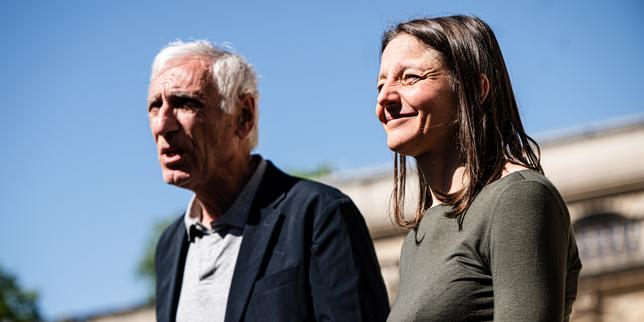
The release of Cécile Kohler and Jacques Paris after nearly four years in Iranian captivity marks the end of a personal nightmare but the continuation of a systemic international crisis. These two French educators, accused of espionage while traveling as tourists, were never targets of a criminal investigation in any traditional sense. They were human capital. Their freedom, secured through grueling back-channel negotiations, confirms a grim reality in modern geopolitics. Tehran has refined the seizure of foreign nationals into a predictable, high-yield diplomatic tool.
France and its allies currently face a predatory cycle where Western passports function as currency. When Kohler and Paris stepped off the plane at Le Bourget, the relief was palpable, but the strategic cost remained uncalculated. To understand why this keeps happening, one must look past the emotional reunions and examine the cold machinery of the Islamic Revolutionary Guard Corps (IRGC) and the specific ways they exploit the legal sensitivities of democratic states.
The Architecture of the Evin Pressure Cooker
The survival of Kohler and Paris is a testament to human resilience, yet their ordeal was designed to break the psyche. This is not accidental cruelty. It is a calibrated psychological process intended to produce televised confessions that serve domestic Iranian propaganda.
Inside the high-security wings of Evin Prison, the "white torture" method predominates. This involves prolonged isolation in cells where every surface is a sterile, blinding white. There is no sound. There is no color. The goal is sensory deprivation that leads to cognitive collapse. For the Iranian state, a prisoner is only valuable if they can be used to leverage a specific concession from their home government. Until that moment of leverage arrives, the prisoner is kept in a state of legal and temporal limbo.
The judicial process they faced was a theater of the absurd. Under the Iranian penal code, "collusion against national security" is a catch-all charge that requires no evidence beyond the presence of the individual in a sensitive area or contact with local activists. In the case of Kohler and Paris, their mere association with trade union movements was enough to trigger the trap.
Hostage Diplomacy as an Economic Necessity
We must stop viewing these arrests as isolated incidents of paranoia. They are tactical maneuvers. Iran uses "hostage diplomacy" to solve three specific problems: the release of its own operatives caught abroad, the unfreezing of sanctioned assets, and the acquisition of a seat at the table during nuclear negotiations.
Historically, the pattern is undeniable. Whenever a significant Iranian figure is arrested in Europe or the United States—whether for terrorism or sanctions-busting—a Westerner is almost immediately detained in Tehran. This creates a "swap pool." It forces Western capitals into a moral corner. They must choose between upholding the rule of law by keeping a convicted criminal in jail or saving the life of an innocent citizen being used as a pawn.
The math is brutal. In 2023, the release of five Americans was tied to the unfreezing of $6 billion in Iranian oil revenue. While the French government maintains that no ransom was paid for Kohler and Paris, "payment" in these scenarios often takes the form of softened diplomatic stances, the release of Iranian prisoners in third-party countries, or the quiet abandonment of certain sanctions.
The Failure of the Western Response
The primary reason this practice continues is that it works. The international community has failed to create a unified deterrent. Currently, each nation negotiates for its own citizens in a vacuum. This "retail" approach to hostage recovery allows Tehran to play countries against one another.
When France negotiates for its citizens, it does so based on its specific bilateral relationship with Iran. This lack of a multilateral front means that Iran faces no collective consequence for seizing a European Union citizen. There are no automatic sanctions triggers. There is no coordinated expulsion of Iranian diplomats. Instead, the offending state is rewarded with high-level engagement and, eventually, the concessions it desires.
The current strategy is reactive. It focuses on recovery rather than prevention. This has created an environment where the risk-to-reward ratio for the IRGC is heavily skewed in favor of further abductions.
The Myth of the Accidental Spy
Western governments often issue travel warnings, yet they frequently fail to explain the specific mechanics of the risk. Tourists and researchers often believe that if they are not actually engaging in espionage, they are safe. This is a lethal misunderstanding of the Iranian security apparatus.
The IRGC does not care if an individual is a spy. They only care if the individual’s home country cares enough to trade for them. The profile of the "hostage" has shifted from high-ranking officials to everyday citizens—teachers, NGO workers, and dual nationals. These individuals are easier to seize and carry less initial political baggage, allowing the tension to build slowly through state media leaks and "confession" videos.
Redefining the Threshold of State Conflict
The detention of Kohler and Paris should be categorized as an act of state-sponsored kidnapping rather than a judicial dispute. By maintaining the fiction that these are legal matters, Western nations play into the hands of the captors.
To break the cycle, the cost of taking a hostage must exceed the value of the eventual concession. This would require a radical shift in policy:
- Automatic Sanctions: Any nation detaining a foreign national without clear, internationally verified evidence should face immediate, pre-negotiated sanctions from a coalition of states.
- The Freeze Mechanism: All diplomatic assets of the offending country should be frozen the moment an arbitrary detention is confirmed, to be released only upon the victim's return.
- A "No-Trade" Doctrine: This is the most controversial and difficult step. As long as swaps are on the table, more citizens will be taken to fill the vacancy left by those released. It is a heart-wrenching paradox: the act of saving one citizen today virtually guarantees the abduction of another tomorrow.
The Lingering Trauma of the Returned
For Kohler and Paris, the return to France is not the end of the journey. The psychological impact of four years in a revolutionary prison does not evaporate upon landing. Former hostages often describe a "re-entry crisis" where the world they left no longer exists, and the world they inhabited—the four walls of a cell—remains etched into their sensory memory.
They return to a country that has moved on, while they have been frozen in time. The French state provides medical and psychological support, but there is no treatment for the knowledge that one’s life was used as a bargaining chip in a cold, geopolitical game.
The case of these two teachers is a stark reminder that the borders of modern conflict are no longer defined by front lines or uniforms. They are defined by who is holding a passport in the wrong place at the time a regime needs a new line of credit.
The international community's insistence on treating these incidents as "consular affairs" is a dangerous delusion. It is a form of asymmetric warfare. Until the response reflects the gravity of the crime, the gates of Evin Prison will continue to swing open for the release of one group, only to lock behind the next.