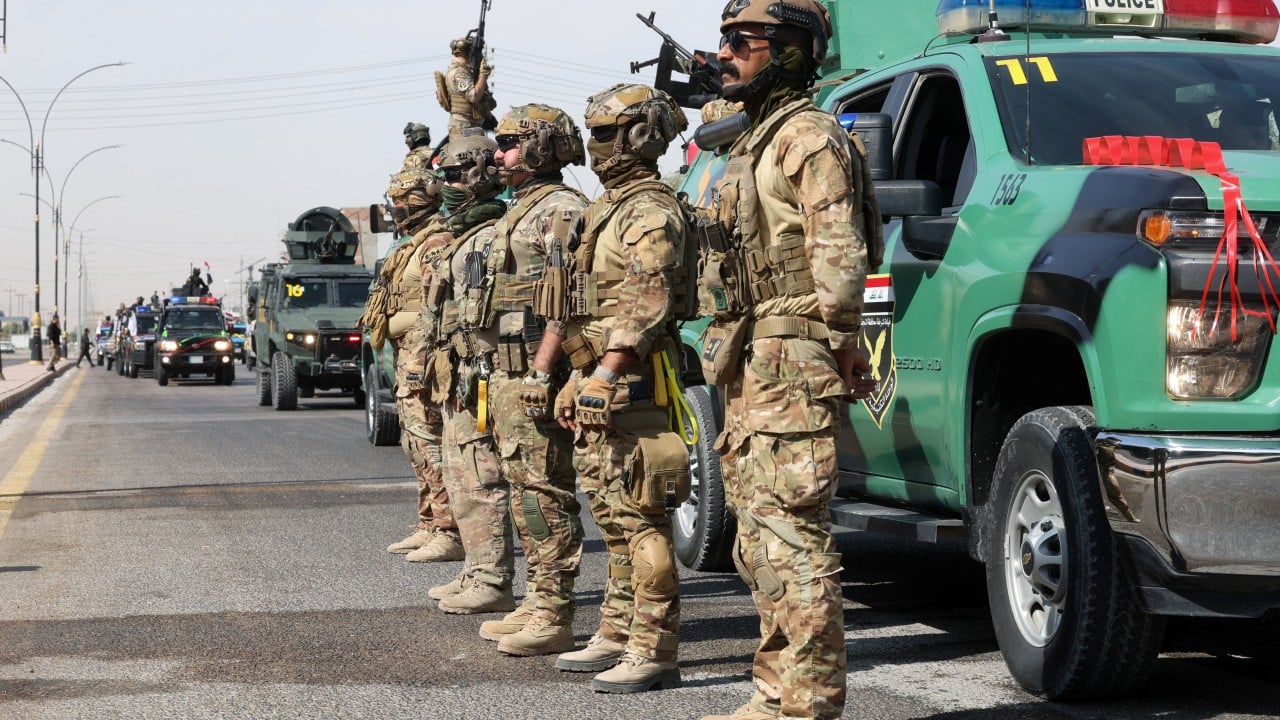
The headlines read like a geopolitical fairy tale. Washington and Baghdad announce the formal conclusion of the combat mission, banners wave for Sovereignty Day, and analysts on cable news talk about a clean break. Everyone wants to believe the clean break. It makes for good soundbites. It lets weary politicians declare victory and move on to the next crisis.
It is also largely a fiction.
Anyone who has spent time navigating the sprawling logistics hubs around Erbil or watching the quiet, continuous flow of contractors through military air terminals knows that the United States military does not simply pack up and leave a critical strategic node because a calendar page turns to October. What gets packaged as a withdrawal is rarely an evacuation. It is an administrative metamorphosis. Titles change, shoulder patches shift, and contract structures are rewritten from the ground up, but the footprint remains.
To understand why the latest announcements about ending the troop mission in Iraq miss the forest for the trees, you have to look past the diplomatic press releases and examine how modern power projection actually works.
The Myth of the Hard Exit
For decades, the standard narrative of military withdrawal relied on ships pulling out of harbors and long convoys rolling across borders. That template died a generation ago. Modern force posture is modular, outsourced, and deliberately ambiguous.
When official troop numbers tick downward, observers celebrate a reduced military presence. They rarely account for the parallel inflation of private security contractors, intelligence enablers, logistics specialists, and technical advisors who operate under corporate umbrellas rather than military command chains. These individuals sleep in the same compounds, eat in the same mess halls, and fly on the same aircraft. They perform the exact same functions, yet they do not show up on the official Department of Defense force-level reports that get fed to the press.
I have watched defense contractors rewrite deployment manifests overnight to circumvent political caps. When a government tells domestic audiences that troop levels are dropping to zero, procurement officers simply shift personnel onto maintenance, training, and advisory contracts. The operational capability on the ground does not drop by a single percentage point. It just changes its billing code.
Calling this a transition to pure diplomacy or normal bilateral relations requires a staggering suspension of disbelief. Baghdad is not suddenly steering its security apparatus free of external dependencies. The intelligence sharing, the airspace management, the logistical backbone required to keep Iraqi airframes in the sky—these systems take decades to build and even longer to decouple. Cutting the umbilical cord overnight would mean grounding half the fleet and blinding command centers.
Sovereignty as a Paper Construct
Sovereignty Day is a great date for a parade, but state sovereignty in the modern Middle East is rarely absolute. It is negotiated, porous, and heavily constrained by regional gravity.
Baghdad finds itself caught in an impossible gravitational pull between Washington and Tehran. Every move the Iraqi government makes regarding security integration, border management, or counter-terrorism financing is calculated not against some abstract ideal of national independence, but against the immediate risk of economic collapse or internal fracture.
When politicians talk about reclaiming full sovereignty through the departure of foreign troops, they are speaking the language of domestic optics. They need a narrative of national dignity to satisfy a young, increasingly restless population that has grown up under the shadow of foreign intervention. But behind closed doors in the Green Zone, the conversation is entirely different. Iraqi commanders know precisely what happens if the remaining advisory and technical architecture disappears tomorrow. The institutional vacuum would be filled instantly by non-state armed actors or external rivals who care very little about democratic norms or constitutional governance.
This is the dirty secret of the new security framework. The official mission ends precisely because the old framework became politically radioactive, not because the underlying security dilemma was solved. Rebranding a combat mission as an advisory partnership is a brilliant bureaucratic maneuver. It shields politicians from accountability while preserving the strategic positioning that matters to generals.
Follow the Logistics, Not the Rhetoric
If you want to know what is actually happening in a conflict zone, ignore the speeches given behind podiums draped in flags. Look at fuel consumption, cargo flights, and supply chain contracts.
Military power is fundamentally a logistics problem. A nation cannot maintain influence in a volatile region without a secure supply chain, reliable communications infrastructure, and maintenance pipelines for advanced hardware. As long as those logistical arteries remain open and active—managed by a mix of uniformed personnel and private contractors—the strategic footprint is intact.
The transition to an advisory role means that troops are trading rifles for clipboards, but they are standing in the exact same rooms. They are still analyzing the same threat matrices, still monitoring the same borders, and still ensuring that the state security forces do not fracture along sectarian or political fault lines.
To pretend that this marks the end of an era is to misunderstand how empires and major powers manage decline or adaptation in the twenty-first century. They do not stage dramatic retreats. They mutate. They integrate deeper into local bureaucracies, lean harder on proxy networks and commercial partners, and turn loud deployments into quiet, permanent fixtures.
The banners will come down after Sovereignty Day. The speeches will fade from the evening news. But the architecture of influence will remain firmly in place, humming quietly beneath the desert heat, waiting for the next crisis to remind everyone that the more things change in military strategy, the more they stay exactly the same.