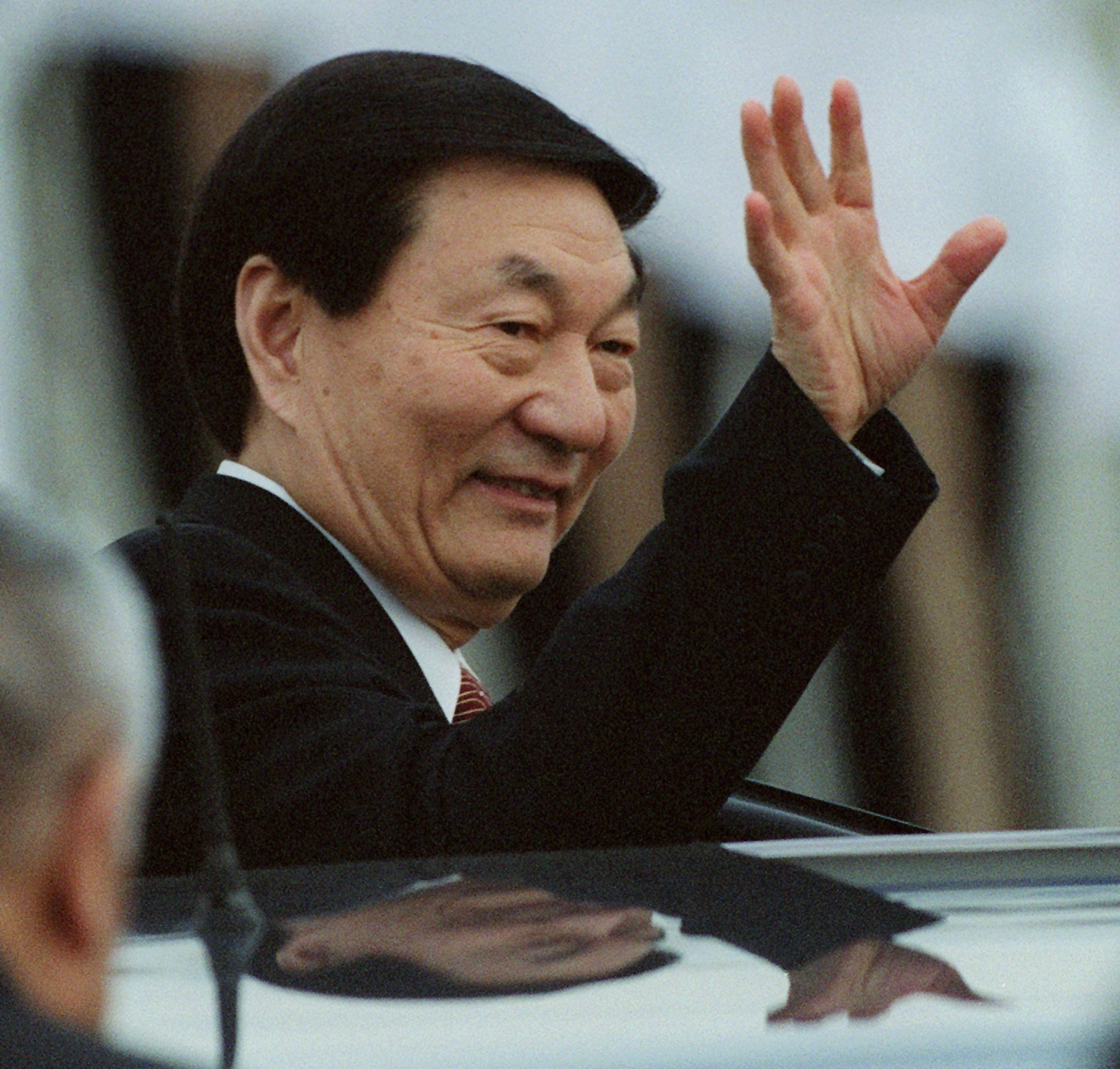
The death of former Chinese premier Zhu Rongji marks the final departure of an era defined by brutal pragmatism, economic restructuring, and calculated risk-taking. Ruling behind a desk with an acerbic tongue and an engineer's intolerance for inefficiency, Zhu engineered the 1990s reforms that fundamentally rewired China's state-dominated economy into a global industrial powerhouse. While standard obituaries list his accomplishments—taming hyperinflation, forcing state-owned enterprises into profitability, and securing World Trade Organization accession—they routinely gloss over the structural scars left by his tenure. Zhu was not a gentle reformer. He was a political street-fighter who used centralization of power to rescue a sinking ship, creating a modern financial engine while simultaneously embedding long-term liabilities that contemporary policymakers are still struggling to resolve.
To understand how modern global trade operates, one must examine the mechanics of Zhu's fiscal overhaul. Before 1994, Beijing was starved of cash. Local governments collected taxes and routinely kept the lion's share, leaving the central treasury weak and unable to fund national infrastructure or defense. Zhu responded with the tax-sharing reform, a policy so aggressive it alienated provincial bosses overnight. He walked into rooms full of hostile regional leaders and demanded compliance. By redirecting bulk revenues straight to the central government, he built the financial muscle of the modern Chinese state.
Yet, this victory carried an invisible cost. Deprived of local tax streams without a corresponding reduction in spending mandates, municipal governments turned to alternative funding models. Land sales and borrowing through local government financing vehicles became the default survival mechanism. The real estate obsession that defines modern Chinese economics is, in many ways, the direct architectural descendant of Zhu's 1994 tax centralization. He solved an immediate insolvency crisis for Beijing, but he inadvertently institutionalized the local debt addiction that haunts contemporary markets.
The Human Toll of State Enterprise Surgery
By the mid-1990s, China's state-owned enterprises resembled bloated museums of the Maoist era. They functioned as social welfare centers, paying for workers' housing, medical care, pensions, and even schools, while producing mountains of unmarketable goods and soaking up non-performing bank loans. Total collapse loomed. Enter Zhu, who earned the moniker "Boss Zhu" and the fearful respect of bureaucrats nationwide.
His remedy was merciless. Under the banner of grabbing the large and letting go of the small, Zhu permitted the restructuring, bankruptcy, or sell-off of thousands of smaller state firms. More than thirty million workers lost their lifetime security practically overnight.
"I have prepared 100 coffins here—99 for corrupt officials and one for myself," Zhu famously declared upon taking office as premier in 1998.
The human cost was staggering. Industrial rust belts across the northeast plunged into deep depression as families who had never known unemployment were cast adrift. Protests flared, but Zhu held the line. He believed that unless the rotting timber of state industry was cut away, the entire economic structure would collapse under the weight of bad debts. This purge forced a massive reallocation of labor, driving a mobile, hyper-motivated workforce into the nascent private sector and export factories. It was cold calculus executed with absolute fidelity. The growth miracle of the 2000s would have been impossible without this bloodletting, but the social contract between the state and the industrial working class was shattered permanently.
The World Trade Organization Gamble
Perhaps his most consequential gamble was forcing China through the needle's eye of World Trade Organization negotiations. Western skeptics argued that China was too state-directed, too opaque, and too protective to join the rules-based global trading system. Domestic hardliners argued that opening domestic markets would destroy native industries and surrender sovereignty to foreign capital.
Zhu navigated this minefield with unmatched diplomatic stamina. He flew to Washington offering sweeping concessions, only to be rebuffed by a Clinton administration that misjudged the political volatility of the moment. Instead of retreating, Zhu doubled down. He recognized that external binding rules were the ultimate weapon to break internal domestic monopolies. By locking China into global trade commitments, he used international law to force recalcitrant local protectionists to modernize.
When China officially entered the trade organization in late 2001, it triggered an export tsunami. Factories multiplied across the Pearl River Delta. Supply chains anchored themselves permanently to the mainland. The subsequent decade produced growth rates that reshaped global GDP calculations. Yet, the integration was asymmetric. While global corporations feigned access to a billion-dollar consumer market, state subsidies and industrial policies remained deeply entrenched, laying the groundwork for the trade wars that dominate twenty-first-century geopolitics.
The Unfinished Ledger
History tends to romanticize reformers once they pass into memory, stripping away the friction of their daily governance. Zhu Rongji was neither a saint of free-market capitalism nor an ordinary apparatchik. He was a high-level technocrat who believed that the Communist Party could only survive by embracing market efficiency while retaining absolute political monopoly.
He retired in 2003, retreating entirely from public view, leaving behind a nation hurtling forward at breakneck speed. His speeches, later collected and read avidly by aspiring bureaucrats, warned repeatedly against overbuilding, corruption, and financial speculation. Those warnings proved prophetic.
The structural imbalances facing modern economic planners—over-leveraged property markets, local debt overhangs, and structural overcapacity—are the unresolved contradictions of the very system Zhu built. He bought China two decades of miraculous expansion through sheer willpower and surgical cruelty. Now, as the era he shaped draws to a definitive close, the bill for those compromises is coming due.
Zhu Rongji Dies At 97: Former Chinese Premier Who Transformed China's Economy
This video provides a concise overview of Zhu Rongji's historic tenure and his role in driving China's economic transformation.
http://googleusercontent.com/youtube_content/1


