The fog over the Thames doesn’t just obscure the water; it hides the secrets of a city that has seen every possible iteration of human vanity. Londoners are accustomed to the grey. They walk with heads down, umbrellas angled like shields, eyes fixed on the cracked pavement or the blue light of a smartphone. We are a people of the peripheral. We notice the shift in a shopfront or the disappearance of a pub, but we rarely look up at the silence.
Then, on a Tuesday that felt like any other Tuesday—damp, hurried, and heavy with the scent of roasted coffee and exhaust—the silence spoke back.
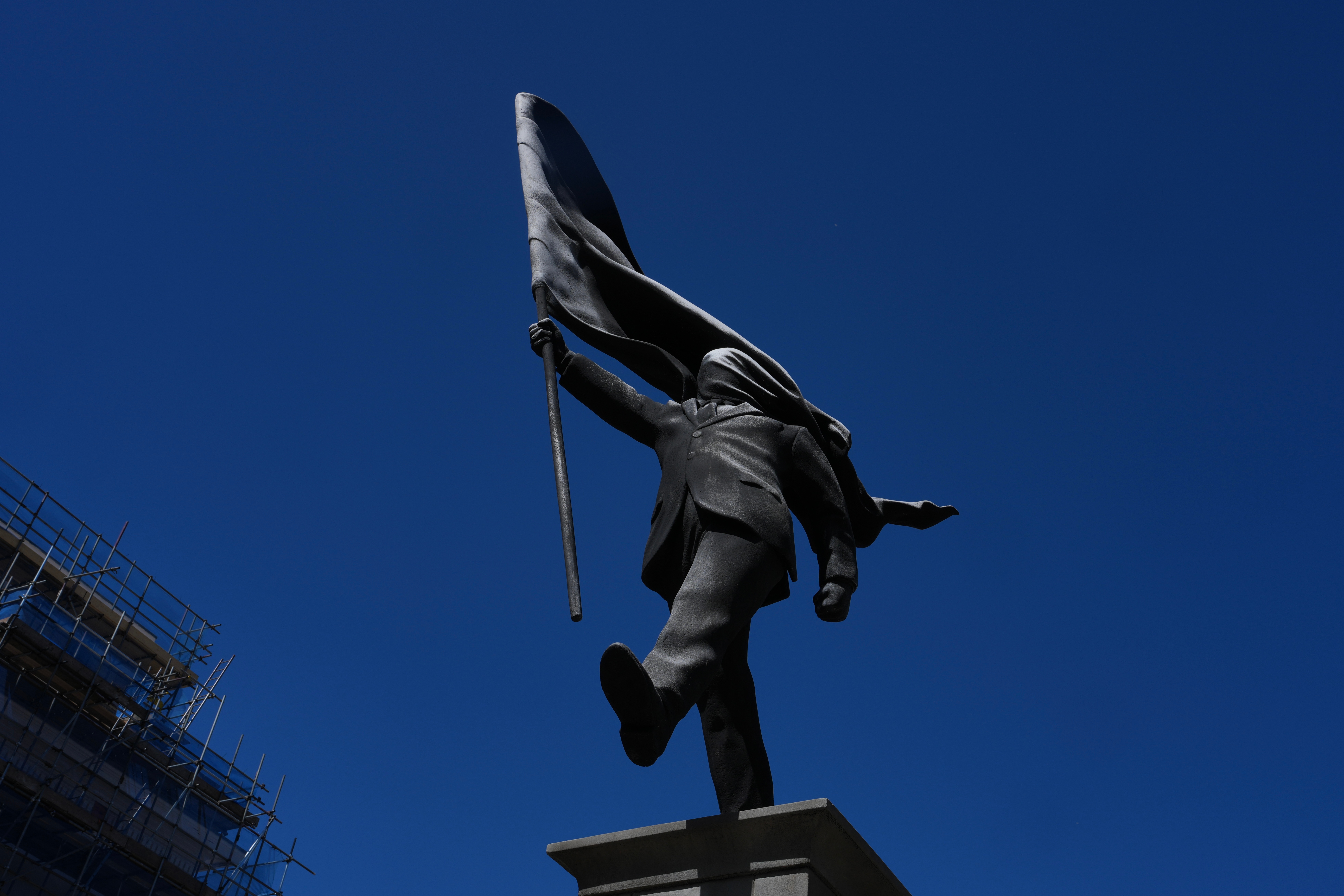
A new figure appeared in the heart of central London. It wasn’t a politician cast in bronze, nor was it a general on a high-strung horse. It was a statue, cold and unmoving, yet pulsing with a frantic energy that stopped the morning rush in its tracks. Within hours, the digital ether was ablaze. The question wasn't just "What is it?" but "Is it him?"
Banksy, the phantom of the art world, had returned to the streets.
The Weight of Metal and Memory
To understand why a piece of street art can paralyze a metropolis, you have to understand the invisible stakes. We live in an era of digital permanence and physical transience. Our buildings are glass, our currency is data, and our memories are stored in a cloud we cannot touch. When a physical object appears overnight—something heavy, something tangible, something that demands space—it disrupts the narrative of our frictionless lives.
Imagine a commuter named Elias. Elias has walked the same route for twelve years. He knows the exact number of steps from the Tube exit to his office door. He is a man of routine, a man who finds comfort in the predictable. But today, the predictable was shattered. He found himself standing before a sculpture that looked as though it had grown from the concrete itself.
The statue wasn't a celebration of power. It was a reflection of the struggle. Banksy’s work has always functioned as a mirror, often showing us the parts of ourselves we’ve spent a lifetime trying to ignore. By the time the official confirmation dropped on Instagram—that simple, wordless validation that sends the art market into a frenzy—the public had already claimed it.
The Confirmation and the Chaos
The verification process for a Banksy is its own kind of theatre. In a world of deepfakes and AI-generated deception, the street artist’s Pest Control office remains a bastion of old-school proof. But for the person standing on the sidewalk, the confirmation isn't a digital certificate. It’s the feeling in the gut. It’s the realization that someone moved through the city while we slept, bypassing cameras and patrols, to leave a gift—or a warning.
The new installation in central London carries the signature wit, but there is a newfound heaviness to it. It isn't just paint on a wall that can be scrubbed away or cut out by a greedy landlord. It is an installation that interacts with the architecture of the city.
Consider the logistical nightmare of such an act. This isn't a quick stencil sprayed in an alleyway. This is engineering. This is planning. This is a heist in reverse. Instead of taking something valuable, the artist has forced value onto a space that didn't ask for it. It forces the authorities into a stalemate: do you remove a masterpiece, or do you let the "vandalism" stand?
The Invisible Stakeholders
There is a hypothetical teenager, let's call her Mia, who sees the statue through the lens of a cracked iPhone screen. For her, Banksy isn't a mysterious middle-aged man from Bristol; he is a symbol of the idea that the world is still malleable. In a society where every square inch of the city is monetized, branded, or restricted, the appearance of the statue is an act of reclamation.
But there is another side. The shop owners, the city council, the police. For them, a Banksy is a liability. It brings crowds. It brings "art thieves" with angle grinders. It brings a level of attention that is impossible to manage. The stakes are physical. They are financial.
The statue is a catalyst for a very specific kind of urban tension. It sits at the intersection of public space and private property, a bronze or iron ghost that refuses to be ignored. It reminds us that the city belongs to those who dare to touch it.
The Language of the Street
Standard journalism would tell you the dimensions of the work. It would tell you the exact street corner and the time the first photo was uploaded. But that misses the point entirely. The "what" is secondary to the "why."
We are starving for authenticity. We are tired of the polished, the curated, and the approved. Banksy’s confirmation of this new work is a reminder that the most powerful messages are the ones that are uninvited. The statue stands as a testament to the fact that you can still make a mark on a world that feels increasingly untouchable.
The narrative of London changed this week. It stopped being a grid of commerce and became, for a brief moment, a gallery without walls. The crowds that gathered weren't just there for a selfie; they were there to witness a rupture in the mundane. They were there to see something that shouldn't be there, yet felt more "real" than the skyscrapers surrounding it.
A Final, Unmoving Witness
As night falls, the statue remains. The flashbulbs have died down, and the news cycle is already beginning to churn toward the next catastrophe. But the iron is cold, and the shadows it casts are long.
The city breathes around it. A bus hisses past, throwing a spray of rainwater over the base. A tourist stops, touches the metal, and shivers. We are all searching for a sign that we exist, that we leave a footprint, that our presence matters in the grand, crushing machinery of the twenty-first century.
The statue doesn't offer an answer. It just stands there, a silent, heavy proof that someone was here. And in the heart of a city that never stops moving, that stillness is the loudest thing of all.