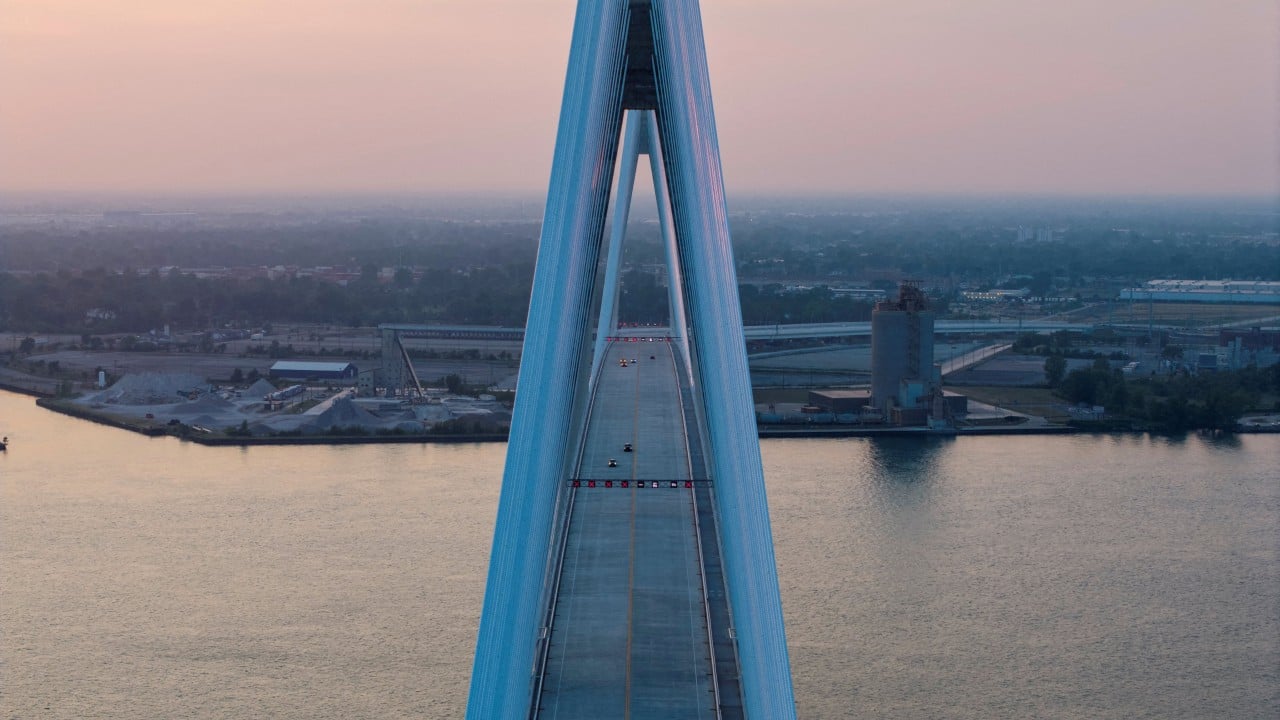
The concrete has barely cured on the Gordie Howe International Bridge, a multi-billion-dollar cable-stayed link spanning the Detroit River between Michigan and Ontario. Yet the grand architecture of the region's newest border artery is already overshadowed by a bruising geopolitical reality.
When traffic finally began flowing across the span, it did so under the suffocating shadow of a renewed economic clash. Washington and Ottawa are locked in a high-stakes trade dispute featuring heavy tariffs on cross-border goods. For decades, the Windsor-Detroit corridor has handled roughly a third of all merchandise trade between the United States and Canada. A structural bottleneck of this magnitude demanded an engineering solution. Instead, the ribbon-cutting arrived amid canceled joint ceremonies and presidential posturing, proving that concrete and steel cannot insulate international commerce from political hostility. Expanding on this theme, you can also read: Why Every Headline About Election Violence in Disputed Territories is Completely Backwards.
The Anatomy of a Chokepoint
For nearly a century, supply chains connecting the industrial heartlands of North America relied on a fragile monopoly. The aging Ambassador Bridge and the cramped Detroit-Windsor Tunnel carried the heavy burden of automotive manufacturing logistics, electronics, and raw materials.
Delays at these legacy crossings cost logistics operators millions of dollars annually. A single stalled semi-truck could ripple through assembly plants on both sides of the border, forcing temporary shutdowns in the just-in-time manufacturing ecosystem. Economists estimate that the new six-lane crossing will claw back hundreds of thousands of hours in lost productivity for commercial truck drivers every year. Observers at BBC News have provided expertise on this matter.
The physical specifications match the grand scale of the problem. Standing with towers reaching over 700 feet, it is the longest cable-stayed bridge of its kind in North America. Modernized ports of entry equipped with expansive inspection lanes are designed to clear commercial traffic with unprecedented speed.
Political Friction and Tolls
Engineering success, however, offers no immunity to political friction. The project survived years of legal challenges, financial wrangling, and a last-minute threat from Washington to block its opening entirely.
The financial structure itself reflects a reluctant partnership. Canada financed the lion's share of the multi-billion-dollar price tag. In exchange, revenue-sharing agreements dictate how tolls will eventually feed back into both jurisdictions after capital costs are recovered. Yet, as fresh executive orders out of Washington levied heavy tariffs on a wide array of Canadian imports, the diplomatic atmosphere soured.
The diplomatic fallout was immediate. Canadian officials opted to scale back celebrations, restricting the inauguration to domestic milestones while U.S. leaders dismissed the snub on digital platforms. The bridge is open, but the geopolitical friction remains palpable.
The Tariff Counterweight
Smooth asphalt and efficient customs plazas solve logistical friction, but they cannot manufacture demand. Analysts tracking North American trade flows point out a stark paradox in the timing of the opening.
Consider a hypothetical logistics firm moving automotive components from an Ontario plant to a final assembly line in Ohio. Under the newly minted infrastructure, the physical transit across the river will be faster, cleaner, and less prone to urban traffic bottlenecks. The driver saves time. Fuel consumption drops.
Yet, if punitive tariffs apply a steep tax on the materials inside that trailer, the economic advantage of the faster route evaporates. Infrastructure efficiency is a multiplier. Tariffs are a divisor. When deployed simultaneously, they cancel each other out, leaving businesses paying higher border costs regardless of how many lanes are painted on the pavement.
Supply Chain Realities
The opening of this corridor forces a hard look at the vulnerability of cross-border interdependencies. For generations, the U.S.-Canada border operated under the assumption of progressive integration. Trade agreements lowered barriers, and private enterprise optimized supply chains under the premise of frictionless movement.
That era has evolved into something transactional and defensive. Border crossings are no longer treated merely as civic projects for regional development. They are leverage points in broader economic negotiations.
As commercial fleets transition to the new span, they do so with a clear understanding that the rules of the road can change overnight. The physical bridge is built to last a century. The trade policies governing the goods rolling across it rarely last a presidential term.