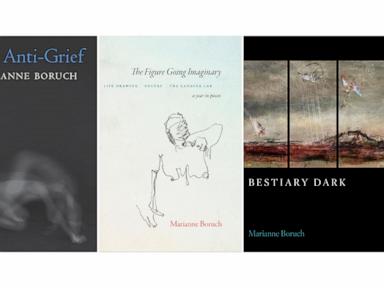
The literary establishment is terrified. You can smell the panic in every gushing press release and every oversized novelty check. When Poets & Writers announced Marianne Boruch as the winner of the $100,000 Jackson Poetry Prize, the judges didn't just praise her work. They attempted to build a fortress around it. They framed her "human genius" as a final stand against the encroaching tide of machine intelligence.
It’s a romantic narrative. It’s also deeply delusional. Don't forget to check out our previous article on this related article.
By positioning poetry as the "anti-AI" medium, the gatekeepers of high culture are doing exactly what they accuse the algorithms of doing: flattening the complexity of art into a marketing gimmick. They are treating the human spirit like a proprietary software license that is about to expire. The "lazy consensus" here is that AI is a threat to the soul of poetry. The reality is that AI is merely a mirror reflecting how formulaic and predictable much of our "soulful" contemporary poetry has actually become.
The Myth of the Uncomputable Spark
The judges for the Jackson Prize spoke of Boruch’s work as having a "wildness" that machines can’t replicate. This is the classic "God in the gaps" argument applied to syntax. Whenever we find a metaphor we can’t immediately deconstruct, we label it "divine" or "human." If you want more about the history here, GQ provides an excellent breakdown.
I have sat in editorial rooms for twenty years. I have watched the "human spark" be manufactured through MFA workshops that function like biological neural networks. We teach poets to use specific linguistic "glitches," to lean into a curated brand of vulnerability, and to follow structural templates that are every bit as rigid as a Python script.
When an industry insider tells you that art is uncomputable, they are usually trying to protect their valuation. The Jackson Prize isn't just an award; it’s a price floor for the human ego. By awarding $100,000 to "humanity," the judges are trying to maintain a monopoly on "meaning."
Why Your Favorite Poet Is Just A Very Slow LLM
Let’s get technical for a second. Large Language Models (LLMs) operate on probabilistic token prediction. They look at what has been said and calculate the most likely—or most aesthetically pleasing—next word based on a massive corpus.
Now, look at the career of a poet like Marianne Boruch. She has spent decades consuming the English canon, the midwestern vernacular, and the specific rhythms of her predecessors. Her brain is a biological processor that has been "trained" on a specific dataset. Her "genius" is her ability to perform highly sophisticated, non-linear cross-referencing of that data.
Is there a difference in degree? Yes. Is there a difference in kind? That is where the argument falls apart.
The literary world wants to believe that "intent" is the magic ingredient. They argue that because a machine doesn't feel the grief it writes about, the poem is empty. This is a fundamental misunderstanding of how the reader's mind works.
The Affective Fallacy 2.0
In the mid-20th century, W.K. Wimsatt and Monroe Beardsley gave us the "Affective Fallacy"—the error of evaluating a poem based on its emotional effect on the reader. Today, we are suffering from the "Intentional Fallacy 2.0." We believe the value of the text is derived from the biological suffering of the author.
If you read a devastating poem about a dying bird and find out later it was written by a prompt, does your heart suddenly un-break? If it does, you aren't a lover of poetry; you are a lover of biography. You are consuming a person, not a piece of art.
The Poetry Industry Is Fostering Its Own Obsolescence
By retreating into "humanism," the poetry world is making itself a museum piece.
When the Jackson Prize judges emphasize that Boruch’s work "could only be written by a human," they are inadvertently narrowing the scope of what poetry can be. They are saying that poetry must be idiosyncratic, slightly messy, and rooted in physical sensory experience.
This is a defensive crouch. It’s the same thing portrait painters did when the camera arrived. They didn't beat the camera by being more realistic; they survived by becoming Impressionists. They fled into abstraction.
The problem is that poetry is already abstract. It is already the "Impressionism" of language. There is nowhere left for the "human" to hide except in the realm of raw, unmediated experience—and even that is being mapped.
The Problem With "Wildness"
The judges praised Boruch's "wildness." In the context of the Jackson Prize, "wildness" is usually code for "syntax that doesn't immediately make sense but feels like it should."
Imagine a scenario where we feed an LLM nothing but the last fifty years of Jackson Prize winners. Within three seconds, it will produce "wildness" that is indistinguishable from the avant-garde. If your definition of human genius is just "unpredictable word choice," you have already lost the war. You’ve defined yourself by a metric that computers are specifically designed to optimize.
The Brutal Truth About The $100,000 Shield
Let’s talk about the money. $100,000 is a significant sum in a field where most practitioners consider a $500 honorarium a windfall.
This prize money acts as a firewall. It’s an attempt to create a "Veblen good"—a product where the demand increases as the price increases because it functions as a status symbol. By attaching a six-figure sum to "human poetry," the organizers are trying to convince the public that this specific type of labor is still valuable.
But you can’t subsidize relevance.
I’ve seen literary journals spend thousands on "anti-AI" manifestos while their readership numbers drop into the low hundreds. They are talking to themselves in a burning building. The "consensus" says we need to protect poets from machines. The "nuance" is that we need to protect poetry from poets who have become too predictable for their own good.
People Also Ask: (And Why They're Wrong)
Can AI write a poem that wins the Jackson Prize?
Not yet, but only because the rules explicitly forbid it. If we conducted a double-blind test where judges had to pick between a mid-tier MFA graduate and a fine-tuned Claude 3.5 Sonnet instance, the results would be a bloodbath for the humans. The only thing keeping AI out of the winner's circle is a "Proof of Biology" requirement.
Does AI lack the "soul" required for great art?
"Soul" is a placeholder for "patterns we haven't mapped yet." In the 1800s, people thought the soul resided in the breath. Now we think it resides in the ability to write a poignant line about a kitchen table. Both are wrong.
Is Marianne Boruch a great poet?
Yes. She is an incredible technician of the English language. But she is great because of her mastery of structure, sound, and association—all things that are fundamentally mathematical. Celebrating her as a "victory over the machine" insults her actual skill. It turns her into a mascot for a Luddite tantrum.
The Downside of This Perspective
If we accept that there is no "magic" in human writing, we lose the comfort of being special. We have to admit that art is a high-level data processing task. That is a bitter pill for a community built on the idea of the "muse."
But the upside is far more interesting.
If we stop trying to out-human the machines, we can start using them to push language into territories that a biological brain could never conceive. Instead of using AI to "mimic" Marianne Boruch, we should be asking what kind of poetry is possible when you have a memory that spans every book ever written and a processing speed that can calculate ten thousand metaphors a second.
The Jackson Prize judges are looking backward, trying to preserve a 20th-century definition of the "individual." They are treating poetry like a closed system.
Stop Fighting the Tool and Start Breaking the Form
The real "human" move isn't to write a poem that a machine can't write. It’s to write a poem that makes the machine irrelevant.
We don't need more "wildness" that fits neatly into a $100,000 prize category. We need a complete demolition of the "poetic" as we know it. If the machine can do the "sensitive observation of nature" bit, then let the machine have it. It was becoming a cliché anyway.
The literary world is currently in a state of "performative humanity." They are over-emphasizing their quirks, their flaws, and their "organic" roots to prove they aren't bots. It’s the artistic equivalent of putting a "Handmade" sticker on a factory-produced chair.
The real genius isn't in the person holding the pen. It’s in the disruption of the signal. If Marianne Boruch is a genius, it’s because she disrupts our expectations of language. That is a technical feat, not a mystical one.
The judges want to save the "human." They should be trying to save the art. And sometimes, saving the art means admitting that the "human" part was the least interesting thing about it.
The check has been signed. The speeches have been made. The fortress is built. But the walls are made of paper, and the "AI age" isn't a storm—it’s just the lights coming on in a room where we’ve been pretending to be alone for a long time.
Stop looking for the soul. Start looking at the code.


