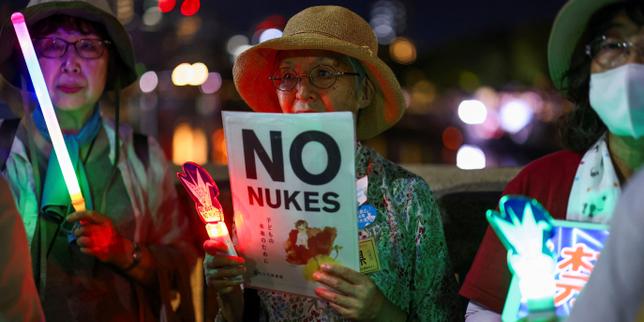
Annual commemorations in Hiroshima and Nagasaki trigger a recurring friction point within Japanese domestic politics, yet the structural mechanics governing Tokyo's security calculations rarely shift beneath the surface ritual. Every August, municipal memorial services serve as public platforms for statements favoring pacifism and non-proliferation, driven by the unique psychological weight of atomic victimization. Simultaneously, defense planners in Nagatacho operate under an accelerating threat matrix defined by North Korean ballistic developments, a modernizing Chinese nuclear arsenal, and a Russian strategic posture that has degraded European and Asian security architectures alike. This dual reality creates a permanent tension between constitutional pacifism and the ruthless arithmetic of great power competition.
The Tripartite Friction Matrix
To understand why Japan's nuclear debate remains trapped in a circular dialogue, analysts must isolate the three distinct constraints that dictate national security policy. These variables operate in tension, preventing any unilateral shift toward nuclear acquisition or a complete reliance on absolute disarmament.
The Constitutional and Legal Boundary
Article 9 of the postwar constitution renounces war as a sovereign right and prohibits the maintenance of land, sea, and air forces, along with other war potential. While successive governments have reinterpreted this text to permit self-defense forces, the domestic legal consensus interprets the acquisition of strategic nuclear weapons as exceeding the threshold of minimum necessary defense.
Revising the constitution requires a two-thirds majority in both houses of the Diet followed by a majority in a national referendum. This political hurdle functions as a structural veto point. Public sentiment, shaped by decades of anti-nuclear education and the collective memory of 1945, historically resists any legislative erosion of the pacifist framework.
The Nuclear Umbrella Mechanics
Japan relies entirely on the extended nuclear deterrence provided by the United States. This arrangement substitutes an American security guarantee for a domestic arsenal, lowering Tokyo's direct defense expenditure while tying its strategic fate to Washington's credibility.
This mechanism introduces two distinct vulnerabilities. First, alliance dependency creates moral hazard and credibility traps. If adversary capabilities expand to threaten the American homeland, Tokyo must calculate whether Washington would risk Seattle or Los Angeles to defend regional sea lanes or distant islands. Second, domestic political shifts in the United States periodically inject uncertainty into the reliability of bilateral security treaties, forcing Japanese planners to model worst-case scenarios where the umbrella fronds begin to close.
The Industrial and Technological Baseline
Japan possesses a paradoxically advanced civil nuclear infrastructure alongside strict legal prohibitions against weaponization. The nation maintains an extensive fleet of commercial reactors, advanced aerospace engineering capabilities, and complete mastery of the nuclear fuel cycle, including plutonium separation technologies.
This technical posture defines a threshold state. Tokyo does not require decades of basic research to build a functional warhead; its latent deterrence capability is among the most formidable in the world. The gap between civil capacity and military application is purely political, not technical. Consequently, international monitors and regional adversaries view Japanese technological infrastructure through a strategic lens, recognizing that policy changes could drastically compress breakout timelines.
The Cost Function of Status Quo Maintenance
Maintaining the current security posture is not a static choice; it involves escalating economic and strategic expenditures. As regional parity shifts away from Western dominance, the cost of relying solely on conventional self-defense coupled with an external nuclear guarantee rises exponentially.
Threat Matrix Acceleration
       │
       ▼
Rising Cost of Extended Deterrence ──► Alliance Friction & Credibility Stress
       │
       ▼
Latent Capability Pressure ──────────► Regional Arms Racing Dynamics
Regional adversaries treat Japan's pacifist posture as an asymmetry to be exploited through gray-zone coercion. Because Tokyo binds its own hands regarding offensive strategic capabilities, Beijing and Pyongyang can press territorial claims in the East China Sea or conduct missile tests over the Japanese archipelago with the confidence that Tokyo's response will remain bounded by self-imposed escalation limits.
This dynamic forces Japanese defense budgets upward despite constitutional constraints. Tokyo has committed to significant defense spending increases, targeting two percent of gross domestic product to acquire counterstrike capabilities, long-range cruise missiles, and advanced integrated air and missile defense systems. These expenditures represent an intermediate strategy: purchasing conventional standoff capabilities to raise the cost of aggression without crossing the nuclear Rubicon.
Strategic Realities of the Nuclear Threshold
Public debates that frame the issue as a binary choice between total pacifism and immediate weaponization misunderstand the mechanics of modern statecraft. Tokyo’s leadership navigates a spectrum of nuanced postures that do not require building an independent arsenal to achieve strategic effect.
Extended Deterrence Dialogues
The primary diplomatic mechanism for managing nuclear anxiety involves strengthening bilateral consultation frameworks with Washington. By institutionalizing joint decision-making processes regarding nuclear planning, Tokyo attempts to reduce the credibility gap inherent in extended deterrence. These mechanisms ensure that American strategic planners incorporate Japanese threat perceptions into their operational scenarios, rendering the security guarantee more tangible.
Non-Proliferation Normative Power
Japan utilizes its status as the sole victim of wartime atomic attacks as a potent diplomatic asset. By championing global non-proliferation initiatives within international bodies, Tokyo maintains moral authority and reassures regional neighbors that its advanced nuclear technology remains strictly pacified. Abandoning this posture would instantly trigger severe diplomatic blowback, alienate key trading partners, and justify aggressive countermeasures from Beijing and Seoul.
Strategic Ambiguity and Latency Management
Maintaining high-level civil nuclear competence while explicitly forbidding weaponization creates an implicit posture of strategic ambiguity. Regional actors are well aware of Japanese industrial capacity. This technical reality acts as an invisible weight in diplomatic calculations, serving as a backstop against extreme coercion without inviting the severe economic and political sanctions associated with an overt nuclear weapons program.
The Structural Trajectory
The domestic friction witnessed during every anniversary of the atomic bombings reflects a society grappling with the contradictions of modern geopolitics. The pacifist ideal established in the aftermath of total defeat conflicts directly with an international system characterized by returning multipolarity and eroding arms control treaties.
Tokyo will continue to thread this needle through incremental adaptations rather than revolutionary shifts. The state will expand its conventional counterstrike options, deepen integration with allied nuclear planning, and reinforce its latent technological capabilities while maintaining the formal architecture of its three non-nuclear principles. The underlying calculus remains unchanged: the systemic costs of acquiring an independent nuclear arsenal—ranging from diplomatic isolation to regional arms races—currently outweigh the strategic benefits, leaving extended deterrence and conventional hardening as the only viable path forward within the constraints of the international order.