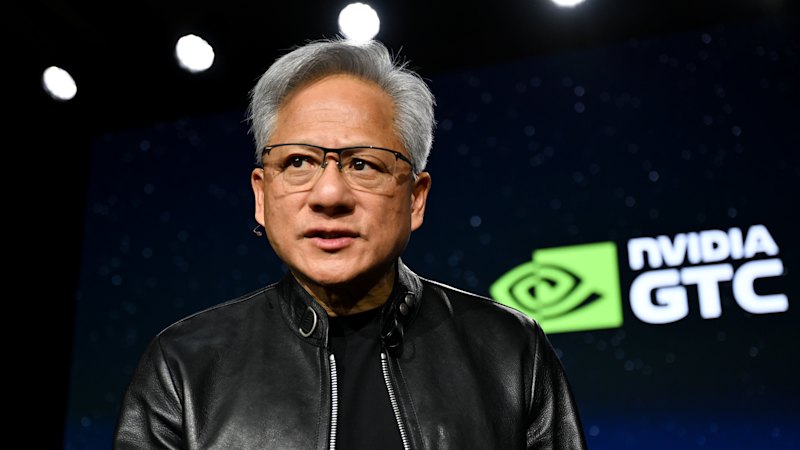
Headlines love a dramatic return. They crave the narrative arc of the fallen executive, the boardroom coup, the crisis that forces a founder back into the captain's chair. Financial media recently buzzed with a manufactured panic regarding Nvidia, spinning a yarn about Jensen Huang stepping back into a post he never actually vacated. The reality on the ground in Silicon Valley and Taipei is far more mundane and significantly more intimidating for competitors: the man has been steering every major decision at the chip giant since 1993, and no title change was ever going to alter that dynamic.
Understanding Nvidia's dominance requires stripping away the soap opera manufactured by hasty news cycles. Huang did not return because of a scandal or an ouster. He has maintained continuous control as chief executive officer for over three decades, turning a company originally designed for 3D graphics rendering into the absolute bedrock of modern artificial intelligence infrastructure. When analysts talk about leadership stability in the technology sector, Nvidia stands alone as an anomaly. Most founders get pushed out by venture capitalists or step aside for professional managers within a decade. Huang remained, embedding himself so deeply into the silicon architecture and software ecosystem that the company and the man are functionally indistinguishable.
The source of the recent confusion stems from corporate governance semantics and a misunderstanding of how massive hardware ecosystems operate. Observers often mistake corporate restructuring or routine executive title shuffles for boardroom drama. In a company where research and development timelines span five to ten years, constant leadership is a strategic necessity. You do not swap out the pilot while flying through a technological storm that happens once a century. The transition from traditional central processing units to parallel computing graphics processing units took twenty years of deliberate losses, software evangelism, and stubborn belief. A CEO who did not bleed for the CUDA programming language in the mid-2000s would have panicked and abandoned it during the lean quarters. Huang stayed the course because he understood the horizon.
Competitors in the enterprise hardware space often operate under short-term pressures from Wall Street quarterly earnings reports. They rotate executives every few years, optimizing for immediate margin expansion rather than foundational platform shifts. This structural difference explains why legacy technology giants struggle to mount a credible challenge to Nvidia's accelerated computing monopoly. Building a chip is expensive. Building the software stack that developers use to write code for that chip is generational work. CUDA turned hardware into an ecosystem, and Huang protected that ecosystem fiercely, refusing to let short-term profit motives fracture developer loyalty.
Look at the economics of the current artificial intelligence boom. Hyperscalers like Microsoft, Google, Meta, and Amazon buy billions of dollars worth of H100 and Blackwell chips not merely because the raw floating-point performance numbers look impressive on a spreadsheet. They buy them because migrating away from the established software stack incurs immense technical debt and operational risk. Huang engineered this lock-in long before generative artificial intelligence became a household term. While critics occasionally point to high gross margins as evidence of monopolistic gouging, enterprise buyers are paying for reliability, backward compatibility, and an army of support engineers who ensure multi-billion-dollar data centers actually function at scale.
The risks facing Nvidia are real, but they are external, not internal. Geopolitical tensions surrounding semiconductor fabrication in Taiwan represent a permanent shadow over the entire tech sector. Taiwan Semiconductor Manufacturing Company remains the sole foundry capable of producing the bleeding-edge nodes required for Nvidia's most advanced accelerators. Diversifying manufacturing geographical footprints takes years and billions of dollars, a reality that no amount of executive reshuffling can accelerate overnight. Furthermore, major cloud providers are aggressively designing their own custom silicon to reduce their reliance on external hardware suppliers and improve their own profit margins. These application-specific integrated circuits will chip away at the margins of specific workloads, even if they cannot immediately replicate the general-purpose flexibility of a modern graphics processing unit.
Yet, betting against a management team that saw the artificial intelligence wave coming two decades before the market noticed is a losing proposition. The corporate structures built under Huang's watch are designed for relentless iteration. Every year brings a new architecture, a tighter integration between hardware and software, and a broader expansion into enterprise software licensing. The drama surrounding executive posts is noise generated by observers who mistake corporate filings for operational reality. The man at the helm has not changed, and neither has the ruthless focus on owning the computational substrate of the next industrial revolution.