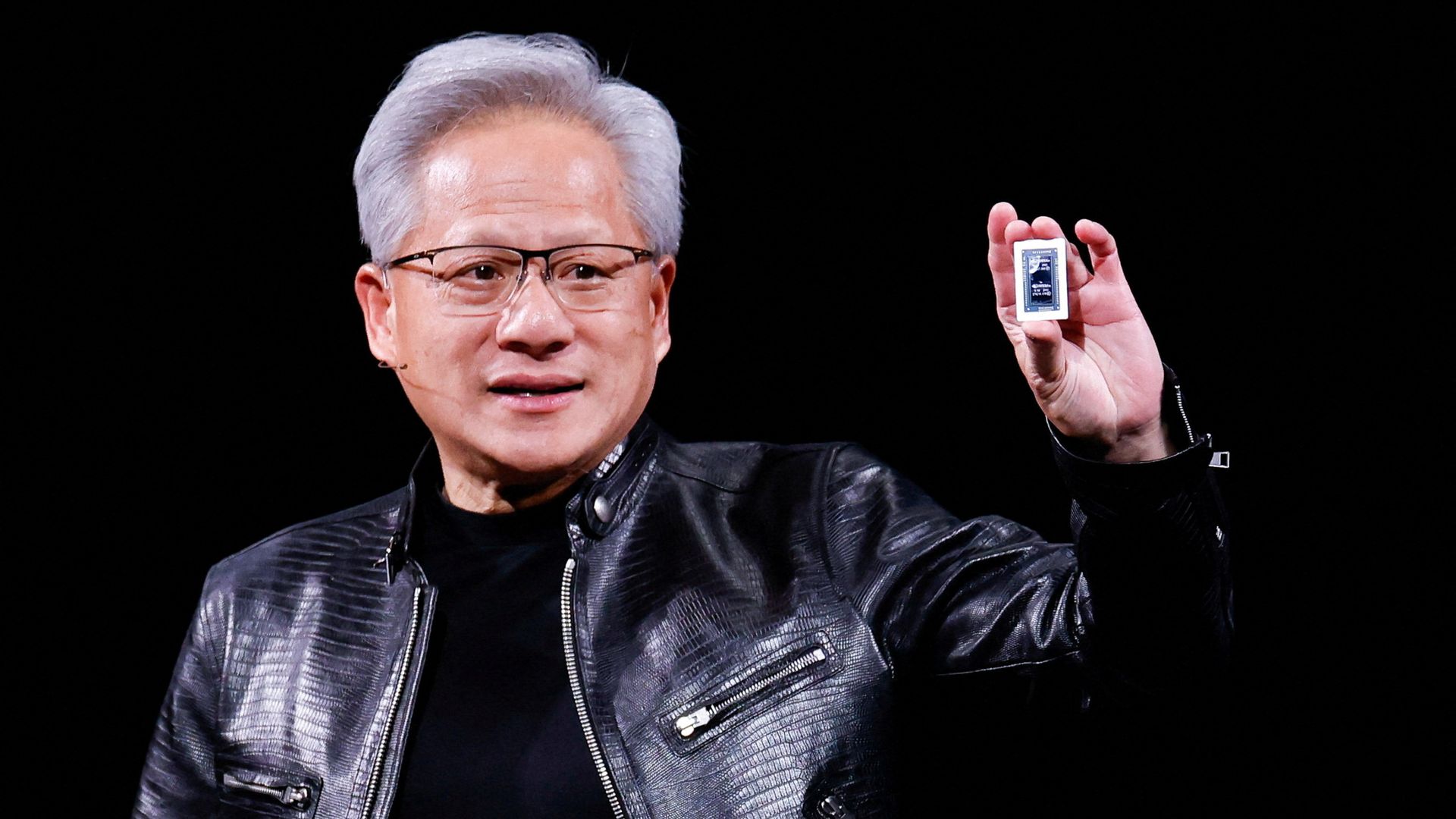
Wall Street cheered when Jensen Huang recently stated he would be "honoured" to keep running Nvidia for another decade, or even return to the role if he ever stepped away. Analysts treated the remark like a victory lap. Institutional investors breathed a collective sigh of relief, assuming the architect of the artificial intelligence boom had just guaranteed another ten years of uninterrupted dominance.
They are celebrating a massive governance failure.
The standard business press loves a founder-hero narrative. In their eyes, a charismatic visionary clinging to the wheel indefinitely is the gold standard of stability. They look at Nvidia’s multi-trillion-dollar valuation and conclude that the man in the leather jacket is irreplaceable. That exact word—irreplaceable—is what should keep every single shareholder awake at night. When a company’s entire market value hinges on the continued pulse and stamina of one executive in his sixties, you do not have a resilient enterprise. You have a single point of failure dressed up as a tech giant.
The Cult of the Founder is a Governance Trap
I have spent twenty years watching boards of directors get hypnotized by charismatic founders, and the ending is always the same. When a leader delivers historic returns, the board stops doing its primary job. Instead of demanding a clear succession pipeline, directors become cheerleaders. They confuse past genius with permanent invincibility.
Look at the mechanics of a healthy mega-cap corporation. True institutional strength means the machine runs regardless of who sits in the corner office. Look at Apple. When Tim Cook took over from Steve Jobs, skeptics predicted immediate collapse. Instead, Cook turned Apple into a logistics and services juggernaut because Jobs spent his final years building an executive bench capable of operating without him.
Nvidia has no Tim Cook waiting in the wings. Better yet, Nvidia doesn't even have a public conversation about who could possibly fill those shoes.
When Huang casually remarks that he has no plans to retire and would happily come back even if he did, he is signaling that no successor exists. He is admitting, without saying the words aloud, that the organizational architecture of Nvidia cannot survive without his direct intervention. In corporate finance, we call this key-person risk. Usually, it applies to small startups or boutique hedge funds. Seeing it at the top of the S&P 500 is unprecedented, and the market is completely mispricing the danger.
Why Flat Organizations Break at Scale
To understand why Huang cannot leave, you have to look at how he runs the building. Huang famously boasts about having roughly fifty or sixty direct reports. He does not believe in traditional middle management layers. He skips one-on-one meetings, prefers group problem-solving, and micromanages product roadmaps down to the silicon level.
In a hyper-growth phase, this structure eliminates bureaucracy. Information travels at the speed of light from the engineering floor straight to the CEO. Bad ideas die fast. Good ideas get funded before competitors even finish their quarterly reviews.
Here is the catch nobody on financial television wants to discuss: a sixty-person direct-report structure only works if the person at the top possesses superhuman cognitive bandwidth and an obsessive, eighty-hour-a-week work ethic. You cannot hand a sixty-node organizational chart to a normal executive. If Huang steps down tomorrow, whoever takes his place will either suffer an immediate nervous breakdown or spend three years hiring vice presidents just to create a normal chain of command. During those three years of internal restructuring, hungry competitors will eat Nvidia alive.
The Boomerang CEO Disaster Nobody Talks About
The second half of Huang’s comment—that he would be honored to return as CEO—touches on one of the worst trends in corporate history. The boomerang founder rarely saves the day. Usually, their return confirms that they failed to build a real company the first time around.
Consider the actual track record of legendary founders coming back to rescue their creations:
- Howard Schultz at Starbucks: Returned multiple times, fought unionization efforts, introduced bizarre olive-oil coffee drinks, and left the company facing stagnant same-store sales and an identity crisis.
- Bob Iger at Disney: Came back after hand-picking his own successor, Bob Chapek, only to spend years publicly undoing Chapek’s decisions while Disney’s stock languished and streaming losses mounted.
- Michael Dell at Dell: Had to take the entire company private in a grueling multi-billion-dollar leveraged buyout just to fix the strategic drift that happened while he was away.
- Jack Dorsey at Twitter: Returned as a part-time CEO while simultaneously running Square, resulting in years of product stagnation that eventually left the platform vulnerable to a hostile takeover.
Steve Jobs is the lone exception that proves the rule, and even Jobs had to completely gut Apple’s product line and rely on a radical cash injection from Microsoft to survive his return. Founding a company requires wartime aggression and intuition. Running a mature, multi-trillion-dollar monopoly requires peacetime diplomacy, regulatory navigation, and institutional delegation. Very few humans possess both skill sets, and almost none can maintain them across four decades.
Dismantling the Market's Favorite Myths
Whenever you point out the fragility of Nvidia’s leadership structure, retail investors and bullish analysts repeat the same three talking points. Every single one of them falls apart under basic scrutiny.
"But look at Warren Buffett at Berkshire Hathaway!"
This is the laziest comparison in modern finance. Warren Buffett is a capital allocator, not an operational semiconductor executive. Buffett sits in Omaha, reads annual reports, and decides where to deploy cash across seventy completely autonomous subsidiaries. If Buffett takes a month off, Geico still sells car insurance and BNSF still runs freight trains.
Jensen Huang is not allocating passive capital. He is actively refereeing supply chain bottlenecks at TSMC, dictating software updates for CUDA, and personally negotiating multi-billion-dollar cluster deployments with hyperscalers like Microsoft and Meta. Comparing a passive holding company to a hyper-complex hardware-software engineering firm is pure financial illiteracy.
"Nvidia's moat is CUDA, not Jensen."
Make no mistake: the CUDA software ecosystem is one of the greatest competitive moats ever built in technology. Millions of developers write code specifically for Nvidia’s architecture, making switching costs brutally high.
However, moats do not maintain themselves. Right now, Google, Amazon, Microsoft, and Meta are spending tens of billions of dollars designing custom silicon—TPUs, Trainium, Maia—specifically to break free from Nvidia’s pricing power. Meanwhile, open-source software layers like PyTorch and OpenAI’s Triton are actively abstracting away the hardware layer, making it easier for developers to run AI models on non-Nvidia chips.
Defending CUDA requires relentless, aggressive strategic pivots every single product cycle. It requires a leader willing to cannibalize their own high-margin products before a rival does. Without Huang forcing the company to move at breakneck speed, CUDA slowly turns from a fortress into a gilded cage.
"He loves his job, so he will never leave."
Passion does not beat biology. Huang was born in 1963. Expecting a human being in his late sixties or seventies to maintain the exact same cognitive sharpness, travel schedule, and stress tolerance he had at forty is magical thinking. Even if his mind stays sharp as a tack, energy is a finite resource. At some point, the board has to govern for reality rather than optimism.
Imagine a Scenario Where Reality Hits
Let us run a quick thought experiment. Imagine a scenario where, eighteen months from now, Huang announces he is stepping back to become Executive Chairman due to a sudden, non-life-threatening health issue that requires him to cut his workload by seventy percent.
What happens on Monday morning?
First, roughly half a trillion dollars evaporates from Nvidia’s market cap before the opening bell even rings. Not because the chips suddenly stopped working, and not because demand for AI compute vanished overnight. The stock crashes because the market suddenly realizes nobody outside Santa Clara knows the names of Nvidia’s top three operational lieutenants.
Second, every major cloud provider—hyperscalers who already resent paying eighty percent gross margins for Nvidia GPUs—immediately uses the leadership vacuum to accelerate their internal chip programs. Procurement teams delay H200 and Blackwell orders by a quarter just to see if the new leadership blinks on pricing.
Third, internal politics erupt inside Nvidia. Remember those sixty direct reports? When a dominant alpha founder steps aside, the executives who spent twenty years competing for his approval suddenly start competing with each other for the throne. Engineering talent starts fielding eight-figure offers from rival startups and Big Tech firms.
This is not science fiction. This is the exact playbook of what happens when a founder refuses to build an exit ramp.
The Uncomfortable Truth About Founder Worship
To be completely fair, there is a valid counter-argument to my thesis. If Huang had stepped down five years ago to install a safe, traditional corporate CEO, Nvidia almost certainly would not be worth what it is today. A traditional MBA-trained executive would have balked at the massive R&D bets required to pivot from video game graphics to data center AI. A cautious boardroom operator would have prioritized short-term margin protection over building out the full-stack networking and software architecture that made Nvidia untouchable.
You cannot have the historic upside of a visionary founder without accepting the terrifying downside of their eventual departure. That is the Faustian bargain every investor makes when they buy into a founder-led monopoly.
The problem is not that Huang built the company this way. The problem is that Wall Street is pretending the bill will never come due.
What Smart Operators and Investors Actually Do
If you are an executive running a high-growth company, or an investor holding massive exposure to founder-led tech stocks, you need to stop drinking the Kool-Aid. Loyalty to a brilliant leader is great; blindness to structural risk is fatal.
1. Audit the bench, not the CEO.
Never judge a company's durability by the brilliance of its founder. Look one level down. If you cannot name the heads of engineering, operations, and finance without using a search engine, the company has a fatal succession flaw. In truly durable organizations—think Microsoft under Satya Nadella or Google under Sundar Pichai—the divisional leaders are household names in the industry long before the top job opens up.
2. Penalize flat hierarchies at scale.
If a company generates over fifty billion dollars in annual revenue and the CEO still brag about having no middle management, treat it as a governance discount, not a feature. Flat hierarchies create speed in startups and fragility in giants. Demand to see clear operational silos with autonomous leaders who hold real profit-and-loss responsibility.
3. Watch the board's behavior, not their press releases.
A real board of directors forces a founder to train their replacement at least five years before retirement is even on the horizon. When a board allows a CEO in his sixties to joke about staying forever without naming a clear number-two executive, that board has been captured. They are acting as employees of the CEO rather than fiduciaries for the shareholders.
4. Price in the transition tax.
Every single founder-led empire eventually pays a transition tax when the creator leaves. Microsoft paid it for a decade under Steve Ballmer before Nadella fixed the culture. Apple paid it in the nineties before Jobs returned, and paid a smaller version of it in valuation multiples during Cook's first two years. Amazon is paying it right now as Andy Jassy tries to navigate post-Bezos bureaucracy. Nvidia’s transition tax is currently sitting at zero in the models of every major investment bank. When that tax finally gets collected, the adjustment will be violent.
Jensen Huang has earned every ounce of praise he gets for turning a struggling graphics card maker into the most important hardware company on Earth. His execution over the past decade belongs in the business hall of fame.
Right now, however, his refusal to step back—and his casual willingness to keep the keys forever—is not a sign of strength. It is proof that the most valuable company in the world is still just one man holding up the sky. Stop applauding the spectacle and start looking at what happens the day his arms get tired.