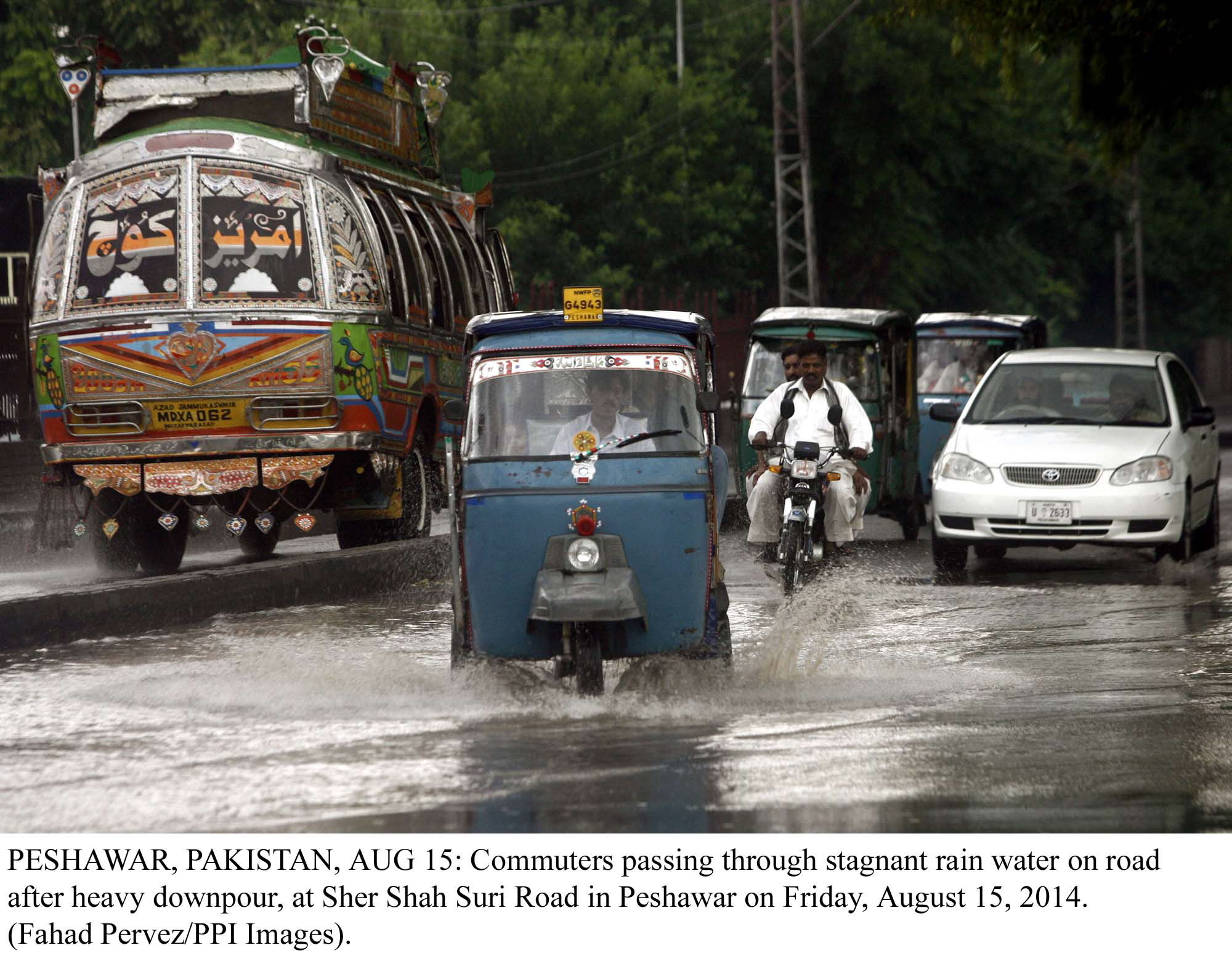
Nineteen people did not die because of "heavy showers." They died because of a systemic refusal to acknowledge basic physics and urban engineering.
The media loves the "Act of God" narrative. It’s convenient. It’s poetic. It’s also a lie. Calling these fatalities a result of a thunderstorm is like saying a man fell to his death because of gravity rather than the fact that someone pushed him off a ledge. When Karachi floods and the body count rises, we aren't looking at a climate catastrophe; we are looking at the predictable, mathematical outcome of treating a megacity like a disposable parking lot.
The Myth of the "Unprecedented" Rainfall
Every time the clouds darken over the Arabian Sea, city officials reach for the same script: "The rainfall was unprecedented."
Let’s look at the data. Karachi’s drainage system is allegedly designed to handle a specific volume of water, but that "design" exists only in dusty blueprints from the 1960s. The reality is that the city’s natural drainage veins—the nullahs—have been strangled.
In a functional ecosystem, water follows the path of least resistance. In Karachi, that path is blocked by concrete encroachments, informal settlements, and, more importantly, high-end real estate developments built directly on reclaimed land and ancient waterways. You cannot pave over the earth’s throat and then act surprised when it chokes.
When $100mm$ of rain falls on a city of 20 million people, it isn't a crisis. It’s a Tuesday in Mumbai or Bangkok. The difference is that those cities have stopped pretending that water is an "unexpected visitor." Karachi treats rain like a surprise party it forgot to plan for, despite the fact that the monsoon happens every single year.
Electrocution is Not a Weather Event
A significant portion of the "rain-related deaths" in Karachi are actually electrocutions. Read that again.
People are dying because the power utility infrastructure is a lethal web of exposed wires and poorly grounded transformers. To blame a thunderstorm for an electrocution is a masterpiece of corporate gaslighting. If a wire falls and kills a teenager on a motorbike, the rain didn't kill him. The failure to maintain a $220V$ grid killed him.
The standard response is to shut off power to the entire city the moment a drop falls. This "precautionary" measure is actually an admission of guilt. The utility providers know their infrastructure is so fragile and dangerous that the only way to keep it from killing people is to make it useless. We have accepted a "landscape" where the price of safety is total darkness. It is a pathetic trade-off.
The Concrete Sump Pump Fallacy
Urban planners in Pakistan are obsessed with "mega-projects." They want deeper drains, bigger pumps, and more concrete. They are solving the wrong problem.
The problem isn't that we don't have enough drains. The problem is that we have destroyed the soil’s ability to absorb a single drop of water. This is the Concrete Sump Pump Fallacy: the belief that you can out-engineer nature by building bigger pipes while simultaneously removing every square inch of permeable ground.
If you cover a city in non-porous surfaces, you create a literal bowl. No amount of pumping can fix a bowl that has no exit.
Why Your Infrastructure Strategy is Failing:
- Siltation over Sophistication: You can build a billion-dollar drain, but if it is filled with plastic bags and solid waste, it is just a very expensive, long trash can.
- Disconnected Nodes: Karachi’s drainage "network" isn't a network. It’s a series of disconnected segments that often lead to nowhere or, worse, back into residential neighborhoods because the elevation levels were calculated by people who seemingly don't understand how water flows downhill.
- The Coastal Paradox: Building massive sea-front developments prevents the city’s internal water from reaching the ocean. We are quite literally walling ourselves in.
The Ethics of the "Poor Infrastructure" Excuse
We often hear that Karachi is too broke to fix this. That is a convenient fiction. Karachi generates the lion's share of Pakistan’s tax revenue. The money exists. The "battle scars" of previous administrative failures show that the funds are consistently diverted into vanity projects—flyovers and underpasses—that look good in photos but contribute to the flooding problem by further disrupting natural water flow.
We choose to build bridges for cars instead of arteries for water. This is a value judgment. We have decided that a 10-minute shorter commute for the elite is worth the periodic drowning of the working class.
Stop Looking at the Sky, Look at the Ground
The "People Also Ask" sections of the internet are filled with queries like "How to stay safe during Karachi rains?"
The honest, brutal answer? You can't. Not as long as the city’s basic geometry is flawed.
If you want to stop the deaths, you don't need "weather alerts." You need a radical, violent reclamation of the city’s waterways. This means tearing down the illegal wedding halls, the elite housing societies built on floodplains, and the industrial units that dump solid waste into the drains.
The Contrarian Roadmap to a Dry City:
- Permeable Pavement: Stop using standard asphalt. Use porous materials that allow the earth to breathe and drink.
- Decentralized Power: Move away from a centralized, overhead wire grid that turns every puddle into a potential death trap. Solar and buried lines aren't a luxury; they are a survival requirement.
- Mandatory Rainwater Harvesting: Every new construction should be legally required to store its own runoff. If you take up the ground's space, you take the ground's responsibility.
The Real Cost of "Resilience"
Politicians love to praise the "resilience" of Karachi’s citizens. It’s a disgusting tactic. Calling someone resilient is just a way of telling them you have no intention of making their life easier. It’s a romanticization of suffering.
The people of Karachi aren't "resilient" because they want to be; they are resilient because they are trapped in a city that treats them as an afterthought. Nineteen lives were lost because we refuse to hold the people in charge of the "grid" and the "drains" accountable for what is essentially manslaughter by negligence.
Stop calling it a natural disaster. Start calling it what it is: an engineering crime.
Next time it rains, don't look for a cloud to blame. Look for the man who signed the permit to build a mall over a riverbed.
Stop praying for the rain to end and start demanding the concrete be ripped up.