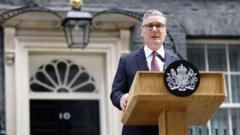
Keir Starmer stood outside 10 Downing Street on Monday morning and tried to convince the British public that he was leaving behind a stronger, fairer nation. He looked into the cameras, his voice breaking with emotion, and delivered a speech that felt remarkably detached from the mood of the country. For a prime minister who won a historic landslide victory just two years ago in July 2024, it was a staggering fall from grace. He didn't jump. He was pushed by a parliamentary party terrified of annihilation at the next general election.
When you strip away the polished rhetoric, Keir Starmer's resignation speech was a defensive defense of a broken premiership. He spent the majority of his time listing policy wins that voters simply don't feel in their day-to-day lives. He spoke about growth, rising wages, and falling NHS waiting lists. Yet, his personal approval ratings recently hit a historical low of -66 according to Ipsos polling. That is lower than Liz Truss at her absolute worst. The disconnect between what Starmer thought he achieved and what the public actually experienced is the real story of his downfall.
Voters didn't turn away because of a single scandal. They walked away because of a profound sense of emptiness. Starmer's government promised change but delivered an endless cycle of confusion, policy reversals, and absolute blankness.
The Anatomy of a Forced Exit
The speech itself followed the classic tradition of the Downing Street podium walk. Starmer began by reminding everyone of the state of the Labour Party when he took it over six years ago. He claimed he inherited a party that was politically, financially, and morally bankrupt. That part is true. He did clean up the party. He removed antisemitism, reshaped its economic policy, and made it electable again. But winning an election on the back of voter exhaustion with the Conservatives is not the same as building a lasting mandate.
Listen closely to his exact words regarding his departure. He said the question his party was asking was whether he was best placed to lead them into the next general election. He noted that he heard the answer of his parliamentary party and accepted it with good grace. That is a polite way of saying his own MPs held a knife to his back. Over half a dozen cabinet ministers had privately told him his time was up over the weekend. His inner circle began drafting this very speech on Saturday at Chequers while he looked at the brutal reality of the internal numbers.
The immediate trigger was the fallout from nationwide local elections and a series of high-profile internal revolts. The breaking point arrived when Wes Streeting resigned from the cabinet, followed closely by Andy Burnham winning the Makerfield by-election. Burnham's return to parliament handed the Labour rebels a ready-made successor. Starmer knew he was beaten.
The Achievements That Voters Didn't Feel
In his address, Starmer aggressively defended his record over the last two short years. He listed a long string of apparent triumphs. He talked about an economy growing faster than its international peers. He pointed to wages rising faster than inflation every single month of his tenure. He boasted about the fastest fall in NHS waiting lists for 17 years and the biggest improvement in rights for workers and renters in a generation.
Look at the public reaction to these claims. A YouGov snap poll released right after the speech showed that 50% of Britons believe Starmer did a poor or terrible job as prime minister. Only 15% rated him as good or great. Why the massive gap? Because macroeconomics don't pay the rent. People are still suffering through a stubborn cost-of-living crisis. Libraries are closing. Local councils are going broke. The bins aren't being emptied in dozens of towns across the country.
When Starmer stood at that podium and talked about securing investment and infrastructure, it sounded like a corporate slide deck. It didn't sound like a leader who understood that ordinary families feel poorer than they did two years ago. His government chose a path of deep caution. Just a month after taking power in 2024, he famously declared that things would get worse before they got better. He was right about the first part. The public never forgave him for that bleak outlook, especially when the promised better days never materialized.
A Legacy of Constant U-Turns
You can't analyze this speech without looking at the massive policy reversals that defined the Starmer era. He spoke about restoring trust, but his actions over the last 24 months did the exact opposite. The British public watched him drop core promises with alarming regularity.
He reversed his positions on welfare reform. He flipped on farmers' inheritance tax. He backed down on business rates for pubs. He even called off a promised national inquiry into grooming gangs. This wasn't tactical flexibility. It was a complete lack of a core ideology. People didn't know what Keir Starmer actually stood for because he seemed willing to change his mind whenever a headline became too hostile.
The worst example came last year when he tried to match the anti-immigration rhetoric of the right. He claimed that immigration risked making Britain an island of strangers. The phrase caused absolute fury among his own activists and MPs. Then, just 46 days later, he completely backtracked, expressing deep regret for using the words. It was an agonizing display. The left hated him for saying it, and the right laughed at him for apologizing. He ended up pleasing absolutely nobody.
The Global Pressures and the Epstein Shadow
Starmer's speech briefly touched on restoring Britain's reputation in the world, mentioning trade deals and standing with Ukraine. He omitted the heavy geopolitical pressures that crippled his final months in office. Relations with the United States under President Donald Trump became incredibly strained. Starmer tried to walk a fine line on global conflicts, notably refusing to allow American forces to stage attacks on Iran from British military bases. He wanted to avoid the historical curse of Tony Blair's foreign policy mistakes, but his stance left Downing Street isolated from its most powerful ally.
Closer to home, a domestic storm was brewing. The lingering fallout from the Jeffrey Epstein scandal began to tear through the British establishment again. Fresh revelations forced Andrew Mountbatten Windsor to vacate his long-time royal residence and lose further titles. The political pressure bled directly into parliament. Activists demanded tougher government action and total transparency. Starmer managed to weather the initial waves of public anger, but the constant atmosphere of crisis drained whatever political energy his administration had left.
The administration ran out of momentum. It lacked the imagination to handle multiple crises at once. When the public wanted bold, decisive intervention, they received committee reviews and defensive press releases.
The Threat From the Fringes
The real force that broke Starmer's grip on power wasn't the Conservative Party. It was the terrifying rise of insurgent political movements. The rise of Reform UK completely changed the electoral math for Labour MPs in working-class seats. Nigel Farage's party capitalised on the widespread feeling that the political establishment in Westminster is fundamentally broken. Simultaneously, the populist Green Party started eating away at Labour's support in urban centers and university towns.
Labour won its massive majority in 2024 with only a fifth of the total electorate's backing. It was a structurally weak victory built on a low turnout and a fractured opposition. The moment Reform UK began targeting post-industrial Labour seats, panic set in across the backbenches.
Andy Burnham's victory in Makerfield proved to panicking Labour MPs that a different kind of politics was required to blunt the populist advance. Burnham ran as a man of the people, explicitly contrasting his style with the cold, legalistic approach of Downing Street. The parliamentary party realized that if they stayed on the path charted by Starmer, they would get absolutely crushed at the next election. The mutiny wasn't personal; it was an act of pure electoral survival.
The Emotional Exit and the Family Factor
The most genuine moment of the entire speech came right at the end. Starmer's voice cracked when he turned his attention away from politics and toward his family. He thanked his wife, Vic, describing her as a rock by his side through good times and bad. He stated that when he leaves the biggest job in the country, he will spend his time on the most important job: being the best husband and the best dad he can be to his children.
It was a stark reminder of the immense human cost of modern British politics. Starmer is a fundamentally decent man who spent decades in public service, first as the Director of Public Prosecutions and then as leader of his party. He is not a corrupt politician. He didn't break the law. He simply lacked the communication skills and the political vision required to lead a restless, angry nation through a period of deep economic pain.
His allies and close staff watched from the sidelines of Downing Street, some visibly upset. Yet, the absence of several key cabinet ministers spoke volumes. Even in his final moments outside No 10, the division within his government was on full display.
The Transition Plan and What Happens Now
Starmer didn't just announce his departure; he laid out a definitive timeline to prevent the government from completely collapsing into chaos. He confirmed he has already spoken to King Charles III to inform him of the decision.
The transition process will move remarkably fast:
- Labour's National Executive Committee will set out the official timetable.
- Nominations for the leadership contest will open on July 9.
- The entire process will be completed by the summer recess in mid-July.
- A new leader and prime minister will be in place before parliament returns in September.
Starmer will remain as prime minister in a caretaker capacity until the contest finishes. He promised to give his successor his full and unequivocal support, though insiders report he is doing so through gritted teeth. The reality is that Andy Burnham is now almost certain to take over the keys to Downing Street. Wes Streeting has already withdrawn his own potential bid and thrown his full support behind Burnham to avoid a summer of toxic infighting.
If you are trying to understand what this means for the country, don't look at the policy lists Starmer read out. Look at the immediate challenges his successor faces. The next prime minister inherits a fractured party, a rising populist threat, an unstable international environment, and an electorate that has completely lost faith in the ability of politicians to make their lives better. Starmer's exit marks the end of a short, defensive chapter in British politics. The next chapter will decide whether the Labour Party can actually survive the forces tearing it apart.