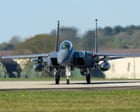
The morning mist usually clings to the fences of RAF Lakenheath like a damp grey shroud. To the casual observer driving past the Suffolk countryside, these bases are merely clusters of grey hangars and long, flat stretches of asphalt. But for those living in the shadow of the perimeter wire, the air feels different lately. It carries the low-frequency hum of a superpower’s anxiety.
Keir Starmer sits in 10 Downing Street, inherited keys in hand, facing a question that hasn't felt this heavy since the height of the Cold War. Who, exactly, controls the triggers on British soil? For another view, consider: this related article.
For decades, the "Special Relationship" has functioned like a long-term lease. The United Kingdom provides the real estate—bases like Lakenheath, Mildenhall, and the listening post at Menwith Hill—and the United States provides the muscle. It was a deal struck in an era of predictable giants. But the predictability has evaporated. The lease is being rewritten by a landlord across the Atlantic who seems increasingly inclined to set the house on fire just to see how the flames look on camera.
Donald Trump’s rhetoric hasn't just crossed the Atlantic; it has landed in the middle of British sovereign territory. When he speaks of "letting Russia do whatever the hell they want" to NATO allies who don't pay their bills, he isn't just making a campaign speech. He is signaling a shift in the very nature of command and control. He is suggesting that the shield we thought was mutual is actually a subscription service. Further coverage on the subject has been shared by Al Jazeera.
And the service can be canceled at any moment.
The Invisible Sovereignty Gap
Consider a hypothetical officer—let’s call him Miller. Miller works in a windowless room deep within a joint intelligence facility. He’s British. He’s meticulous. He’s spent twenty years analyzing threats to the realm. Across the desk sits an American counterpart. They share coffee, they share data, and they share a common goal. Or they did.
Under the current legal framework, the U.S. can theoretically launch operations from UK bases without explicit, case-by-case permission from the Prime Minister. We call it "joint use," but the reality is often "unilateral utility." If a future American president decides to use a drone based in the UK to strike a target in a way that violates international law, Miller is no longer a partner. He is a bystander. He is an accomplice on his own soil.
This is the "sovereignty gap" that a growing chorus of defense experts and MPs are now begging Starmer to close. They aren't asking to kick the Americans out. They are asking for a veto.
The danger isn't just a rogue missile. It’s the slow-motion collapse of British agency. We have built our national security around the idea that American interests and British interests are two circles in a Venn diagram that is almost a perfect circle. Trump is pulling those circles apart. If he returns to the Oval Office, the gap between what Washington wants and what London can tolerate will become a canyon.
The Cost of the Long Lease
History teaches us that bases are never just buildings. They are lightning rods. During the Libyan bombing in 1986, Margaret Thatcher allowed U.S. jets to fly from British bases, a move that made the UK a direct target for retaliatory terror. The public outcry was deafening. Today, the stakes are exponentially higher. We are talking about cyber warfare, long-range hypersonic missiles, and the persistent, nagging specter of tactical nuclear weapons.
The US is currently upgrading storage facilities at Lakenheath. These aren't for extra grain or spare parts. They are designed to house the B61-12 guided nuclear bomb.
When those weapons arrive, the soil of Suffolk becomes the most valuable—and most dangerous—square footage in Western Europe. If these weapons are controlled by a leader who views alliances as protection rackets, the UK isn't a partner. It’s a shield. A human shield made of sixty-seven million people.
The legal reality is a tangled mess of Cold War-era memos. The 1951 Status of Forces Agreement (SOFA) is the bedrock, but it’s a document written for a world of bayonets and prop planes. It doesn't account for algorithmic warfare or a Commander-in-Chief who uses social media to announce foreign policy shifts at three in the morning.
The Starmer Dilemma
Starmer is a man of the law. He likes clear lines. He likes evidence. But there is no legal precedent for a stray-bullet presidency. He is being urged to implement a "double-key" system—a digital and diplomatic lock that ensures no kinetic action can be taken from British soil without a British finger also pressing a button.
But how do you tell your biggest ally you don't trust them with the keys to your front door?
The risk of offending Washington is significant. The UK relies on the U.S. for everything from the Trident missile system to high-level satellite intelligence. If Starmer pushes too hard for "operational veto power," he risks a petulant withdrawal of cooperation. Trump is not a man who takes "no" gracefully. He views "consultation" as a weakness and "sovereignty" as something only the strongest player gets to claim.
Imagine the scene in the Cabinet Room. The advisors are split. On one side, the traditionalists argue that any friction with the U.S. is a gift to Putin. On the other, the realists point out that being a loyal ally to a madman isn't diplomacy; it’s a suicide pact.
The silence from Number 10 is calculated, but it can't last. The construction crews at Lakenheath are already moving dirt. The silos are being prepared. The clock is ticking toward a November election that could turn every U.S. base in Britain into a launchpad for a policy of chaos.
The Ghost in the Machine
We often think of war as a series of conscious choices made by rational actors in suits. But modern warfare is a machine. Once the sensors at Menwith Hill pick up a signal, the data flows through servers in Virginia, and the orders flow back to a drone pilot in a trailer in Nevada. That pilot might be operating a craft that is physically located in the East of England.
If that drone fires, the world doesn't blame the pilot in Nevada. They blame the country that let the drone take off.
This is the invisible thread that ties a voter in Ipswich to a conflict in the Middle East or Eastern Europe. It’s a thread of accountability that has become dangerously frayed. If Starmer doesn't act to codify a "UK-specific consent" requirement, he is effectively outsourcing British morality to the highest bidder in the Electoral College.
The arguments against restriction usually center on speed. "We can't wait for a committee meeting when a missile is incoming," the hawks say. And they are right. For defensive actions, speed is life. But for offensive strikes, for targeted assassinations, for the projection of power that shapes the world for decades? Speed is a trap.
The Suffolk Fog
Back at the perimeter fence in Suffolk, the locals see the C-17 transport planes banking low over the trees. They see the lights that never go out. They know that their home is a vital node in a global network of power. But there is a growing sense that the node is being disconnected from the national brain.
The "Special Relationship" was never supposed to be a master-servant dynamic. It was meant to be a marriage of shared values. When one partner stops sharing those values—when they start talking about abandoning friends and rewarding aggressors—the other partner has a duty to change the locks.
Starmer's challenge isn't just about military protocols or legislative amendments. it’s about the soul of British independence. It’s about ensuring that the "unsinkable aircraft carrier," as some Americans call the UK, has a British captain on the bridge with the authority to say "stop."
The mist eventually clears over the runways, revealing the sheer scale of the machinery housed there. It is a terrifying, beautiful display of human ingenuity and destructive potential. But as the sun hits the metal, the question remains unanswered.
Whose hand is on the lever? And what happens to the rest of us when they decide to pull it?
The silence of the government isn't a strategy; it’s a countdown. Every day without a clear, written guarantee of British veto power is a day we gamble with the sovereignty of the wind and the safety of the soil. The man in the suit in London has to decide if he’s a leader or a landlord. Because the tenant is getting restless, and he’s started talking to himself in a language we no longer recognize.
The fences remain. The planes keep landing. But the ground beneath them has never felt less stable.



