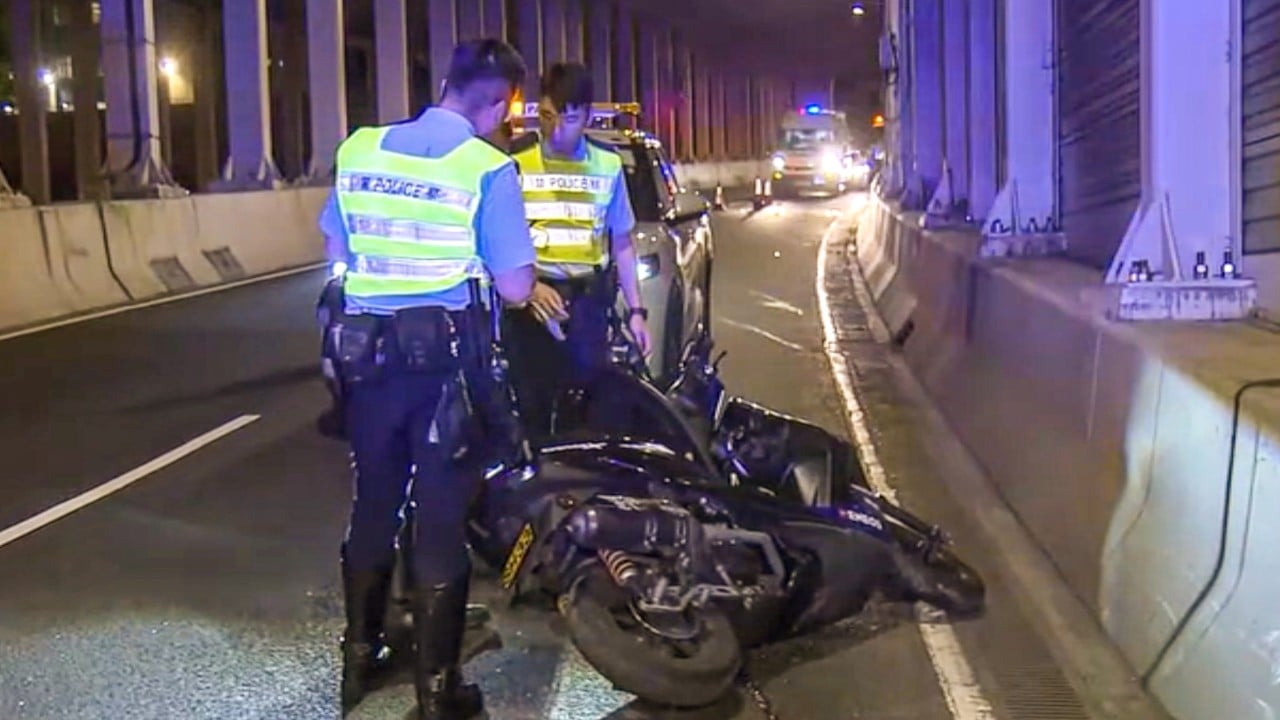
The fatal collision involving a 58-year-old motorcyclist at the Eastern Harbour Crossing (EHC) represents more than a localized traffic incident; it is a case study in the intersection of high-density infrastructure bottlenecks and the physics of vulnerable road users. To understand why this specific incident occurred, one must move beyond the basic police report and analyze the structural variables of the EHC—a critical artery connecting Quarry Bay and Lam Tin—under the pressures of peak-hour mechanical load and geometric limitations.
The Triad of Incident Causation
Every urban transit fatality is the result of three converging vectors: mechanical integrity, human decision-making under stress, and environmental infrastructure constraints. In the EHC context, these vectors create a high-risk environment where the margin for error is effectively zero.
1. The Bottleneck Effect and Flow Compression
The Eastern Harbour Crossing functions as a pressure valve for trans-harbor traffic. When vehicle density reaches a critical threshold, the flow becomes non-linear. Small adjustments in speed by lead vehicles propagate backward as "shock waves," forcing following vehicles into rapid deceleration. For a motorcyclist, these compression waves are lethal. Unlike a four-wheeled vehicle, a motorcycle’s stability is derived from gyroscopic forces that diminish at lower speeds, precisely when the traffic density is at its highest.
2. Geometric Deficiencies of the EHC
The EHC, completed in the late 1980s, was not designed for the current volume or the specific dimensions of modern heavy goods vehicles (HGVs). The tunnel’s curvature and lane widths provide minimal lateral clearance. When an HGV and a motorcycle share these narrow lanes, the "Bernoulli effect"—the creation of low pressure between two moving bodies—can physically pull a lighter motorcycle toward the larger vehicle. This aerodynamic instability often precedes the physical contact that leads to a loss of control.
3. Kinetic Energy Disparity
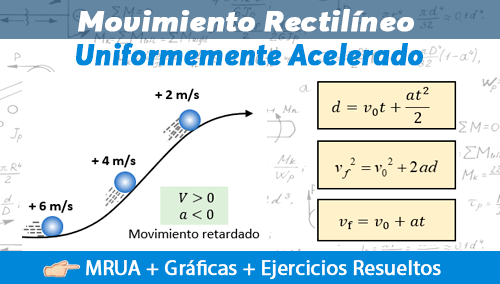
The fundamental "Cost Function" of a tunnel collision is measured in joules. A 58-year-old operator, while possessing decades of experiential data, faces a biological disadvantage in energy absorption. At 60 km/h, the kinetic energy of a standard motorcycle and rider is approximately $E_k = \frac{1}{2}mv^2$. While the velocity may seem manageable, the lack of a crumple zone means the totality of this energy is transferred directly to the rider or the tunnel wall upon impact.
Structural Failures in Victim Protection
The reporting of this incident identifies the victim as a 58-year-old male. From a physiological standpoint, this demographic presents a specific risk profile. Bone density and reaction times typically begin a non-linear decline after age 50, meaning a "low-speed" slide that a 25-year-old might walk away from becomes a multi-organ trauma event for an older rider.
Mechanical Forensics and Pre-Crash Variables
Investigation teams focus on "Tire Mark Analysis" and "Point of Final Rest" (PFR), but the preceding five seconds are more instructive. The core question is whether the incident was a "Single Vehicle Incident" (SVI) or a "Multi-Vehicle Interaction" (MVI). In the EHC, MVIs are frequently triggered by lane-changing maneuvers in the approach or exit portals.
- Lane Splitting vs. Filtering: In high-congestion zones like the EHC, motorcyclists often engage in filtering—moving between slow or stationary vehicles. While technically a tool for reducing congestion, it places the rider in the "blind sector" of HGVs where the mirrors fail to cover the immediate 2-meter lateral radius.
- Surface Friction Coefficients: Tunnel environments accumulate a "slick" consisting of oil, rubber particulates, and exhaust soot. This mixture, when combined with the high-pressure sodium lighting of the EHC, reduces the rider's ability to perceive changes in road grip, particularly during braking.
The Economic and Operational Impact of Tunnel Stoppage
The EHC is a primary economic conduit. A single fatality does not just end a life; it triggers an immediate systemic shutdown. The "Incident Management Protocol" requires the closure of lanes for forensic mapping, which creates a ripple effect across the Hong Kong Island and Kowloon road networks.
The "Opportunity Cost of Congestion" during the EHC investigation can be quantified by the thousands of man-hours lost in the resulting tailbacks. This highlights the tension between forensic necessity and urban functionality. The police must preserve the scene to determine if criminal negligence (e.g., dangerous driving causing death) occurred, but every minute of closure increases the probability of secondary "looky-loo" accidents in the opposite tube.
The Mechanism of the Fatal Strike
In most tunnel-based motorcycle fatalities, the cause of death is rarely the initial fall. Instead, it is the "Secondary Impact" with fixed infrastructure or following vehicles.
- Primary Impact: The motorcycle loses traction or clips a lane-divider/vehicle.
- Centrifugal Ejection: The rider is thrown from the seat. In a tunnel, the presence of concrete curbs and walls means the rider hits a non-yielding surface within milliseconds.
- The Crush Factor: In the EHC’s dense traffic, the time-gap between vehicles is often less than 1.5 seconds. If a rider falls, the following vehicle—even with an attentive driver—may lack the braking distance required to avoid a secondary strike.
Infrastructure Modification as a Mitigation Strategy
To reduce the frequency of such events, the discussion must shift from "driver behavior" to "forgiving infrastructure."
- High-Friction Surfacing: Implementing specialized resin-based surfaces in tunnel portals to maximize braking efficiency.
- Variable Speed Limits (VSL): Utilizing real-time sensors to drop the speed limit to 30 km/h the moment a density spike is detected, preventing the "compression waves" mentioned earlier.
- Dedicated Two-Wheeler Lanes: While the EHC’s current footprint makes this difficult, future trans-harbor projects must consider the segregation of HGVs and motorcycles to eliminate the aerodynamic and visibility issues inherent in shared lanes.
Forensic Logic in the Police Investigation
The ongoing investigation by the Kowloon East Traffic Accident Investigation Team will likely pivot on two data points: Dashcam telemetry and Tunnel CCTV.
The first limitation of the current investigation is the reliance on witnesses. In a high-stress, enclosed environment like a tunnel, human memory is notoriously subject to "perceptual narrowing." Forensic engineers will instead use the scrape marks on the tunnel floor to calculate the "Drag Factor" ($\mu$), allowing them to reverse-engineer the motorcycle's speed at the moment of the slide.
This data is then compared against the HGV’s tachograph (if an HGV was involved) to see if there was an illegal lane change or an abrupt speed fluctuation. If no other vehicle was contacted, the investigation shifts to "Road Surface Contamination" or "Mechanical Failure," such as a tire blowout or a seized engine.
Strategic Realignment for Urban Commuters
For the aging demographic of motorcyclists in Hong Kong, the EHC represents a high-entropy zone. The strategic response for riders is not merely "caution," but "tactical positioning." This involves maintaining a "Space Cushion" that exceeds the standard three-second rule to account for the reduced visibility and increased braking distances required on tunnel surfaces.
From a policy perspective, the government must evaluate whether 50+ year-old infrastructure like the EHC can continue to support the current mix of heavy logistics and light personal transport without significant technological intervention. The integration of AI-driven "Incident Detection Systems" that can identify a fallen rider within 0.5 seconds and instantly trigger red-light stoppages is the only way to prevent the "Secondary Impact" that is so often the actual cause of death in these environments.
The fatality at the Eastern Harbour Crossing is a data point in a clear trend: as infrastructure reaches its end-of-life capacity, the most vulnerable users pay the highest price. The investigation must look beyond the 58-year-old victim’s actions and address the systemic failure of a transit system that allows for such high-consequence interactions in confined spaces.
The immediate operational requirement is a comprehensive audit of tunnel lighting and surface grip levels across all harbor crossings, followed by a mandated increase in "Hazard Awareness" training for Class 3 (Motorcycle) license renewals for riders over the age of 50. This targeted approach addresses the biological and environmental variables that converged in this tragedy.