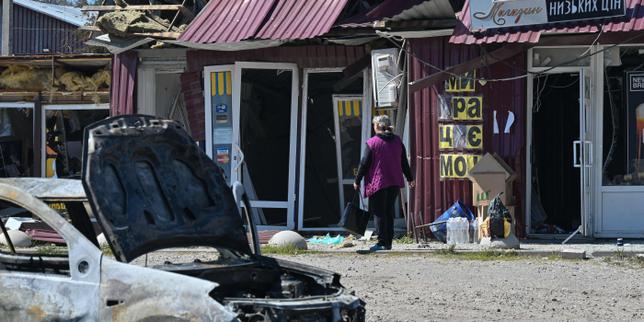
The current operational tempo of Russian long-range strikes against Ukrainian civilian and military infrastructure represents a shift from tactical disruption to a calculated strategy of systemic exhaustion. To understand the impact of 70 strikes resulting in 14 fatalities within a 24-hour window, one must look beyond the immediate casualty count. The efficacy of these strikes is measured by the "Degradation Coefficient"—the ratio between the cost of the munitions expended and the long-term economic and psychological repair cost incurred by the defender.
The Triad of Kinetic Objectives
Modern aerial bombardment in this theater operates through three distinct functional channels. Each strike serves a specific purpose within a broader campaign of attrition.
- Grid Fragmentation: Strikes targeting energy sub-stations and thermal power plants are designed to create localized "islands" of power. By breaking the synchronized national grid, the aggressor forces the defender to divert scarce air defense assets away from the front lines to protect static economic hubs.
- Logistical Chokepoint Pressure: While 14 deaths indicate a high civilian toll, the geographic distribution of these 70 strikes suggests an attempt to intersect supply lines. Targeting rail nodes and storage facilities creates a "bottleneck effect," where the throughput of Western-supplied material is throttled before it reaches the Donbas or Kherson fronts.
- Psychological Saturation: The high volume of strikes (70 in a single day) aims to overwhelm the sensory and response capacity of emergency services. This is a saturation tactic meant to prove the "porosity" of the air defense umbrella, regardless of the actual intercept rate.
The Mathematics of Air Defense Economics
A critical oversight in standard reporting is the failure to quantify the "Interceptor Asymmetry." Ukraine’s defense relies on a heterogeneous mix of Soviet-era systems (S-300, Buk) and modern Western platforms (Patriot, IRIS-T, NASAMS).
The cost-exchange ratio is currently skewed. A single Shahed-type loitering munition may cost between $20,000 and $50,000. In contrast, a Patriot PAC-3 interceptor missile carries a price tag exceeding $3 million. When Russia launches a high-volume salvo, they are not only seeking to hit targets but also to "bankrupt" the defender’s magazine depth. The success of a strike campaign is often found in the missiles that were not fired because the defender had to prioritize targets, leaving 14 people dead in lower-priority or unprotected zones.
Structural Vulnerability and the Urban Heat Island
The lethality of these strikes is exacerbated by the density of Soviet-style high-rise architecture. These structures were designed for thermal efficiency, not blast resilience. A single kinetic impact on a load-bearing "panel" building triggers a progressive collapse.
The "14 deaths" metric often masks the "Displacement Multiplier." For every fatality, approximately 10 to 15 households lose access to essential utilities—water, sewage, and heating. In a winter or early spring context, this weaponizes the environment itself. The destruction of a transformer station is a kinetic act with a thermodynamic consequence: the forced migration of the local population as internal building temperatures drop below habitable levels.
Resource Diversion as a Strategic Outcome
The 70 strikes necessitate a massive redirection of internal resources. This creates a "Secondary Attrition" effect on the Ukrainian state apparatus:
- Medical Triage Strain: Treating 14 fatalities and the presumably dozens of wounded consumes specialized surgical and trauma resources that would otherwise support front-line casualties.
- Reconstruction Opportunity Cost: Capital diverted to repairing a hit apartment block is capital not spent on drone production or electronic warfare (EW) development.
- Intelligence Burden: Each of the 70 impact sites must be analyzed for "Battle Damage Assessment" (BDA). This ties up reconnaissance assets and human intelligence to determine what was hit and what failed to detonate.
The Bottleneck of Western Industrial Throughput
The sustainability of the current Ukrainian defensive posture depends on the "Lead Time" of Western manufacturing. We are seeing a transition from a war of stocks to a war of production. The 70 strikes per day frequency tests whether European and American assembly lines can produce interceptors faster than Russia can procure or manufacture cruise missiles and drones.
The current failure of the international community to provide a "Closed Sky" is a result of the "Escalation Ladder" theory. There is a persistent fear that providing sufficient high-altitude coverage to prevent all 70 strikes would require deep-strike capabilities into Russian territory to neutralize the launch platforms (Tu-95 bombers and Iskander TELs). This creates a tactical stalemate where the civilian population bears the brunt of the "Strategic Depth" disadvantage.
Tactical Calibration and Munition Diversity
The composition of the 70 strikes likely involved a mix of high-precision cruise missiles (Kh-101), ballistic missiles, and low-cost drones. This "Mixed Salvo" approach is designed to confuse radar signatures. Drones fly low to exploit the "Radar Horizon" and ground clutter, while ballistic missiles descend at hypersonic speeds from the upper atmosphere.
The defense against a Kh-101 is fundamentally different from the defense against a Geran-2 drone. By forcing the Ukrainian Air Force to engage multiple profiles simultaneously, Russia increases the probability of a "Leakage Event"—where a munition bypasses the primary screen and strikes a residential area.
Operational Forecast and Necessary Countermeasures
The persistence of these strikes indicates that the Russian military-industrial complex has stabilized its supply chain, likely through the "Sanction Bypass" of dual-use electronics. To counter this, the defensive strategy must move from "Point Defense" (protecting individual buildings) to "Area Denial" and "Left-of-Launch" interventions.
- Passive Defense Hardening: Encasing critical energy infrastructure in concrete "sarcophagi" to mitigate the fragmentation damage of near-misses.
- Electronic Warfare Expansion: Scaling the deployment of "spoofing" technology that disrupts the GPS/GLONASS guidance systems of low-cost drones, forcing them to crash in uninhabited areas.
- The Interceptor Lifecycle Management: Transitioning to lower-cost interceptors, such as Gepard-style anti-aircraft guns or laser-guided rockets (APKWS), to preserve high-tier missiles for ballistic threats.
The 14 lives lost are the human face of a geometric problem. Until the cost of launching a strike exceeds the utility gained by the aggressor, the volume of fire will remain high. The strategic priority is no longer just "holding the line" in the east, but rather securing the "Vertical Front" above the cities. Failure to achieve parity in the air-defense cost-exchange ratio will lead to a gradual hollow-out of the Ukrainian rear, making the forward positions unsustainable regardless of their tactical success on the ground.