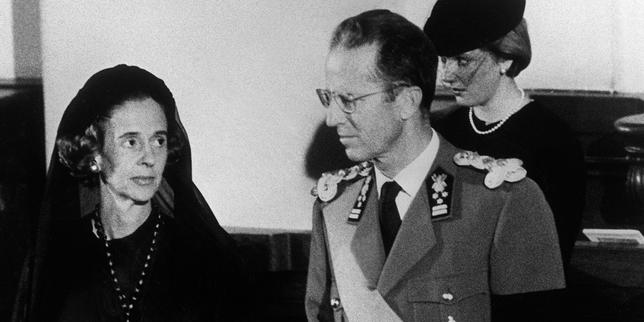
In the spring of 1990, Belgium didn't have a king for 36 hours.
The throne wasn't empty because of a coup, an assassination, or a sudden illness. King Baudouin simply walked away from his crown because he couldn't stomach signing a bill. The law in question legalized abortion.
Most constitutional monarchs understand their job description. You wave at crowds, you give speeches written by politicians, and you sign whatever piece of paper the democratically elected parliament puts on your desk. Royal assent is supposed to be a rubber stamp. Baudouin decided his personal morality mattered more than political tradition.
What followed wasn't just a political standoff. It was a bizarre, creative, and highly questionable exploitation of legal loopholes that left constitutional experts scratching their heads. It preserved the Belgian monarchy, but it exposed the fragile fiction of the crown's neutrality.
The Collision of Personal Grief and Catholic Dogma
To understand why Baudouin was willing to risk a full-blown regime crisis, you have to look at his private life and his faith. He wasn't just a casual Sunday churchgoer. Baudouin was a deeply devout Roman Catholic, heavily influenced by the conservative Catholic Charismatic Renewal movement.
But there was a deeper, more painful layer to his conviction. He and his wife, Queen Fabiola, desperately wanted children. Fabiola suffered through five miscarriages. They never had an heir.
For a man who viewed every unborn child as a sacred miracle—and who spent his private life mourning the children he could never have—the idea of putting his royal signature on a document that legalized the termination of pregnancy felt like an impossibility.
When the Belgian parliament passed the Lallemand-Herman-Michielsens bill in early 1990, allowing abortion up to 12 weeks for women "in distress," Baudouin knew he was cornered. The bill passed because a coalition of socialists and liberals outvoted the Christian Democrats.
On March 30, 1990, Baudouin wrote a blunt letter to Prime Minister Wilfried Martens. He didn't mince words. He stated that his conscience wouldn't allow him to sign. He also made it clear that he didn't want to block the democratic process. He didn't want to be a dictator, but he refused to be an accomplice.
The 36-Hour Dethronement Trick
The Belgian government panicked. If the King refused to sign, the law couldn't take effect. If the government forced him to sign, he would abdicate, sparking a massive crisis in a country already tearing itself apart along linguistic lines between Dutch-speaking Flanders and French-speaking Wallonia.
Politicians needed a magic trick. They found it in Article 82 of the Belgian Constitution.
This specific article was designed for moments when a king couldn't rule due to physical or mental incapacity—like falling into a coma, being captured by an enemy army, or losing his sanity. It allowed the Council of Ministers to take over the king's duties collectively.
The government chose to interpret Baudouin's moral crisis as a literal inability to reign. Here's how the 36-hour farce played out:
- On April 3, 1990, the Cabinet met and formally declared that King Baudouin was "in the impossibility of reigning."
- With the King temporarily stripped of his powers, the Council of Ministers became the collective head of state.
- Every single member of the Cabinet signed the abortion law in place of the King.
- On April 5, 1990, parliament met in a joint session, voted that the King was now perfectly capable of ruling again, and restored Baudouin to the throne.
The law passed. The King kept his conscience clean. The monarchy survived.
The Legal Fiction That Cost the Crown Its Mystique
While politicians cheered the "Belgian compromise," jurists were horrified. Constitutional experts like Marc Verdussen pointed out the obvious flaw in the logic. Impossibility to reign is supposed to be caused by an external factor, not an internal mood. A crisis of conscience isn't a medical emergency.
By stretching the constitution to the breaking point, the government set a weird precedent. They basically admitted that if the King disagrees with a law, the government can just turn him off and on again like a broken computer.
The public reaction was mixed. A massive 77% of Belgians wanted Baudouin to stay on the throne, showing how much they respected his overall moral authority. But the intellectual elite and the press weren't as forgiving. The influential newspaper Le Soir published a scathing editorial asking a dangerous question: If the King can choose which laws apply to him based on his conscience, why can't regular citizens do the exact same thing?
Baudouin's gamble worked once, but it stripped the monarchy of its remaining illusion of power. It proved that the King's signature wasn't a powerful validation; it was just a mechanical requirement that could be bypassed with the right legal paperwork.
When Baudouin died three years later in 1993, his brother Albert II took the throne under a very different reality. The country eventually legalized euthanasia and same-sex marriage without any royal interventions. Nobody dared to try the Article 82 trick again.
If you want to understand modern European constitutional crises, you don't look at grand declarations of war. You look at 36 hours in Brussels where a guilt-ridden king and a desperate prime minister used a technicality to rewrite the rules of a kingdom.