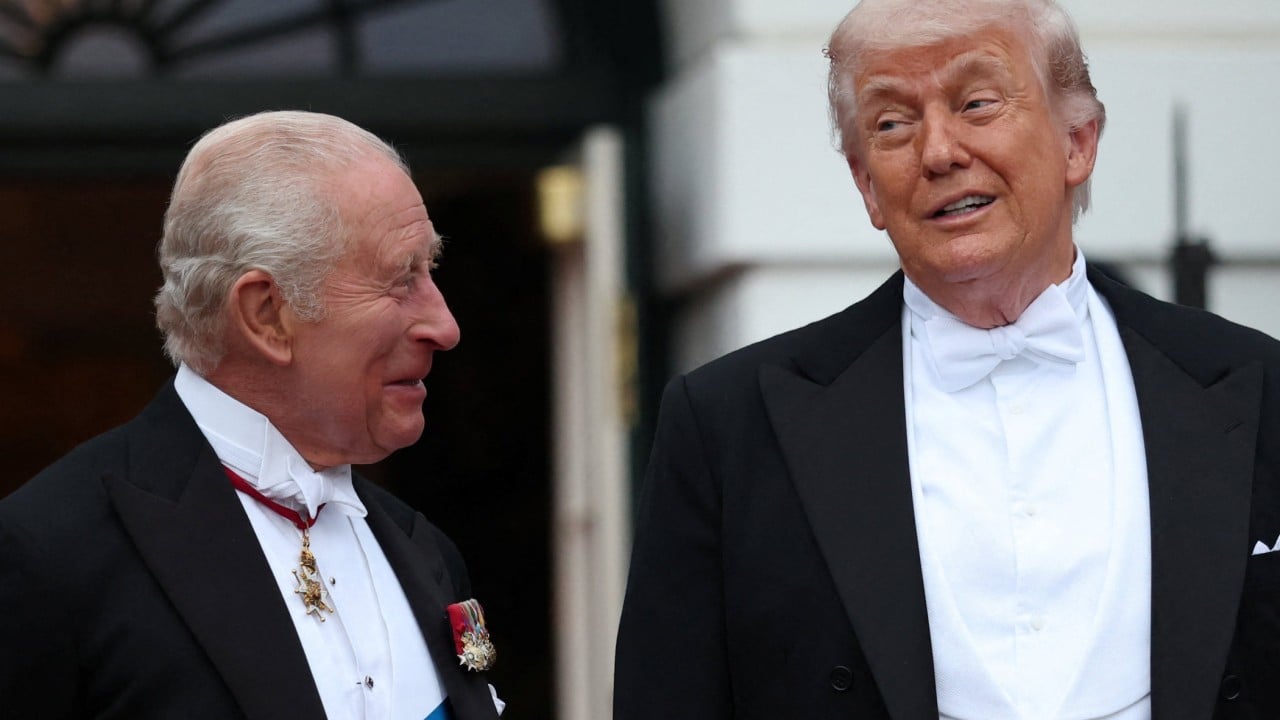
The headlines are screaming about a "roast." They want you to believe that King Charles III, the supposed relic of an ancient institution, just dunked on Donald Trump with a quip about the French language and colonial history. They see a witty grandfather putting a brash billionaire in his place.
They are wrong.
What the mainstream press misses—with their predictable obsession with "claps back" and "savagery"—is that this wasn't a schoolyard insult. It was a calculated display of the only thing the British Monarchy has left: the ability to frame the reality of the most powerful people on earth. While pundits argue over who "won" the exchange, they ignore the terrifyingly effective machinery of diplomatic theater that allows a man with zero legislative power to patronize the leader of the free world and get away with it.
The Myth of the Colonial Burn
The "lazy consensus" suggests that by telling Trump he’d be speaking French if not for the British, Charles was defending the honor of the UK. This is historical revisionism dressed up as wit. It assumes a hierarchy where the UK is the benevolent protector of American stability.
Let's look at the actual mechanics of the Seven Years' War. The idea that Britain "saved" the American colonies out of the goodness of its heart is a fairytale for tourists. It was an imperial land grab. By invoking it, Charles isn't just making a joke; he’s reasserting a narrative of British exceptionalism that the UK hasn't been able to back up with hard power since 1945.
If you want to understand the real tension here, stop looking at the words. Look at the status. Trump is a man obsessed with dominance, yet he finds himself in a room where he is technically a guest of a sovereign who claims his position by divine right rather than a popular vote. The "roast" is a tool of containment. It’s how the old guard tells the new money, "You are still playing in our house."
Soft Power is a Sharp Blade
The media treats these royal interactions like a reality show. I’ve sat in rooms where "soft power" is discussed as if it’s just tea and polite conversation. It’s not. It’s psychological warfare.
When a monarch uses humor to remind an American President of their "colonial" roots, they are executing a precise maneuver. They are devaluing the President’s office by placing it in a historical context where it was once a subordinate entity. It’s a subtle way of saying, "Your republic is a phase; our institution is an era."
Most analysts are too busy checking Twitter metrics to see the structural arrogance. They think the King is being "relatable." In reality, he is being incredibly distant. By joking about the French language, he’s leaning into the very "Elite" persona that Trump’s base claims to despise. Yet, because it’s wrapped in the velvet of royalty, it bypasses the usual defenses.
The Trump Response Paradox
Why didn't Trump fire back with his usual vitriol? Because the Monarchy is the only brand on earth that Trump actually respects.
Trump understands branding better than almost any politician in history. He sees the gold coaches, the titles, and the inherited wealth, and he sees the ultimate version of his own aspirations. This creates a fascinating power imbalance. The King can insult Trump to his face because Trump views the King’s approval as the ultimate validation of his own "aristocratic" status.
It’s a classic trap. By accepting the "roast" with a smile, Trump isn't being a good sport. He’s acknowledging the King’s superior social standing. For a man who built his entire political identity on being the "unfiltered" voice of the people, his deference to a hereditary monarch is the most glaring contradiction in his repertoire.
The French Connection and the Seven Years' War
Let’s dismantle the "you’d be speaking French" logic. It refers to the mid-18th-century conflict where Britain defeated France for control of North America.
The irony is thick enough to choke on. Britain won the war but lost the colonies because they tried to tax the Americans to pay for that very "protection." By bringing up this specific era, the King is inadvertently reminding everyone that British overreach is what created the United States in the first place.
If we’re being brutally honest, if Britain hadn't "saved" the colonies from the French, the American Revolution might never have happened. The colonies might have remained a fragmented series of territories, or perhaps they would have found a different path to independence. The King’s quip relies on the "Great Man" theory of history—or in this case, the "Great Empire" theory—which ignores the messy, bottom-up reality of how nations are actually built.
Why the Press Needs the "Roast" Narrative
The media loves this story because it simplifies a complex, deteriorating relationship. The UK is currently struggling with its post-Brexit identity, trying to figure out its place in a world dominated by the US and China.
Admitting that the UK is a junior partner in the "Special Relationship" is boring and depressing. But framing the King as a sharp-witted genius who can take down Trump with a single line? That sells. It gives the British public a sense of cultural superiority that masks their lack of geopolitical leverage.
I have seen this play out in corporate boardrooms. When a legacy company is being disrupted by a faster, meaner competitor, the legacy CEOs often resort to "wisdom" and "tradition" as a defense mechanism. They make jokes about the new guy’s suit or his lack of "experience." It feels good in the moment, but it doesn't stop the stock price from sliding.
The Cost of the Quip
There is a downside to this contrarian view: the risk of over-analyzing a simple joke. Sometimes a quip is just a quip. But when you are the head of the House of Windsor, nothing is accidental. Every word is vetted. Every "spontaneous" moment is a rehearsed beat in a centuries-old play.
By leaning into this "colonial" humor, the King is alienating the very people the UK needs to court: the skeptics of empire. In a world where the Commonwealth is fraying and calls for reparations are growing louder, reminding everyone of the time Britain "owned" America isn't exactly a masterclass in modern PR. It’s a retreat into the past because the present is too difficult to navigate.
The Actionable Truth for the Rest of Us
What can you actually learn from this besides the fact that rich people have weird senses of humor?
- Status is Negotiated, Not Granted: The King used history to negotiate his status upward. You can do the same by framing your expertise within a timeline that predates your competitors.
- Humor is the Ultimate Tool of Dominance: If you can make someone laugh at themselves, you’ve already won the psychological high ground.
- Beware the "Legacy" Trap: Don't be the person relying on what your ancestors (or your company’s founders) did in 1763. It makes for a great roast, but it’s a terrible business strategy.
The UK King didn't "roast" Trump. He performed a ritual of institutional survival. He reminded the world that while Presidents come and go every four to eight years, the Crown remains, perpetually ready to remind the "colonials" who really wears the jewelry. It’s not wit. It’s a warning.
Stop looking for a winner in a conversation between two men who live in palaces. Start looking at the audience. The "roast" wasn't for Trump. It was for you. It was designed to make you believe that the old world still has a bite. But a bite without teeth is just a gumming, no matter how much gold you wrap around it.