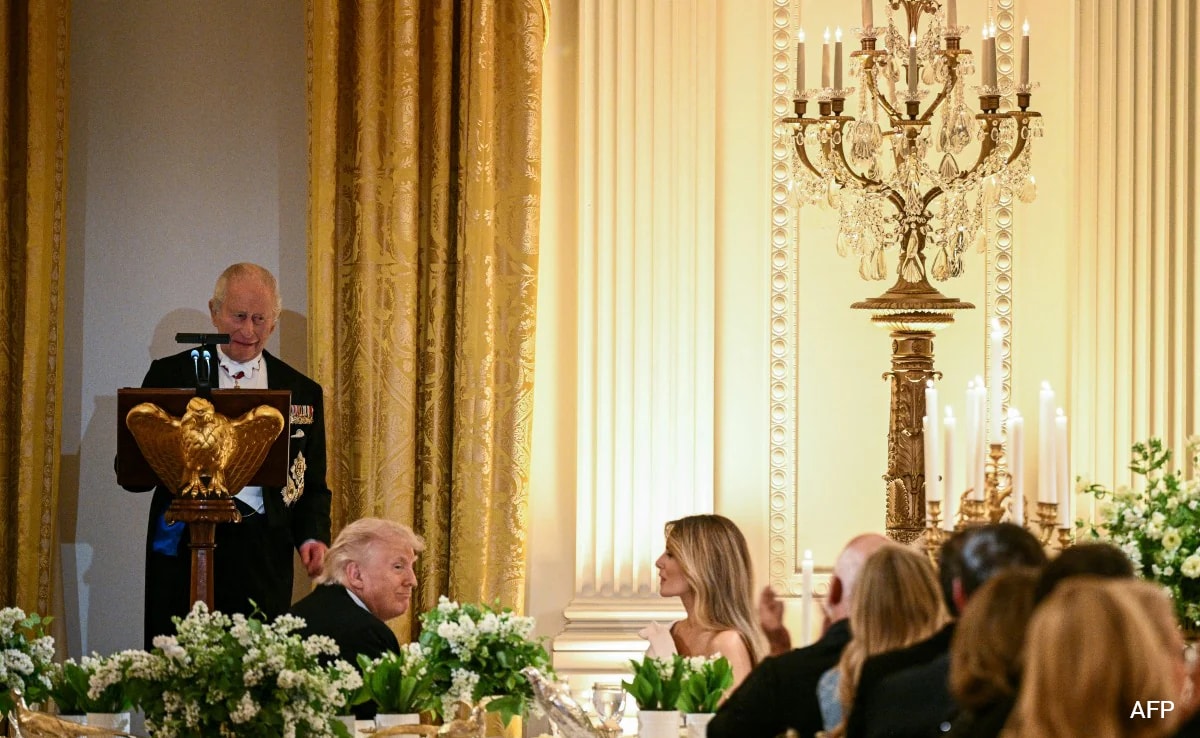
The air inside the Elysee Palace doesn't just smell like floor wax and expensive lilies. It smells like history. It is a heavy, silent weight that sits on the shoulders of every world leader who walks those gilded halls. On this particular evening, the chandeliers flickered over a table set for 160 guests, a sea of crystal and silver meant to commemorate the 80th anniversary of D-Day.
Seated there were men who hold the world in their hands. King Charles III, frail but steady, and Donald Trump, the former president whose very presence often acts as a tectonic shift in international relations.
Politics usually happens in press releases. But true power? That reveals itself in the pauses between courses, in the sharp glint of a wine glass, and in the kind of dry, aristocratic wit that can dismantle a man’s entire worldview before the sorbet arrives.
The Weight of the Longest Day
To understand the tension in that room, you have to look past the tuxedoes. You have to look back to the mud of Normandy.
Eighty years ago, thousands of young men—boys, really—flung themselves into a wall of lead. They didn't do it for a headline. They did it because of a collective agreement that the world was worth saving from a singular, encroaching darkness. This alliance, forged in blood and salt water, became the bedrock of the West. It created the "special relationship" between the United Kingdom and the United States.
But alliances are fragile. They are not statues; they are gardens. If you stop watering them, they die.
Donald Trump has never been a fan of traditional gardens. His approach to international diplomacy has always been that of a demolition expert. He looks at NATO and sees a bill he doesn't want to pay. He looks at historical obligations and sees a bad deal. For years, his rhetoric has leaned toward isolationism, a "Me First" philosophy that suggests the old alliances are more of a burden than a shield.
King Charles, a man whose entire life is a walking personification of tradition and duty, represents the opposite pole. He is the guardian of the "Long View."
The Roast Heard 'Round the World
The dinner was supposed to be a somber affair. High-minded speeches about liberty and sacrifice are the standard currency of such events. But King Charles, perhaps sensing the fragility of the current geopolitical moment, decided to trade in a different currency: the truth, wrapped in a serrated edge of British humor.
The conversation turned, as it often does when Trump is involved, to the role of America in Europe. The former president had been vocal about his skepticism. He had questioned why American tax dollars should protect borders thousands of miles away.
The King leaned in.
With the practiced ease of a man whose ancestors have dealt with upstarts for a millennium, he delivered a line that froze the room. He reminded the former president that without the intervention and the sustained unity of the Allied forces—forces that Trump had often disparaged as being one-sided—the very culture they were currently enjoying might not exist.
"If it weren't for the grit shown by our unified front," the King essentially remarked, "you’d be speaking French right now."
It was a "roast" in the most regal sense. It wasn't a schoolyard insult. It was a historical correction delivered with the precision of a surgeon.
Why Language Matters
The King wasn't just talking about verbs and nouns. To suggest that an American president would be "speaking French" is a coded way of saying that the world would have been lost. It was a reminder that the United States didn't just "help" Europe; the United States saved itself by saving Europe.
Imagine a world where the Atlantic Wall never fell.
In that hypothetical reality, the American experiment would have been strangled in its crib. An isolated United States, facing a consolidated, hostile Eurasia, would have become a fortress state, stripped of its trade, its influence, and its security. The "special relationship" isn't a charity. It is a survival pact.
When the King made his remark, he was pointing out the fundamental flaw in the "America Alone" logic. Isolationism feels like strength when you’re standing behind a wall, but history shows that walls eventually become tombs.
The Invisible Stakes of the Dinner Table
The reaction was immediate, though muffled by the decorum of the Elysee. Trump, never one to enjoy being the butt of a joke, was forced to navigate the social minefield of a monarch's wit.
But the real story isn't Trump’s reaction. It’s the message Charles was sending to the rest of the world.
The King was acting as the voice of the dead. He was speaking for the veterans who were sitting just a few miles away in the windswept cemeteries of Colleville-sur-Mer. Those men didn't die for "America First." They died for a world where no one has to be first because everyone is together.
The stakes of this exchange are invisible but massive. We live in a time where the Liberal International Order—the system of rules and alliances that has prevented a third world war for eight decades—is cracking. People are tired. They are frustrated by the cost of living and the complexities of globalism. It is easy to point at a map and say, "That’s not my problem."
Charles was saying: "It is always your problem."
The Ghost at the Table
Consider the hypothetical soldier, let’s call him Arthur. Arthur is twenty years old in 1944. He’s from a small town in Nebraska. He’s never seen the ocean. He finds himself on a flat-bottomed boat, vomiting from seasickness, watching the cliffs of Normandy loom through the grey mist.
Arthur isn't thinking about the GDP of France. He’s thinking about the guy to his left and the guy to his right. One is from London, one is from Toronto. They are a "unified front."
If Arthur’s leaders had decided that the alliance wasn't "cost-effective," Arthur wouldn't have been on that boat. And the world Arthur left behind would have eventually been swallowed by the same shadow that took Europe.
The King’s roast was a defense of Arthur. It was a reminder that the peace we enjoy today is an inheritance, not a right. And like any inheritance, it can be squandered by the arrogant or the short-sighted.
A Lesson in Regal Shade
There is a specific kind of power in the British monarchy that Americans often struggle to understand. The King has no legislative power. He cannot pass a law or command an army in the field. His power is purely symbolic.
But symbols are what people live and die for.
By using humor to check a man who prides himself on being the ultimate "strongman," Charles demonstrated the power of institutional memory. He reminded everyone in that room that presidents come and go, but the lessons of history are permanent.
The "roast" served as a bridge. It bridged the gap between the 1940s and the 2020s. It suggested that while the technology has changed, the human impulse toward tribalism and isolation remains our greatest threat.
The Lingering Echo
As the dinner ended and the guests moved toward the exits, the air felt different. The "You'd be speaking French" comment began to ripple through the news cycles, dissected by pundits and cheered by critics.
But beyond the political theater, the comment remains a haunting question for the future of the West.
How much is our history worth? Is an alliance something we keep only as long as it’s convenient, or is it a sacred vow?
Trump’s vision of the world is one of transactions. A series of one-off deals where there is always a winner and a loser. Charles offered a different vision: a world of relationships. A world where we acknowledge that our fates are so deeply intertwined that to pull on one thread is to unravel the whole garment.
The King didn't just roast a politician. He defended a civilization.
The lights of the Elysee eventually went dark, and the motorcades sped off into the Parisian night. But the words hung in the air, a stubborn reminder that the past is never truly past. We are all living in the shadow of 1944, and whether we speak French, English, or the language of silence depends entirely on whether we remember why those boys got on the boats in the first place.
The most dangerous thing in the world isn't a powerful enemy; it's a short memory.



