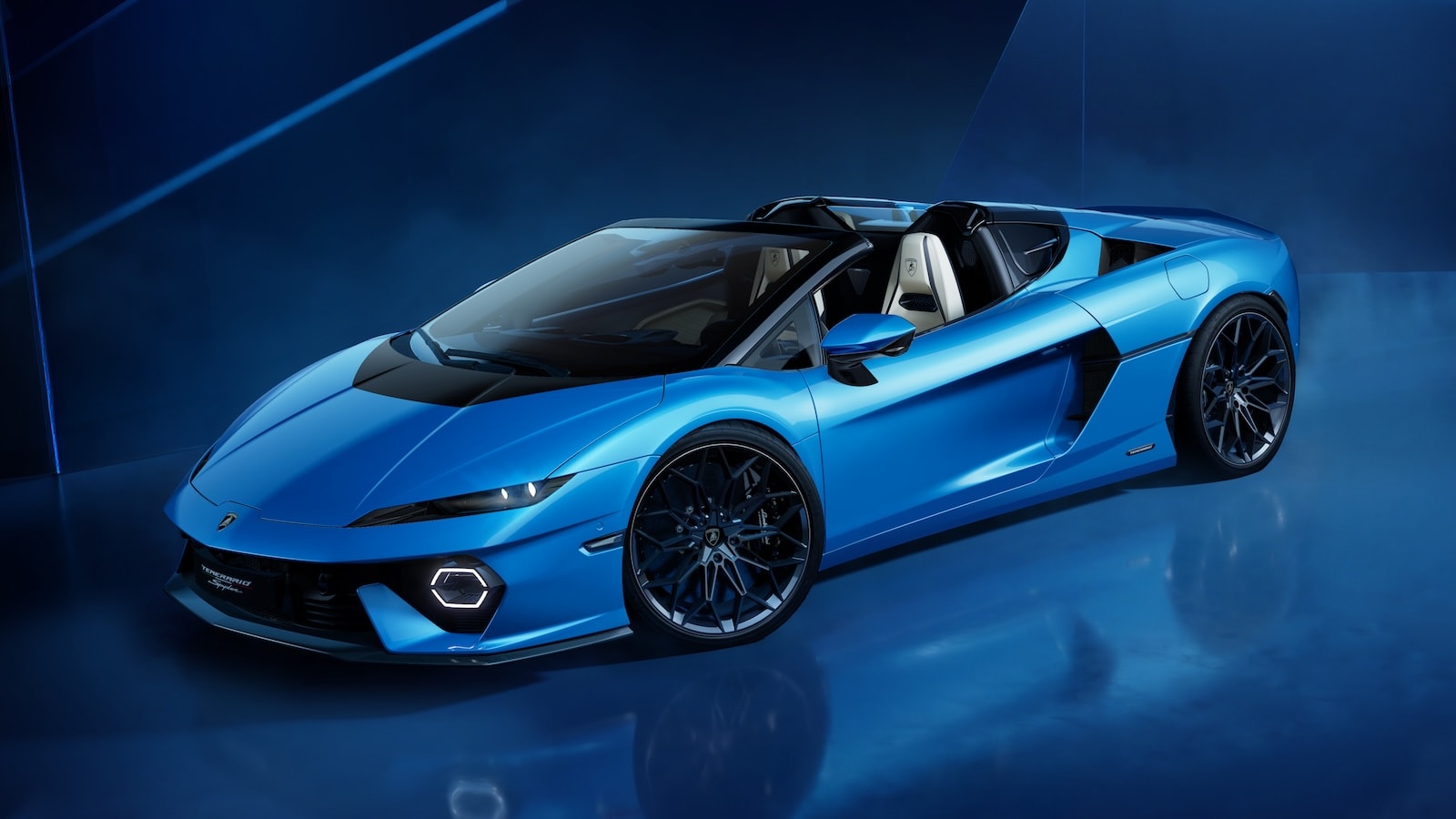
For decades, Sant'Agata Bolognese treated the open-top supercar as an exercise in glorious, uncompromising theater—even if it meant letting a little rain ruin the upholstery. With the debut of the Lamborghini Temerario Spyder, the Italian automaker has broken a fifty-year tradition by fitting its entry-level V8 hybrid with the brand’s first-ever retractable hardtop (RHT). This move is not merely a stylistic pivot or a concession to luxury; it is an engineering necessity dictated by the brutal aerodynamic and acoustic demands of a 10,000-rpm hybrid powertrain.
The Death of the Canvas Compromise
Fabric roofs have always carried a distinct romanticism in Italian motoring, from the manual toupee on the Murciélago Roadster to the electro-hydraulic cloth mechanisms on the Gallardo and Huracán Spyders. They kept visual mass low and preserved a clear distinction between coupe and convertible silhouettes. Yet behind closed doors in engineering departments across Modena and Sant'Agata, the soft top had become a liability.
Cloth deforms under extreme pressure. When a car pushes past 200 miles per hour, aerodynamic lift pulls upward on a fabric canopy like a sail, creating cabin buffeting, wind roar, and structural flex that no amount of multi-layer acoustic padding can fully cure. The Huracán Evo Spyder was a visceral thrill, but at triple-digit speeds, conversation required shouting over the rush of air vibrating through the canvas overhead.
"A fabric roof tells the wind where to push; a composite hardtop tells the wind where to go."
By adopting a folding hardtop for the Temerario Spyder, Lamborghini eliminates the aerodynamic penalty of cloth ballooning at high velocity. The rigid roof panels maintain an exact airfoil profile identical to the coupe when deployed, allowing engineers to manage airflow toward the rear deck and active aerodynamic elements with millimeter precision.
Packaging a Folding Roof Around a Mid-Mounted V8
Fitting a retractable hardtop into a mid-engine supercar is an exercise in spatial warfare. Unlike a front-engine grand tourer, where a massive trunk sits waiting to swallow folded roof panels, a mid-engine layout places the engine block, turbochargers, intercoolers, and exhaust manifolds directly behind the driver’s shoulder blades.
To make the Temerario Spyder work without turning its rear deck into a bloated, awkward shelf, Lamborghini relied heavily on the aluminum spaceframe architecture introduced on the Temerario coupe. That chassis uses fewer structural castings and eliminates roughly half the welds found in the old Huracán platform, freeing up crucial millimeters around the rear bulkhead.
The roof mechanism itself relies on lightweight carbon-fiber composite panels and cast aluminum linkages. Rather than folding into a single bulky stack, the roof splits into discrete sections that articulate and nest tightly into a dedicated compartment directly ahead of the engine bay.
This packaging feat comes with strict thermal management hurdles. Storing painted carbon panels mere inches away from a hot-vee twin-turbocharged V8 requires aggressive heat shielding and dedicated airflow channels so the roof mechanisms do not warp or cook in summer traffic.
The Weight Penalty Versus Hybrid Torque
Every convertible pays a price on the scales, and a retractable hardtop typically demands a steeper toll than fabric. Between the electric motors, hydraulic actuators, thicker structural sills, and reinforced windshield header, an RHT conversion usually adds between 110 and 150 pounds to a mid-engine chassis.
In the naturally aspirated era, that extra mass dulled throttle response and blunted lateral agility. Today, the Temerario’s plug-in hybrid powertrain renders that weight penalty nearly invisible from behind the wheel.
The drivetrain pairs a flat-plane crank 4.0-liter twin-turbo V8 with three axial-flux electric motors—two driving the front axle and one sandwiched between the engine and the eight-speed dual-clutch transmission. Total system output sits north of 900 horsepower, with instantaneous electric torque filling every millisecond of turbo spool.
Weight still matters under hard braking and during rapid direction changes on a technical circuit. However, the low-mounted battery pack running down the central tunnel helps anchor the center of gravity, offsetting the higher mass of the folding roof mechanism when it sits stowed behind the seats.
Why Competitors Forced Lamborghini’s Hand
Lamborghini did not make this leap in a vacuum. Ferrari abandoned soft tops on its mid-engine V8 lineup over a decade ago, introducing the 458 Spider in 2011 with an aluminum retractable hardtop that folded neatly into a remarkably compact space. McLaren followed suit with the 12C Spider, 650S Spider, 720S Spider, and 750S Spider, proving that carbon-tub supercars could offer coupe-like rigidity and refinement with the push of a button.
For years, Lamborghini held out, arguing that fabric roofs preserved the raw, exposed mechanical drama of its V10 engines. Buyers loved the sound, but many quietly complained about daily usability, cabin noise on long highway runs, and security concerns when parking an exotic car on city streets.
- Acoustic insulation: A rigid roof cuts highway cabin decibels dramatically compared to canvas, making the Temerario Spyder viable for cross-continental touring rather than just Sunday morning canyon runs.
- All-weather durability: Hardtop seals resist UV degradation, heavy snow loads, and automated car washes far better than woven textiles.
- Visual continuity: With the roof up, the Temerario Spyder retains the sharp, hexagonal design language and aggressive roofline of the coupe without the visual break of a contrasting cloth top.
- Resale stability: Historically, RHT supercars like the Ferrari 488 Spider and F8 Spider have commanded stronger residual values in secondary markets than fabric-roofed rivals of the same era.
The Acoustic Paradox of the 10,000-RPM Hybrid
There is a catch. Converting to a hardtop changes how the driver experiences the engine, and the Temerario’s powerplant is unlike anything Lamborghini has built before.
The old naturally aspirated 5.2-liter V10 screamed with an organic, metallic wail that filled the cabin effortlessly, even with a cloth roof closed. Turbochargers, by nature, act as mufflers in the exhaust stream. To keep the Temerario from sounding muted, Lamborghini engineered the V8 with a flat-plane crankshaft capable of revving to an astonishing 10,000 rpm, supplemented by bespoke acoustic resonators that pipe induction and exhaust frequencies directly into the cockpit.
With the retractable hardtop raised, the cabin acts as an acoustic chamber, amplifying those engineered frequencies while blocking out tire roar and wind rush. Lower the roof, and the barrier disappears entirely, exposing the occupants to the unfiltered mechanical shriek of a ten-grand redline bouncing off canyon walls.
To ensure the open-air experience does not become a wind-whipped mess at high speeds, Lamborghini integrated an electronically adjustable rear glass wind blocker between the rear buttresses. Raised independently of the roof panels, this glass partition disrupts low-pressure eddies behind the headrests while still allowing raw engine noise to wash over the driver.
The Business Reality Behind the Hardtop Shift
Automotive engineering rarely happens without a spreadsheet dictating the margins. Moving from a soft top to a retractable hardtop increases bill-of-materials costs and assembly line complexity in Sant'Agata Bolognese. Yet the financial upside for Lamborghini is massive.
In key markets like North America, the Middle East, and Southern Europe, Spyder variants routinely account for roughly 40 to 50 percent of total model sales. Buyers in these regions are willing to pay a substantial premium—often $35,000 to $50,000 above the coupe—for open-air capability, provided they do not have to sacrifice daily comfort or coupe-like aesthetics.
By equipping the Temerario Spyder with a retractable hardtop, Lamborghini effectively captures buyers who previously cross-shopped the Ferrari 296 GTS or McLaren 750S Spider solely because they refused to own a soft-top convertible. It eliminates the single biggest objection dealers heard on the showroom floor.
What Buyers Actually Lose
Progress always leaves casualties on the cutting room floor. Enthusiasts who favored the Huracán Spyder for its unpretentious, old-school roadster charm will notice the trade-offs immediately.
First, rearward visibility shrinks. The buttresses required to house the folding hardtop mechanism and support the rear glass create larger blind spots over the driver’s shoulders than the sleeker rear deck of a soft-top convertible. Parking maneuvers rely almost entirely on high-definition cameras and proximity sensors rather than a quick glance over the shoulder.
Second, luggage capacity remains strictly theoretical. The front trunk still holds a pair of soft weekend bags, but the space behind the seats—already tight in the coupe—is completely consumed by the roof storage bay and firewall reinforcements.
Finally, mechanical complexity increases exponentially. A retractable hardtop relies on an intricate ballet of hall-effect sensors, microswitches, hydraulic lines, and multi-axis hinges. Fifteen years from now, when these cars enter the collector market, a misaligned sensor or leaking actuator will present a far steeper restoration bill than replacing a torn canvas top.
A Defining Shift for Sant'Agata
Lamborghini built its reputation on excess, drama, and a stubborn refusal to follow conventional wisdom. Adopting a retractable hardtop might look like the brand finally playing it safe, bowing to the same luxury-sport formula perfected by Maranello and Woking.
Look closer at the engineering, and the opposite becomes clear. Sticking with a cloth roof on a 900-plus-horsepower, 210-mph hybrid supercar would have been an act of nostalgia that actively handicapped the vehicle's aerodynamic stability and acoustic potential. The Temerario Spyder proves that modern supercar performance has outgrown the physical limits of fabric—forcing even the most theatrical automaker in Italy to embrace rigid composite precision over canvas tradition.