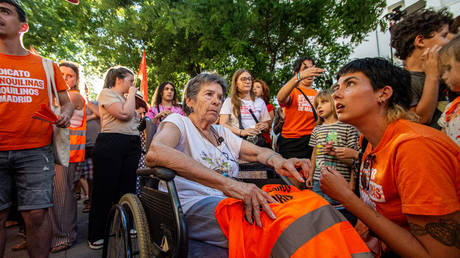
The key was always cold.
In the winters of Madrid, metal conducts the damp air straight through your knuckles, settling deep into the joints until your fingers refuse to close quite right. For decades, that key belonged to a hand that knew every knot in the wood of the front door, every draft that slipped beneath the frame, and every creak in the hallway floorboards. Also making news recently: Why Fighting Over Trees on a Golf Course Misses the Real Point entirely.
Then came the knock.
Not a friendly knock from a neighbor bringing up a warm loaf of bread or asking for a cup of sugar. Not the postman's sharp rap. This was the steady, rhythmic pounding of an eviction notice enforced by the state—a bureaucratic heartbeat signaling that a lifetime of memories could be packed into cardboard boxes within the span of a single afternoon. Additional insights into this topic are explored by Associated Press.
Her name was Carmen. To the cold ledgers of municipal housing data, she became a statistic long before her heart finally gave out under the weight of the pavement. To the streets of Madrid, however, she was an icon—not by choice, but by survival. When you have lived in the same apartment for fifty years, paying rent through changing regimes, shifting economies, and soaring property speculation, your home is not merely a lease agreement. It is your skin.
Strip it away, and you bleed.
Consider the arithmetic of urban gentrification. On paper, it looks clean. A neighborhood revitalizes. Old buildings undergo rehabilitation. Property values rise, attracting foreign capital and modern commerce. The charts slope upward in neat, confident green lines. Economists point to increased municipal revenue and modernized infrastructure as proof of progress.
Now look at the ground level.
Look at what happens when the math forgets that houses are made of people.
When Carmen received her final notice, the courts did not see the kitchen where she had cooked Sunday meals for children who had since grown gray. They did not see the wallpaper stained by time, or the small balcony where she watched the neighborhood transform from a community of working families into a revolving door of short-term tourist rentals and luxury flats. They saw an obstacle. A legal technicality. An expired contract.
The morning they came for her, the street did not remain silent.
That is the curious thing about modern housing crises. They happen in plain sight, yet they are treated as invisible until a crowd gathers to block the wheels of the vans. Neighbors, activists, and total strangers formed a human wall across the asphalt. They linked arms, shouting slogans that echoed off the crumbling stone facades of buildings that had stood for centuries. They understood a fundamental truth that lawmakers often miss: housing is not just a commodity traded on a global exchange. It is the foundation of human dignity.
If you lose your home at twenty, it is an interruption. A chaotic chapter in a long book. You sleep on a friend's couch, you scramble, you rebuild.
If you lose your home at eighty-something, it is an eraser.
The shock is literal. Medical professionals have a name for it, though it sounds too clinical for the raw devastation it describes: relocation stress syndrome. When elderly residents are uprooted from familiar environments, their cognitive decline accelerates. Their blood pressure spikes. The disorientation breaks their will to fight. The body, accustomed to a specific rhythm in a specific space, simply forgets how to function when cast adrift.
Carmen did not survive the transition long. Her heart, already strained by the humiliation of being carried out of her own doorway by riot police while protestors wept in the street, finally stopped.
The headlines called it tragic. The politicians issued standard statements expressing regret and promising reviews of tenant protection laws. Then, the news cycle spun forward. Another crisis took its place. Another trendy cafe opened down the block. The apartment was cleaned, repainted, and priced at a rate that would have paid Carmen’s pension ten times over.
Yet the ghost of that front door remains.
Walk down any historic street in Madrid, Barcelona, Lisbon, or Athens today, and you can feel it—a quiet, humming tension beneath the surface of café terraces and boutique storefronts. The air smells of artisanal coffee and fresh paint, but underneath lingers the scent of displacement.
We are living through a grand experiment in spatial economics. We have decided that convenience for the transient traveler matters more than stability for the permanent resident. We have optimized our cities for investment yields while squeezing out the very souls who built their character.
The numbers tell part of the story. Average rents have skyrocketed past the reach of average wages, let alone fixed pensions. Entire neighborhoods have been hollowed out, transformed into open-air museums for tourists who take selfies in front of doors they will never have to worry about losing.
But numbers do not capture the sound of a heavy wooden door clicking shut for the very last time. They do not measure the quiet grief of an old woman sitting on a park bench with her entire life stuffed into plastic bags, wondering where the world went.
Change is inevitable. Cities must grow, adapt, and renew themselves. No one advocates for stagnation. But there is a profound difference between a city that evolves to shelter its people and a city that consumes them to feed a speculative machine.
When we look back at this era of housing precarity, we will not remember the quarterly returns of real estate investment trusts. We will remember the empty windows. We will remember the elders pushed to the margins. We will remember the coldness of a key turning in a lock that was never supposed to open from the outside.
The street is quiet now. The afternoon sun hits the stone facade, casting long shadows across the pavement where the crowd once stood. Somewhere inside, a television murmurs through thin walls.
The key is gone. But the weight of what happened here lingers in the mortar, waiting for the rest of us to decide what kind of world we actually want to live in.



