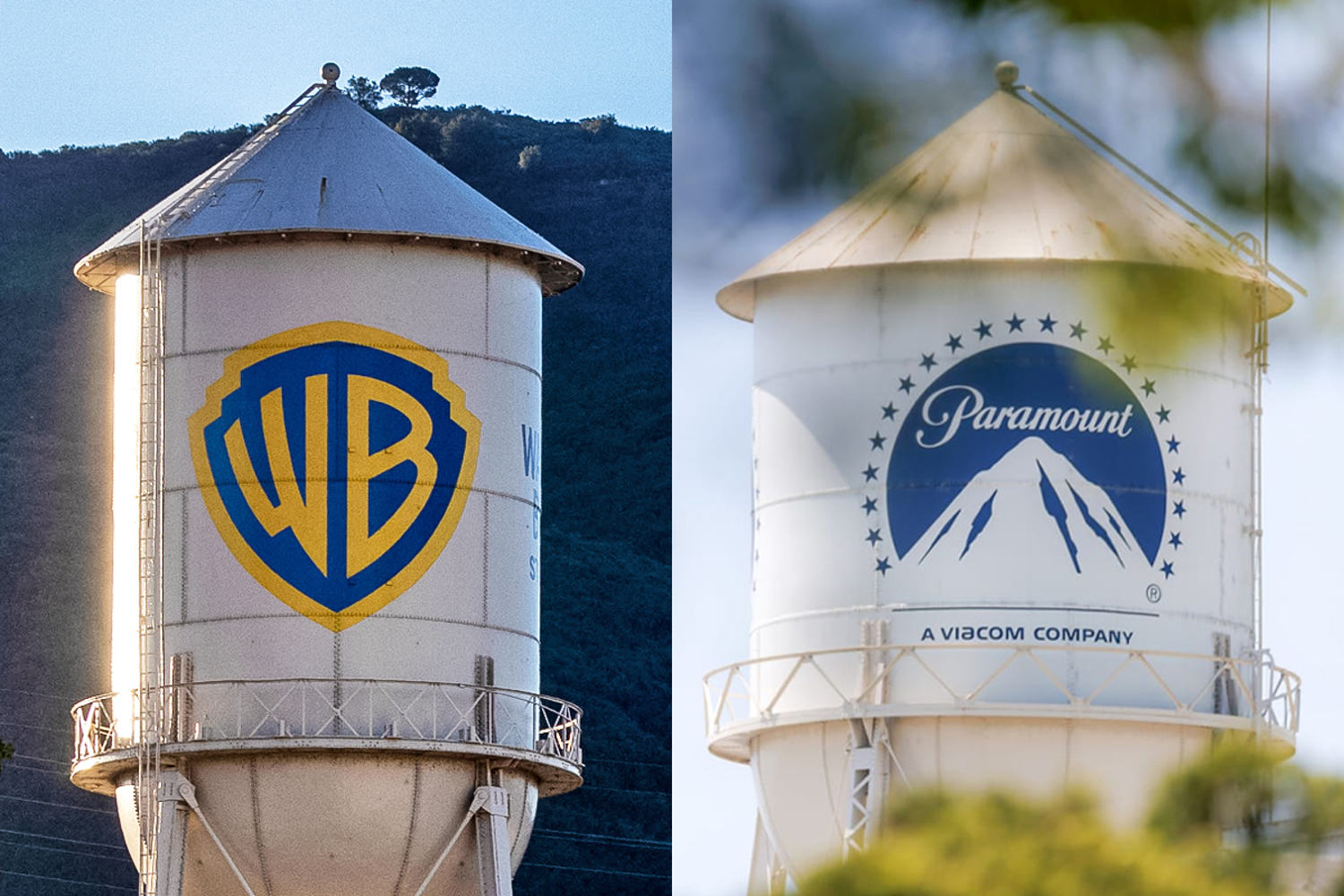
The ink on a Department of Justice sign-off is always black, but it smells like cold copper and fluorescent lighting. When the antitrust division finally cleared Paramount Skydance’s acquisition of Warner Bros. Discovery, there were no champagne corks popping in the streets of Burbank. There was just a sudden, heavy silence that fell over the backlots.
For nearly a century, the movie business operated on a chaotic, beautiful friction. Two fierce rivals, housed on opposite sides of the Hollywood hills, spent decades trying to out-gamble, out-spend, and out-dream one another. One gave the world the gritty realism of gangsters and the technicolor majesty of Oz. The other built an empire on the slick glamour of star-driven blockbusters and the enduring myth of the mountain with the stars.
Now, they belong to the same ledger.
The dry financial wires reported the news as a triumph of regulatory compliance, a standard consolidation of media assets designed to maximize shareholder value in a volatile streaming ecosystem. But numbers do not make movies. People do. And to understand what just happened in Washington, you have to look past the stock tickers and step into a hypothetical writers' room on a rainy Tuesday morning.
Let us call our writer Sarah. She has spent three years developing a complex, mid-budget political thriller. It is the kind of movie that does not involve capes or laser guns, the kind of human story that used to be the bedrock of American cinema. Under the old system, if Paramount passed on her script, her agent would immediately pitch it to Warner Bros. The two studios would bid against each other, driving up the value, forcing both rooms to sharpen their creative pencils.
Tomorrow, Sarah has only one door left to knock on. If that single corporate committee says no, the script goes into a drawer forever. The friction is gone. The safety net has been cut.
The consolidation of Paramount Skydance and Warner Bros. Discovery is not just a corporate merger; it is the final, definitive end of the traditional studio system. We are watching the architecture of our cultural imagination being remodeled by accountants.
The Ghost in the Projector
To understand how we arrived at this boardroom monopoly, we have to look back to a time when the threat to cinema was not an algorithm, but a simple television set. In the 1950s, the studios panicked. They realized that if people could stay home and watch pictures for free, they had to offer something massive, something a wooden box in a living room could never replicate.
They built spectacles. They engineered widescreen formats. They survived because they believed, deeply and fundamentally, that the theatrical experience was a sacred public ritual.
Today, the threat is entirely internal. The danger did not come from an outside competitor; it came from a slow, decades-long erosion of creative independence. When AT&T bought Time Warner in 2018, it was heralded as a masterstroke of vertical integration. It was a disaster. Tech executives who understood cell phone towers tried to run a dream factory, treating iconic cinematic history like raw data to fill bandwidth. When that experiment failed, it was spun off into Discovery, leading to a brutal era of cost-cutting where completed movies were locked away in vaults for tax write-offs, never to be seen by human eyes.
Meanwhile, Paramount found itself caught in a dizzying game of corporate musical chairs, caught between legacy family dynamics and the aggressive ambition of Skydance.
When the Department of Justice looked at this combined entity, they saw a survival strategy. They saw two bruised giants that, if left alone, might collapse under the weight of their own debt and the relentless pressure of Silicon Valley tech monopolies. The regulators blinked because they believed that a single, massive American media conglomerate was better than no traditional studios left at all.
But in saving the structures, they may have suffocated the soul of the machine.
The Fiction of the Endless Scroll
We have been conditioned to believe that more is better. The modern entertainment consumer is told that a merger like this is a victory because it unites massive libraries under a single interface. You can watch a gritty prestige drama, a classic cartoon, and an explosive action franchise without ever switching apps.
It feels like freedom. It is actually a monoculture.
Consider what happens next: when a single entity controls both the production pipeline and the distribution platform, the economic incentive to take risks vanishes. In a healthy market, a studio takes a chance on an eccentric director or an unconventional story because they need a breakout hit to stand out from the crowd. They need a wild card.
When you own the entire crowd, you do not need wild cards. You need predictability.
The algorithm does not value the slow-burning tension of a scene, nor does it understand the emotional resonance of a quiet performance. It values retention metrics. It values the exact second a viewer decides to click away to a different piece of content. When Paramount Skydance and Warner Bros. Discovery operate as one, their combined data pool will dictate the creative process before a single line of dialogue is written.
Scripts will be optimized by software to ensure maximum passive consumption. The rough edges will be sanded down. The strange, beautiful, confusing elements that make a movie stick with you for weeks after the credits roll will be deemed "risk vectors" and eliminated in the pre-production phase.
We are trading the thrilling uncertainty of art for the comforting numbness of a perpetual loop.
The Cost of the Invisible Cut
There is a specific smell to a movie theater right before the trailers start. It is a mix of stale popcorn, ozone from the projector, and the collective anticipation of two hundred strangers sitting together in the dark. It is one of the last places in modern society where we are forced to look in the same direction, to feel the same tension, and to laugh or cry at the exact same moment.
It is an exercise in shared empathy.
When we lose the independence of our studios, we lose the diversity of those shared moments. The danger of this merger is not that movies will stop being made. The danger is that they will all start to feel exactly the same, produced by the same small group of executives who are terrified of losing their jobs in the next quarterly contraction.
The independent creators, the visionary directors, and the young writers who do not have the leverage of a massive franchise behind them are being pushed to the absolute margins. They are being told that their stories are too specific, too niche, too human for a global platform that requires billions of hours of engagement just to break even.
The Department of Justice signed a piece of paper, and the markets responded with a brief, clinical nod of approval. The stock prices stabilized. The executives released press statements filled with corporate platitudes about leveraging IP and maximizing global reach.
But somewhere on a backlot, an old technician is turning off the lights in a screening room that used to hold the dreams of a fiercely independent studio. The room is quiet now. The air is still. The screens are still wide, but the world that populates them just got catastrophically smaller.