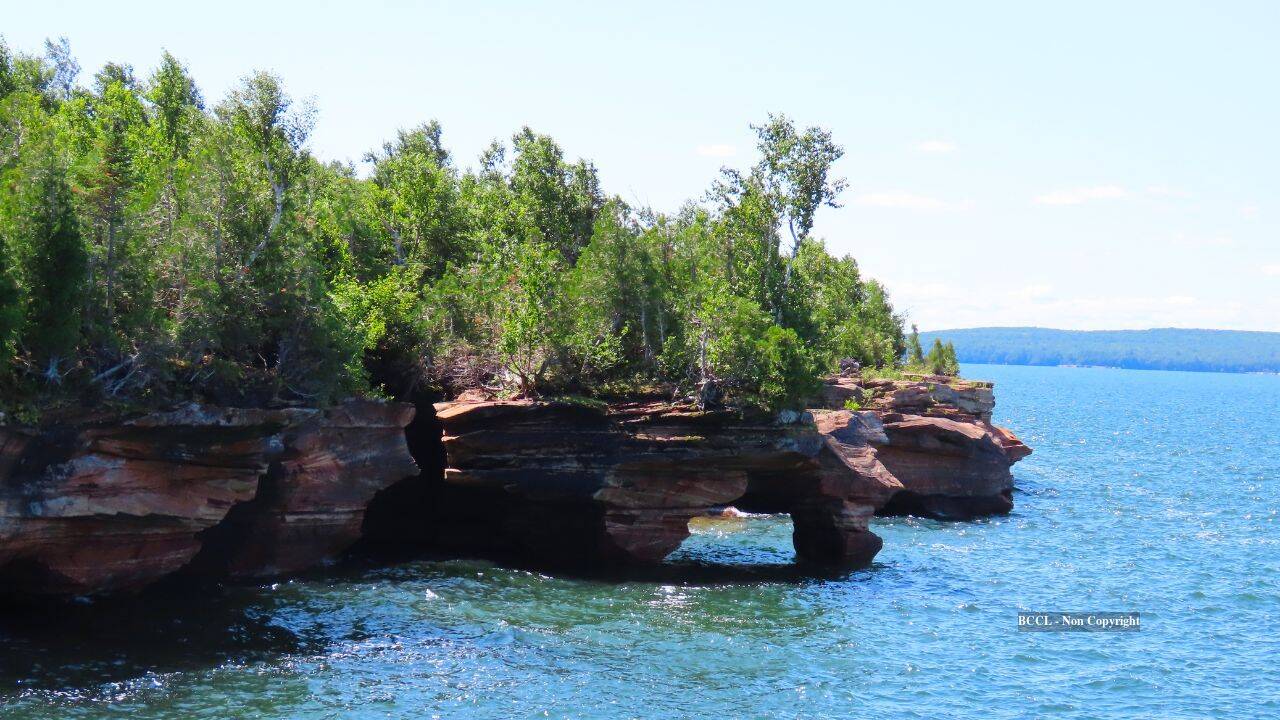
The water up here does not belong to you. You feel that the moment your paddle dips below the surface of Lake Superior and meets a cold so ancient it feels personal.
Thirty-two islands of red sandstone and pine scatter across the horizon like breadcrumbs dropped by a giant. For centuries, the Ojibwe paddled these waters, reading the temper of the lake in the flick of a whitefish tail or the sudden, violent darkening of the northern sky. Today, we call them the Apostle Islands. But to anyone who has ever crouched inside a sea cave carved by ten thousand years of winter ice, watching turquoise light bounce off frozen cathedral ceilings, names begin to feel entirely inadequate. If you liked this post, you might want to look at: this related article.
Right now, those caves, those sandstone cliffs, and the quiet spruce forests standing sentinel above them are caught in the crosshairs of a profound administrative shift. A movement is underway to elevate the Apostle Islands National Lakeshore into America’s sixty-fourth national park.
Politicians call it a designation. Conservationists call it long overdue protection. Local commercial fishermen and traditional hunters, watching their family histories knit into the fabric of these islands, sometimes call it an approaching storm. For another angle on this development, refer to the latest coverage from National Geographic Travel.
To understand why this matters, you have to look past the glossy brochures. You have to stand on the wind-scoured docks of Bayfield on an October morning when the tourist ferries have packed away their canvas awnings and the town belongs entirely to the gulls and the frost.
Change is coming. The question is whether it will preserve the wild heart of the place or love it to death.
Let us be honest about what a park label does. It acts as a beacon.
When New River Gorge in West Virginia made the jump from national river to national park in late 2020, tourism surged. Visitors poured in by the hundred thousand, clogging two-lane roads that had previously known only the quiet hum of local traffic. The economic injection was undeniable. Small businesses breathed easier. But local residents also found themselves picking up trash along trails that had been pristine for generations, waiting longer at boat launches, and watching real estate prices inch out of reach for the people who actually lived there.
The Apostle Islands currently operate under the jurisdiction of the National Park Service as a national lakeshore. That distinction might sound like bureaucratic hair-splitting, but on the ground, it changes everything. Lakeshores traditionally permit a wider, more flexible range of local uses. Hunting has deep roots here; white-tailed deer and black bear management through regulated hunting is a cultural tradition passed down through generations of northern Wisconsinites. Commercial fishing rights, dating back to eras before statehood, carry immense weight.
National parks carry a different kind of gravity. They are icons. They sit on bucket lists.
Ask Sarah Miller, a hypothetical fifth-generation Bayfield resident whose grandfather pulled lake trout from these freezing depths when nylon nets were still a modern luxury. She looks out over the harbor from her porch, cradling a mug of black coffee, and her expression tightens.
"We love these islands," she tells you, her voice dropping an octave against the rising wind off the water. "We protect them because they are our backyard, not because a sign at the entrance tells us to. You turn this into a national park, and suddenly everyone with an Instagram account thinks they own a piece of the shoreline. Who cleans up when the sea caves are packed solid with kayakers who don't know how to read a lake shift?"
She isn't wrong. Superior is not a vacation pond. It is an inland sea with the raw, unpredictable fury of the Atlantic. Waves routinely crest twenty feet during November gales. Water temperatures in the summer hover near fifty degrees—cold enough to trigger hypothermia within minutes. Every year, unwary paddlers underestimate the distance between mainland Meyers Beach and the western sea caves, requiring dramatic rescues by the Coast Guard and local park staff.
Elevating the status of the islands without drastically upgrading infrastructure and safety management is a recipe for disaster. Yet, the proponents of the upgrade point to a different reality.
Funding.
National parks draw federal dollars, dedicated philanthropic foundations, and specialized management resources that lakeshores often struggle to secure in tight fiscal years. With climate change bringing erratic freeze-thaw cycles that threaten the very existence of the famous ice caves—preventing the thick lake ice required for safe winter tourism in recent years—the Apostle Islands need heavy, sustained investment. They need science. They need boots on the ground, shoreline erosion mitigation, and robust habitat monitoring.
Can you have both? Can you elevate a fragile archipelago to global stardom while keeping its doors locked to the crushing weight of mass tourism?
History suggests it is a brutal tightrope walk.
To grasp the stakes, you have to drift back in time.
Long before French fur traders named these islands after the twelve apostles—mistakenly believing there were only a dozen when there are actually twenty-two main islands plus ten smaller satellites—this archipelago was a spiritual homeland. The Ojibwe, or Anishinaabe, migrated here following prophecies telling them to find "the food that grows on water"—wild rice. Madigan Island and the surrounding shores held profound ceremonial importance.
The physical landscape tells an even older story.
Around ten thousand years ago, the Laurentide Ice Sheet was retreating, leaving behind colossal glacial meltwater lakes. As the ice groaned and shifted, it dumped massive loads of sediment, sand, and red clay into the basin. Over millennia, waves battered the exposed sandstone cliffs of Stockton, Hermit, and Devils Islands, carving arches, vaults, and subterranean chambers that look like gothic architecture built by water.
In the late nineteenth and early twentieth centuries, the islands underwent an industrial stripping. Brownstone quarries popped up on Hermit Island; blocks of the deep red stone were shipped across the Midwest to build stately courthouses and mansions in Chicago and Milwaukee. Logging camps leveled the virgin white pine and hemlock forests, leaving the islands vulnerable to massive wildfires that swept through the slash in the early 1900s.
What you see today is a miracle of secondary succession. The forests grew back. The hemlocks returned to shadow the ravines. Black bears swam across the open channels from the mainland to reclaim the interior of Stockton Island, digging dens beneath the root systems of ancient oaks.
The current proposal to designate the area a national park is essentially an attempt to cement this hard-won recovery in amber. But ecosystems are not museums. They breathe. They rot, they burn, they flood, and they freeze.
When you strip away the political maneuvering in Washington and the zoning debates in local town halls, the core argument comes down to a simple, uncomfortable truth: we destroy what we love simply by looking at it too closely.
If visitation doubles—which is the typical trajectory for any site that earns the official "National Park" brand—the delicate shoreline vegetation, the fragile nesting grounds of piping plovers, and the pristine water quality face an unprecedented test. The red sandstone of the sea caves is notoriously soft. Thousands of human hands touching, leaning, and scraping against the rock accelerate erosion at a geological warp speed.
And yet, doing nothing carries its own quiet catastrophe.
Without increased funding and national visibility, local conservation budgets remain perpetually strained. Invasive species like sea lampreys and zebra mussels knock relentlessly at the ecosystem's door. Climate anomalies shorten the window of the ice caves, robbing local winter economies of vital revenue while warming the lake's surface layers, altering the aquatic food web from the bottom up.
The proposal is not a cure-all. It is a gamble.
Consider what happens when the last ferry of the season pulls away from Madeline Island, leaving the channel to the grey ghost of an early winter storm.
The wind howls through the skeleton of the woods. The red cliffs stand bleeding against the white foam of the waves. Out there, on Devils Island, the automated lighthouse flashes its solitary warning into the gathering dark, completely indifferent to whether Congress votes to call this place a lakeshore or a park.
The islands will endure. They have survived ice ages, logging booms, fires, and centuries of human hubris.
The real test is not whether the Apostle Islands can survive becoming a national park. The real test is whether we, as a culture, can learn to love a wild place without loving it to death. Can we visit with reverence rather than entitlement? Can we fund its protection without paving its solitude?
As the first snow begins to dust the pine needles along the mainland trail, the silence of Superior returns. It is a heavy, beautiful silence, waiting for an answer we haven't quite figured out how to give yet.


