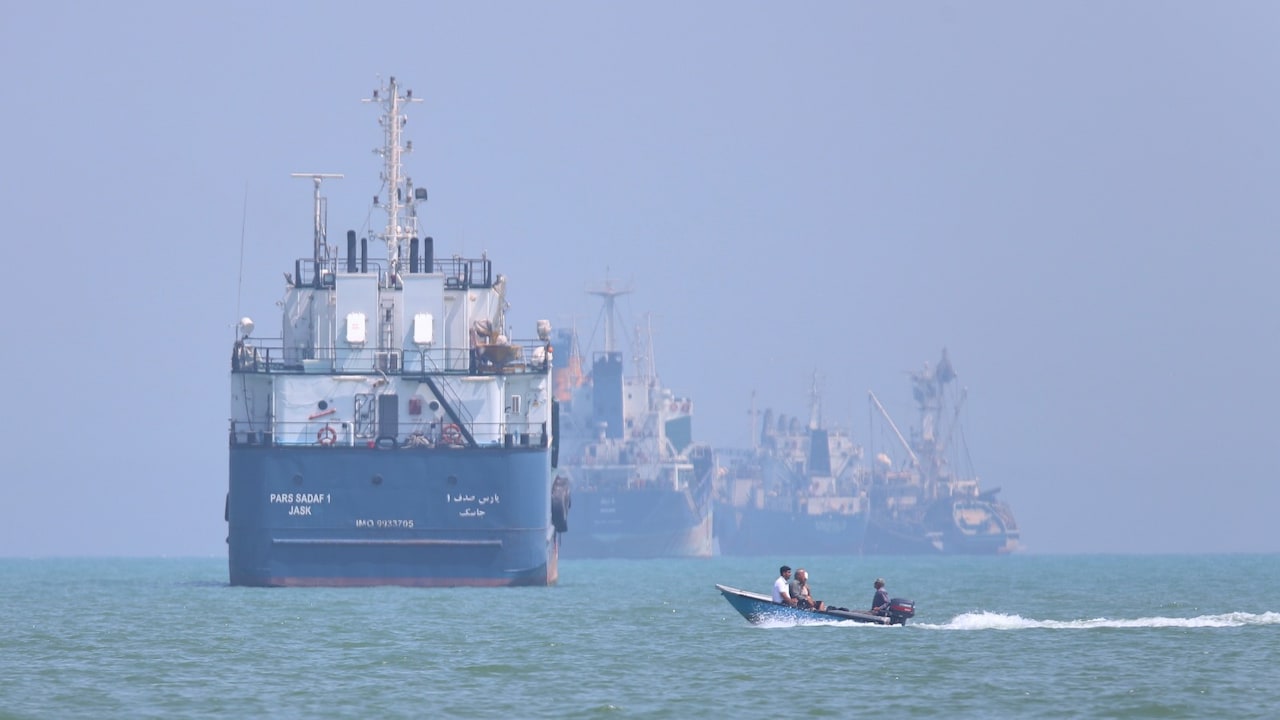
Imagine standing on the bridge of a 150,000-ton supertanker. Beneath your feet is enough crude oil to heat a major city for a month. Ahead lies a narrow, 21-mile-wide ribbon of water squeezed between the jagged, sun-scorched mountains of Oman and the arid cliffs of Iran. This is the Strait of Hormuz. Through this single geological choke point flows roughly one-fifth of the world’s petroleum. If it closes, global energy markets panic. Gas prices spike across the globe, factories lose power, and the delicate gears of international trade grind to a terrifying halt.
Yet, the quiet crisis of the Strait is not fought with missiles or naval mines. It is fought with paragraphs, definitions, and commas.
The battle for control over this critical waterway is a legal chess match between the United States and Iran. Strangely, both nations are arguing over a massive global treaty that neither of them has actually ratified. To understand why a conflict here could ignite a global crisis, you have to understand the invisible legal lines drawn in the water.
The modern law of the sea was supposed to prevent conflicts like this. In 1982, nations gathered to sign the United Nations Convention on the Law of the Sea, known as UNCLOS. Before this treaty, countries generally claimed a narrow three-mile limit of territorial waters off their coasts. Beyond that lay the high seas, where anyone could sail freely.
But UNCLOS allowed nations to extend their territorial waters out to 12 nautical miles. This caused a massive problem. Because the Strait of Hormuz is only 21 miles wide at its narrowest point, the new 12-mile rules meant that the territorial waters of Iran and Oman overlapped entirely. There was no longer any "high seas" corridor in the middle. Every ship passing through would technically be sailing inside another country's sovereign territory.
To keep global trade from suffocating, the negotiators of UNCLOS invented a brand-new legal concept: "transit passage".
Think of transit passage as an absolute, non-negotiable hallway. Under these rules, any ship or aircraft—including foreign warships and military jets—has the right to pass through an international strait continuously and swiftly. The coastal country cannot block them, tax them, or suspend their passage, even during times of tension.
But there is a catch. To access these rights easily, you generally need to be a part of the treaty.
Iran signed UNCLOS in 1982 but never ratified it, meaning the Iranian parliament never formally made it law. The United States, wary of international regulations on deep-sea mining, never signed it at all.
Because of this, Iran argues that it is not bound by the rules of "transit passage". Instead, Tehran insists that the older, more restrictive rule of "innocent passage" applies.
Innocent passage is like walking through a neighbor's front yard. You can do it, but you have to follow their rules. Under innocent passage, a coastal state has the right to regulate traffic, demand prior authorization for foreign warships, and even suspend passage entirely if they believe their national security is threatened. Submarines must surface and fly their flags.
If Iran’s interpretation holds, they have the legal right to pull the plug on the Strait whenever they feel threatened.
The United States sees things differently. The U.S. Navy relies on the Strait of Hormuz to move aircraft carriers, destroyers, and submarines in and out of the Persian Gulf to support its allies and protect oil shipping lanes.
Washington argues that even though the U.S. did not sign UNCLOS, the concept of "transit passage" has transitioned into "customary international law". This means the rule has been practiced so widely and for so long by the international community that it is now binding on every country on Earth, whether they signed the piece of paper or not.
To prove this point, the U.S. Navy regularly conducts "Freedom of Navigation" operations, intentionally sailing warships through the Strait without asking Iran’s permission, daring them to do something about it.
When an oil tanker captain looks out over the horizon at the Strait of Hormuz, they are not just navigating shallow waters and crowded shipping lanes. They are navigating a legal void where two of the world's most powerful military forces operate under entirely different rulebooks.
If a conflict erupts, it will not be because one side simply decided to break the law. It will be because both sides believe they are the ones enforcing it.