Diplomacy rarely sounds like a slammed door. Usually, it sounds like the clink of porcelain cups in a quiet Parisian drawing room, polite pauses between translated sentences, and the careful phrasing of words designed to soften a blow before it lands.
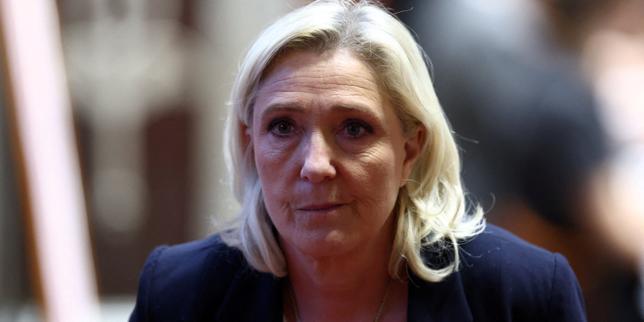
Yet when Marine Le Pen, the longtime leader of France’s National Rally and a recurring contender for the French presidency, met with Ukraine’s ambassador to France, Vadym Omelchenko, the message carried across the table lacked the usual diplomatic fog. According to public statements and reporting surrounding their exchange, Le Pen made her position plain: if elected President of the Republic, France would no longer be able to provide financial aid to Kyiv.
Four words in French—plus aider financièrement—carry an entire continent’s anxiety inside them.
To understand why a single sentence spoken in Paris reverberates from the trenches of Donetsk to the kitchen tables of Lyon, you have to step away from the podiums and look at what happens when geopolitics becomes personal arithmetic.
The Arithmetic of a Cold Winter
Picture a hypothetical apartment on the sixth floor of a concrete building in Kharkiv. Let us call the woman who lives there Olena, a retired physics teacher whose pension arrives electronically on the fifth of every month. Olena does not track the polling averages of French presidential candidates, nor does she read the transcripts of parliamentary debates at the Palais Bourbon. What she knows is whether the radiators hiss with steam at six in the morning when the temperature outside drops to minus twelve degrees.
In wartime Ukraine, a pension is not merely an economic metric; it is the fragile thread keeping civilian society upright while the state funnels its domestic tax revenues toward soldiers, ammunition, and air defense. Since February 2022, the Ukrainian government has relied heavily on bilateral grants, loans, and European Union macro-financial assistance to pay teachers, nurses, firefighters, and pensioners. France, as the second-largest economy in the European Union, sits near the structural center of that financial architecture.
Now shift the camera two thousand kilometers west to a bakery in northern France, in the former mining basin of Pas-de-Calais—a region where Marine Le Pen’s message has resonated deeply for over a decade. Call the baker Marc. Marc watches his electricity bill triple over two winters, sees the price of butter and flour climb, and hears politicians on the evening news announce billions of euros in aid packages for a war three borders away. When Marc hears a candidate say that France’s own coffers are strained and that French taxpayers must come first, he does not hear a betrayal of international law. He hears someone finally acknowledging the ledger sitting on his own counter.
Both Olena and Marc are real archetypes of a single, agonizing equation. And the collision between their two worlds is precisely what makes Le Pen’s statement to Ambassador Omelchenko so consequential.
What Was Actually Said in Paris
To strip away partisan distortion, it helps to examine the exact contours of Le Pen’s stance as articulated by her camp and reported in French media.
During her discussions with Ukrainian representatives, Le Pen maintained a distinction that has become the cornerstone of the National Rally’s foreign policy doctrine. She reiterated her condemnation of Russia’s invasion of Ukraine and expressed respect for the courage of the Ukrainian people defending their sovereignty. At the same time, she drew a hard boundary around France’s material involvement—specifically ruling out future financial aid and questioning continued deliveries of offensive weaponry, arguing instead for an immediate push toward diplomatic negotiations.
Her reasoning rests on two pillars, both repeated consistently in interviews and parliamentary speeches:
First, domestic fiscal constraint. France carries a public debt exceeding three trillion euros, running persistent budget deficits that have drawn scrutiny from credit rating agencies and the European Commission alike. In Le Pen’s framing, a country struggling to fund its own hospitals, pensions, and public services cannot indefinitely underwrite the budget of another state.
Second, strategic caution. Le Pen and her allies in the National Rally, including party president Jordan Bardella, have repeatedly warned against what they describe as "co-belligerency"—the idea that deepening financial and military entanglement pulls France closer to a direct confrontation with a nuclear-armed Russia.
Supporters of President Emmanuel Macron’s government, alongside traditional center-right and left-wing parties in France, view that logic as fundamentally flawed. From their perspective, halting financial aid to Kyiv does not buy peace; it buys a far more expensive crisis later. If Ukraine’s state apparatus collapses under fiscal asphyxiation, millions more refugees could move westward, energy markets could convulse anew, and European deterrence against further territorial aggression would erode.
In the Élysée Palace, aid to Ukraine is framed as an investment in French security—buying safety with euros rather than with the lives of French soldiers. In Marine Le Pen’s headquarters, that same aid is framed as an unsustainable drain on a nation already stretched thin.
The Architecture Behind the Aid
People often imagine foreign aid as pallets of shrink-wrapped banknotes loaded onto cargo planes bound for Kyiv. The reality is far less cinematic and far more intricate.
Think of European financial support for Ukraine like the foundation pilings driven beneath a coastal bridge during a storm. You never see them when you drive across the road, yet without them, the first high tide washes the asphalt away.
France contributes to Ukraine through two distinct channels. The first is direct bilateral support—grants, concessional loans, and targeted funds for infrastructure reconstruction, civil defense, and humanitarian relief. The second, and far larger, channel runs through the European Union’s collective mechanisms, such as the multi-year Ukraine Facility, which pools contributions guaranteed by the EU budget and member states.
Because EU budgetary commitments require unanimity or complex qualified majorities among member states, a French president does not merely control France’s national checkbook; she holds a decisive hand on the steering wheel of the entire European bloc. Even if Paris stopped only its bilateral transfers, a shift in France’s posture in Brussels would immediately alter the political gravity of every European Council summit. Other skeptical capitals—such as Viktor Orbán’s Hungary—would suddenly find themselves no longer isolated on the margins, but aligned with one of the founding pillars of the European Union.
That is why Ambassador Omelchenko’s meeting with Le Pen mattered so acutely to Kyiv. Ukrainian diplomats understand that Washington’s political winds can shift every four years; losing Paris simultaneously would leave European solidarity fractured down the middle.
A Familiar Ghost in French Politics
There is nothing accidental about how this debate feels in France. Anyone who has spent time walking through provincial towns outside Paris—places where shuttered factories sit beside roundabouts that once hosted Gilets Jaunes protests—recognizes the emotional current running beneath foreign policy headlines.
For years, a quiet resentment has simmered among voters who feel that global emergencies always find funding while local emergencies meet bureaucratic shrugs. When a bridge in a rural department remains closed for lack of municipal funds, or an emergency room shuts down overnight for lack of doctors, headlines announcing multi-billion-euro international packages land like salt in an open wound.
I remember standing outside a train station in Picardie during a previous election cycle, listening to a retired rail worker explain why he felt invisible to Paris. He was not cruel. He had donated blankets to a local charity drive for Ukrainian refugees the month before. Yet he pointed toward the darkened ticket office behind him and asked a question that no white paper from the Foreign Ministry has ever cleanly answered: "Why is there always money for the crisis over there, and never money for the quiet decay right here?"
Le Pen’s political career has been built on translating that exact frustration into electoral power. By telling the Ukrainian ambassador directly that France could no longer afford to help Kyiv financially under her presidency, she was speaking to two audiences at once: she was offering candor to a foreign envoy, and she was sending an unmistakable signal to millions of French voters that her loyalty stops at the national border.
Yet history offers a sobering counterpoint to the allure of pulling up the drawbridge. In the late 1930s, across both Paris and London, powerful voices argued that Eastern Europe was too distant, too costly, and too entangled in complex disputes to justify domestic sacrifice. Back then, too, fiscal caution and the desire to avoid escalation felt like common sense—until the bill arrived at France’s own doorstep in the spring of 1940, infinitely higher than the price of early deterrence would ever have been.
History never repeats itself cleanly, and modern nuclear deterrence makes simple comparisons dangerous. Still, the underlying tension remains unchanged: isolation feels cheaper in the short term, while collective security demands paying upfront for disasters that, if prevented, never appear on anyone’s balance sheet.
The Unanswered Questions
If Marine Le Pen were to win the presidency and halt financial aid to Kyiv, what would actually happen next? Even seasoned economists and diplomats admit the aftermath is clouded by competing uncertainties.
Could Germany, the Nordic states, the Baltic nations, and Poland absorb the financial shortfall left by France? On paper, Europe’s combined GDP dwarfs Russia’s economy. In practice, Germany faces its own constitutional debt brake and industrial slowdown, while smaller eastern states are already spending unprecedented shares of their national budgets on defense. Without France’s fiscal weight and political leadership, rallying the remaining twenty-six EU members to double their contributions would face fierce domestic resistance across the continent.
And what of Ukraine itself? A sudden contraction in Western budgetary support would force Kyiv into impossible choices: print money and unleash hyperinflation, slash public-sector salaries in the middle of a war, or accept a frozen conflict on terms dictated from Moscow—terms that Ukrainian officials warn would merely give Russia time to rearm before resuming its offensive.
Conversely, what happens if France continues its current trajectory of open-ended financial support without a clear diplomatic endgame? Critics across the French political spectrum—not solely on the nationalist right, but also among segments of the far left—warn that indefinite war funding without a credible path to negotiations risks exhausting European democracies from within, fueling the very populist backlash that threatens support for Ukraine in the first place.
There is no risk-free column on this ledger. Every choice carries a price tag, and neither side can guarantee the outcome it promises.
The Silence After the Conversation
When Ambassador Omelchenko left his meeting with Marine Le Pen, no treaties were signed, no troops were moved, and no immediate funds were frozen. On the surface, the machinery of French foreign policy kept humming along as before.
Yet something fundamental had shifted in the open air. For years, opposition to aiding Ukraine in Western Europe lived mostly in campaign speeches and television studios—words spoken for domestic consumption while diplomats reassured allies behind closed doors that core commitments would hold regardless of who occupied the presidency. By delivering that message face-to-face to Ukraine’s representative in Paris, Le Pen removed the cushion of ambiguity.
Back in that hypothetical sixth-floor apartment in Kharkiv, Olena knows nothing of the rules governing French presidential elections or the nuances of the National Rally’s parliamentary votes. She only knows that when the winter wind presses against her taped windowpanes, the warmth coming through the iron pipes beneath her sill depends on decisions made in rooms she will never enter, by leaders whose names she can barely pronounce, weighing the cost of her survival against the patience of their own voters.