The coffee in Old Havana tastes of chicory and scarcity. If you sit on a crumbling limestone balcony just as the sun dips below the Straits of Florida, you can hear the city breathe. It is a heavy, rhythmic sound—the rumble of 1950s Chevrolets kept alive by sheer engineering voodoo, the slap of dominoes on folding tables, and the low hum of a population that has spent generations learning to read between the lines of international decrees.
To the bureaucrats in Washington, Cuba is a ledger. It is a series of policy adjustments, embargo extensions, and targeted asset freezes. But when the United States government tightens the vise, the metal does not press against abstract political structures. It presses against skin.
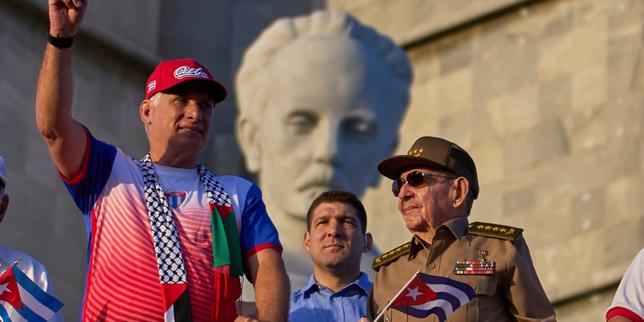
The latest turn of the screw arrived without the thud of artillery, yet its shockwave reverberated through every kitchen on the island. By placing President Miguel Díaz-Canel and the immediate family of the late Raúl Castro under strict financial and travel sanctions, Washington signaled a total freeze in an already glacial relationship. The official press releases from the State Department spoke of accountability, human rights, and the dismantling of authoritarian networks.
But look past the microphone stands. The reality of a sanction is not found in the frozen bank accounts of elites who likely saw the blow coming years ago. It is found in the sudden, terrifying silence of a supply chain.
The Weight of the Signed Name
Consider a hypothetical citizen named Mateo. He is forty-two, though the tropical sun and a diet short on protein make him look fifty. Mateo does not hold a government post. He does not care about geopolitical posturing. His entire universe revolves around sourcing four fresh eggs and a single liter of cooking oil for his daughter's birthday dinner.
When Washington blacklists the highest tier of Cuban leadership, the immediate effect is psychological paralysis across the global financial sector. Imagine you are a mid-level compliance officer at a European bank. You see the names Díaz-Canel and Castro added to a global watch list. Do you carefully parse which transactions are purely humanitarian and which might tangentially touch a sanctioned entity?
No. You do not. You reject the entire wire transfer. It is safer to say no to Cuba entirely than to risk a multi-million-dollar penalty from the U.S. Treasury.
This is the phenomenon experts call "over-compliance," but to Mateo, it feels like an invisible wall. The shipping container filled with milk powder or medical supplies sits idling at a dock in Rotterdam or Veracruz because a bank somewhere became afraid of a shadow. The Cuban government blames the American blockade for every broken pipe and empty pharmacy. Washington points to regime corruption and economic mismanagement as the true authors of the misery.
The truth is a suffocating web woven by both.
A Dynasty of Ash and Iron
The inclusion of the Castro family in these sanctions is less about changing current policy and more about exorcising a historical ghost that refuses to leave the room. For decades, the name Castro was synonymous with defiance, an ideological thorn embedded deeply in the flank of successive American administrations.
But the Cuba of today is not the Cuba of the Sierra Maestra. The bearded revolutionaries are largely gone, replaced by graying men in civilian suits who must govern an island running on empty. Raúl Castro, though officially retired from the forefront of daily governance, has long cast a massive shadow over the country’s military and economic apparatus. By targetting his inner circle and descendants, the U.S. is attempting to slice through the legacy network that still controls the most lucrative sectors of the Cuban economy, specifically the military-run tourism conglomerates.
The strategy seems logical on a whiteboard in D.C. If you starve the elites of their resources, you weaken their grip on power.
But the architecture of authoritarianism is remarkably resilient. When resources shrink, they do not disappear from the tables of the powerful; they vanish from the plates of the vulnerable. The security apparatus remains funded because a threatened regime prioritizes its own survival above all else. The civilian infrastructure—the water pumps, the electrical grids that fail for twelve hours a day, the public transit systems—is what is allowed to rot.
The Anatomy of the Blackout
Step into a Havana night during a rolling blackout. The darkness is total. It is an active, heavy entity that swallows the colorful colonial facades and leaves only the heat.
The state-run oil tankers cannot find insurers willing to touch their cargo due to the fear of American retaliation. Without fuel, the thermoelectric plants groan to a halt. In the dark, people sit on their doorsteps seeking a breeze that never comes. They talk in whispers. They wonder if the currency, the Cuban Peso, will survive another week of hyperinflation before it loses all remaining value against the informal market dollar.
The emotional toll of this existence is a quiet, eroding despair. It is the realization that your life is being used as a laboratory variable in a fifty-year-old experiment with a zero percent success rate.
The United States maintains that these sanctions are precision instruments designed to punish oppressors without harming the populace. It is a comforting narrative for policymakers who need to show domestic voters, particularly in volatile electoral swing states like Florida, that they are being tough on communism. It allows for triumphant speeches and sternly worded tweets.
Yet, the precision of a economic sanction is an illusion. It is less like a sniper rifle and more like a dam built upstream. The rulers still drink from the reservoir; the people downstream watch the riverbed turn to dust.
The Flight from the Island
When hope becomes a luxury that cannot be rationed, people leave.
The most profound metric of the current crisis is not found in the economic growth charts or the value of the non-convertible peso. It is found in the numbers of those who have crossed the Florida Straits or flown to Central America to begin a desperate trek northward. Cuba is experiencing its largest demographic drain since the early years of the revolution.
It is a exodus of the young, the educated, the doctors, the engineers, and the artists. The very human capital required to build a modern, democratic society is packing its meager belongings into synthetic backpacks and slipping away into the night.
This creates a bizarre paradox in American foreign policy. The sanctions intended to destabilize the regime to promote a democratic transition are instead fueling a migration crisis that strains American borders and creates immense domestic political pressure within the United States itself. The policy defeats its own objectives in a circular loop of geopolitical frustration.
The Unbroken Circle
To walk through the streets of Central Havana is to witness an incredible, heartbreaking resilience. You see a mechanic fixing a piston using a piece of a discarded refrigerator. You see a grandmother dividing a single loaf of bread into precise, microscopic rations with the accuracy of a diamond cutter.
There is no love for the bureaucratic incompetence of the state among the ordinary citizens who queue for hours under a blistering sun. They know exactly who is mismanaging their country. They know the cost of a system that prioritizes ideological purity over economic reality.
But they also know the sound of a foreign hammer hitting the anvil.
When news of the sanctions against Díaz-Canel and the Castro family filters through the state-controlled television networks, it is framed as another act of imperialist aggression. For a segment of the population, particularly the older generation that remembers the heights of the social safety net before the collapse of the Soviet Union, that narrative still holds a powerful, defensive resonance. It allows the government to deflect blame for its own monumental failures onto an external enemy.
The sanctions do not break the circle. They complete it.
The sun has fully set now over the Malecón. The sea wall is crowded with couples, musicians, and fishermen casting lines into the dark water, hoping for a catch that will ease tomorrow’s anxiety. A breeze finally kicks up, carrying the scent of salt and exhaust. Somewhere in the distance, a generator sputters to life, its ragged cough a reminder that survival here is an hourly negotiation. The names of presidents and dictators are spoken in Washington and Havana with grand gravity, but on this concrete ledge, the only language that matters is the quiet calculation of how to endure until morning.