The scent of cardamom and toasted marigolds usually clings to a Diwali venue long after the last sparkler dies down. It is a heavy, sweet warmth that signals home to millions of people who have spent months—sometimes decades—building lives thousands of miles from where they were born.
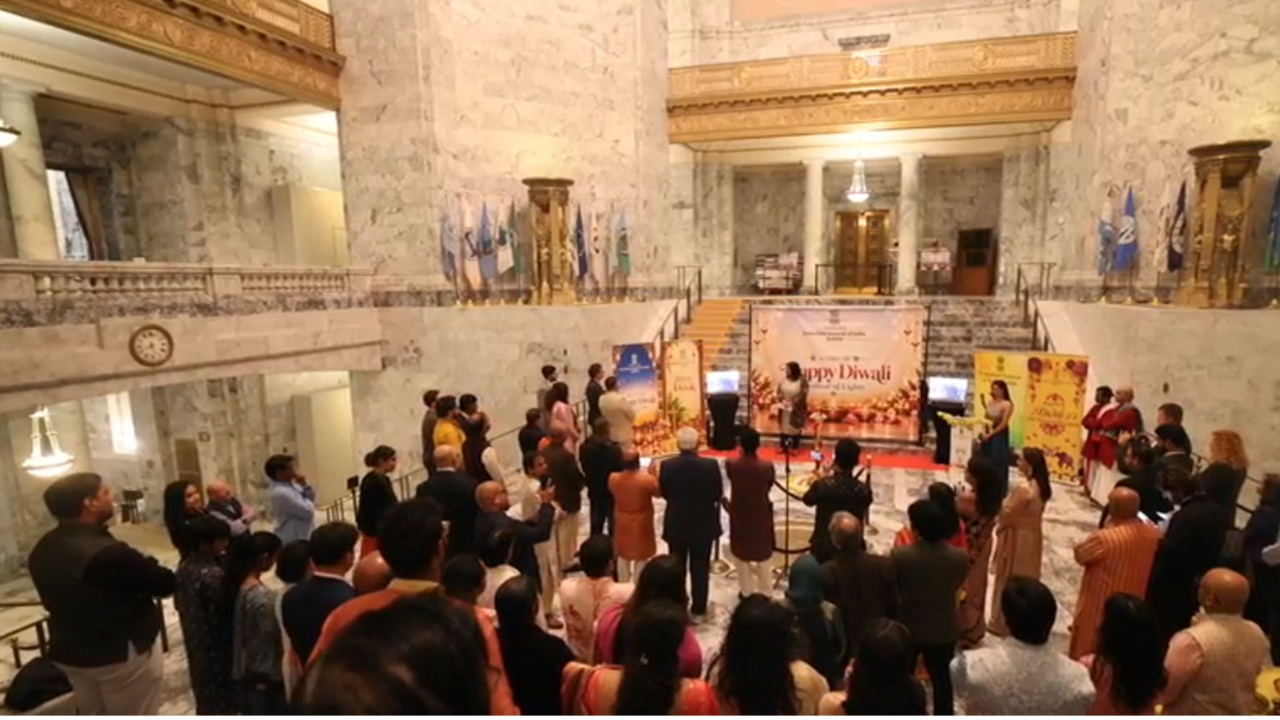
In Seattle, that warmth was supposed to fill a public hall. Parents had spent weeks pressing silk kurtas and adjusting tiny gold bangles on restless wrists. Elders had rehearsed classical blessings. Community organizers had checked and rechecked sound systems, food trays, and seating charts, treating the evening not merely as a party, but as a quiet declaration of belonging in the Pacific Northwest.
Then came the signs.
They were not subtle. They did not arrive as an academic debate over foreign policy or a spirited disagreement at a city council microphone. They arrived as blunt, racialized insults thrust into a space built for children, grandparents, and neighbors. Within minutes, the geometry of the room changed. Laughter thinned out. Parents pulled their kids closer to their hips. The celebration stalled, disrupted not by a fire alarm or a power outage, but by the sudden, unmistakable message that the people inside were viewed as intruders.
And now, months after the posters were folded away and the hall emptied out, that single night in Seattle has traveled all the way to the marble corridors of Capitol Hill.
The Anatomy of a Ruined Evening
To understand why a group of United States lawmakers is demanding a formal investigation into what happened at a local Diwali gathering, you first have to strip away the sterile vocabulary of police blotters and press releases. When a news wire reports that an event was "disrupted over racist signs," the words slide across the screen like cold water on glass. You read them, nod, and scroll to the weather.
Picture instead what that disruption actually feels like inside your ribs.
Imagine—as a hypothetical composite of the dozens of families who attended—a software engineer named Meera who moved to King County eight years ago. She pays property taxes, coaches youth soccer on muddy Saturday mornings, and spent forty dollars on fresh jasmine garlands so her seven-year-old daughter could experience the Festival of Lights the way Meera remembered it from childhood. You do not bring a seven-year-old to a cultural festival expecting to explain why strangers outside—or inside—are holding placards mocking your skin, your accent, or your right to gather in peace.
Yet that is the exact calculation immigrant families across America have been forced to make with growing frequency.
In Seattle, the incident did not stay contained within the walls of the venue. Organizers and attendees documented the confrontation, capturing the visual evidence of slurs and targeted harassment aimed squarely at South Asian Americans. What began as an evening dedicated to the triumph of light over darkness curdled into a case study in public intimidation. People left early. Some left shaking. Many went home wondering whether local authorities treated the episode as a minor noise complaint rather than what it felt like to those standing in the crosshairs: a coordinated attempt to chill a minority community's right to assemble.
That gap—between how a community experiences hostility and how institutions classify it—is precisely what drew federal lawmakers into the fray.
Why Washington Stepped Into a Local Hall
Congress rarely intervenes in municipal event disputes without a reason. Members of the House of Representatives, particularly those caucusing around civil rights and Asian American and Pacific Islander representation, receive thousands of constituent complaints every month. Most stay in district offices, handled through quiet phone calls to local mayors or police precincts.
The Seattle Diwali disruption broke through that filter because it touched a raw, national nerve.
Lawmakers formally pressed federal and local officials to examine how the incident unfolded, why security and law enforcement responses appeared insufficient to prevent the escalation, and whether civil rights protections were adequately enforced. In letters and public statements, legislators pointed out a troubling pattern: anti-South Asian and anti-Hindu rhetoric has surged across digital spaces and spilled onto physical sidewalks, yet enforcement agencies often lack either the training or the urgency to recognize targeted ethnic harassment when it wears the disguise of a protest.
Think of a smoke detector wired into an old house. If the sensor is calibrated only to detect massive structural fires, it will stay completely silent while toxic fumes fill the basement. By the time the alarm finally shrieks, the damage is already irreversible. For years, civil rights advocates have argued that municipal hate-crime and bias-incident frameworks suffer from that exact calibration problem. Unless someone throws a brick through a window or inflicts physical injury, authorities frequently downgrade racialized intimidation to "disorderly conduct" or "free speech friction."
Lawmakers examining the Seattle incident are essentially asking who calibrated the detector—and why it failed when families were standing right underneath it.
The Line Between Protest and Intimidation
Whenever federal officials scrutinize a disrupted public gathering, a predictable constitutional argument surfaces almost immediately. Critics and legal absolutists ask a fair question: Where does protected political speech end and unlawful harassment begin?
It is a question worth answering honestly, without hiding behind slogans.
The First Amendment protects offensive speech. In the United States, people have the constitutional right to stand on a public sidewalk holding signs that are deeply unpopular, historically ignorant, or emotionally painful to passersby. Courts have upheld that principle for generations, recognizing that giving the government power to ban "offensive" signs today guarantees the government will ban righteous protest tomorrow.
But constitutional law has never treated free speech as a blank check to terrorize, trespass, or hijack someone else's lawful assembly.
There is a profound legal and moral difference between standing across the street expressing a political viewpoint and invading or obstructing a cultural celebration with racial slurs designed to make families flee. One is participation in the public square; the other is an effort to drive a specific group out of the square altogether. When demonstrators use targeted racial tropes to shut down a religious or cultural holiday, they are not debating policy. They are exercising a heckler's veto backed by ethnic hostility.
Consider what happens next when authorities blur that line. If city officials treat racialized disruption as just another Tuesday in a busy metropolis, two things happen simultaneously. First, the agitators learn that cultural festivals are soft targets—high-visibility gatherings filled with families who will pack up and leave rather than risk a physical fight. Second, the targeted community learns that the state will not protect their space unless blood is spilled first.
Both lessons are poison for a pluralistic democracy.
A Pattern Written in Data and Silence
To see the Seattle incident clearly, you have to zoom out from the Puget Sound and look at the broader national ledger. Over the past several years, federal hate-crime statistics published by the FBI, alongside independent tracking from civil rights organizations like Stop AAPI Hate and South Asian advocacy groups, have documented a stubborn, unsettling rise in bias incidents targeting Indian Americans, Sikhs, Hindus, and broader South Asian communities.
The numbers tell a stark story, even though experts widely agree they represent an undercount:
- Religious and ethnic facilities—from gurdwaras to temples to community centers—have reported sharp increases in vandalism, threatening phone calls, and coordinated sidewalk harassment.
- Online dehumanization, fueled by viral algorithms that reward outrage, has normalized racial caricatures of South Asian immigrants that would have been unthinkable in mainstream discourse a decade ago.
- Underreporting remains chronic, largely because first-generation immigrants often carry a deep cultural reluctance to attract police attention or be seen as "complaining" in a country they worked hard to enter.
I remember speaking years ago with an elderly community organizer in New Jersey after vandals spray-painted slurs across the entrance of a local cultural center. Before the police cruiser even arrived, two board members were out in the freezing rain with buckets of soapy water and wire brushes, scrubbing the brick wall raw. When I asked why they were erasing the evidence before detectives could photograph it, the older man looked at me with exhausted eyes and said, "If the children see this when they arrive for language class, they will think they are not safe here. We clean it first. We grieve later."
That instinct—to absorb the blow quietly, scrub the wall clean, and keep the children shielded—is honorable, human, and heartbreaking. It is also the exact reason bad actors keep coming back. Silence looks like consent to people who only understand force.
The Invisible Cost of a Cancelled Sparkler
When lawmakers call for a probe into the Seattle Diwali disruption, skeptics sometimes roll their eyes and mutter about political theater. They wonder why Congress is spending time on a single event when inflation, housing shortages, and global conflicts demand attention.
That skepticism misses the invisible stakes entirely.
A society does not unravel all at once. It frays at the edges, one ruined evening at a time. When a cultural festival is disrupted by racist signs and nothing happens afterward, the cost is not measured in broken glass or stolen property. It is measured in the events that never get scheduled the following year. It is measured in the volunteer who quietly steps down from the organizing committee because she cannot bear the thought of exposing her aging parents to another confrontation. It is measured in the teenager who decides to leave her heritage at the front door because carrying it in public feels like painting a target on her back.
Economists talk about the "chilling effect" in markets—how regulatory uncertainty or sudden violence causes investors to pull their capital and sit on the sidelines. Communities operate on a remarkably similar currency. Trust is the capital that makes civic life possible. Every time a neighborhood gathers to share food, music, and tradition, it makes a deposit into that shared account. Every time an organized disruption goes uninvestigated, someone drains the vault.
Seattle prides itself on being a global crossroads—a city whose skyline, hospitals, universities, and technology corridors were built in massive part by immigrants from across Asia. To allow a celebration of light in that very city to be dimmed by racial hostility without a rigorous accounting would be an act of civic amnesia.
What an Investigation Can—and Cannot—Fix
Let us be candid about what a congressional inquiry can realistically achieve. A letter from Capitol Hill will not magically erase prejudice from the human heart. It will not rewrite the First Amendment, nor will it turn every municipal official into an overnight expert on South Asian cultural nuance.
What a formal probe can do is force institutional accountability into the daylight.
It compels local agencies to answer basic, uncomfortable questions on the public record: What threat assessments were conducted prior to the event? How many officers or security personnel were assigned, and what rules of engagement were they given? When racist placards appeared and attendees reported intimidation, what specific actions were taken in real time—and why did those actions fail to preserve the event's integrity?
Just as importantly, federal scrutiny establishes a paper trail. In civil rights enforcement, documentation is everything. When members of Congress demand a formal review, they signal to municipal leaders across the country—from Seattle to Houston, from Edison to Fremont—that bias incidents against South Asian communities will no longer be filed away in a drawer marked miscellaneous.
Law enforcement agencies respond to incentives and oversight. When mayors and police chiefs know that federal lawmakers are watching how they protect minority gatherings, permit reviews become sharper, communication with event organizers improves, and frontline officers receive clearer guidance on distinguishing peaceful protest from unlawful disruption.
The Light That Refuses to Go Out
Diwali, at its oldest philosophical root, has never been a festival about pretending darkness does not exist. In the ancient stories passed down across generations, the lamps are lit precisely because the night is deep, uncertain, and full of shadows. A single clay diya does not banish the entire dark sky; it simply claims a small, stubborn circle of warmth and refuses to surrender it.
That is why the image of those racist signs in Seattle feels so jarring, and why the pushback from Washington matters far beyond one Pacific Northwest zip code.
Months after the hall emptied out, the families who attended that night are still here. They are still coaching weekend soccer, still staffing emergency rooms, still writing code, still running neighborhood storefronts, and still iron-pressing silk garments for the next gathering on the calendar. The lawmakers pressing for answers on their behalf are not asking for special treatment. They are asking for the baseline promise of American civic life: that when you gather in peace to celebrate who you are, the law will stand beside you rather than look away.
Next autumn, when the evenings turn crisp along the Puget Sound and the scent of cardamom begins to drift through community halls once again, someone will strike a match and touch it to a cotton wick—and this time, the whole country will be watching to see who keeps the wind from blowing it out.