Gravity is a cruel romance. We spend our entire lives bound to it, complaining about our weight, dropping coffee mugs, and feeling the steady, grounding pull of the earth beneath our boots. We take it for granted. But when you strip it away, the human body begins to forget what it is.
Bones soften. Muscles wither like unwatered vines. The fluid in your body drifts upward, crowding your chest and filling your skull, tricking your brain into thinking you are drowning in your own blood.
Now, imagine enduring that slow unraveling for 365 days.
This is the invisible reality behind the launch of the Shenzhou 23 spacecraft. To the casual observer scanning a news feed, the headline reads like a standard tally in the ongoing Asian space race: three astronauts, a heavy-lift rocket, and a routine docking sequence at the Tiangong space station. But look closer at the manifest. Two of those astronauts will return after the standard six-month stint. The third is staying for a full year.
A year. That is not a mission. It is an exile.
The Weight of Weightlessness
To understand why a nation would sentence one of its elite pilots to a yearlong suspension in a metal tube, you have to look beyond the sleek press releases issued by the China Manned Space Agency. You have to look at Mars.
We talk about interplanetary travel as if it is a logistical problem of fuel and trajectory. It is not. It is a biological gamble. A round-trip journey to the Red Planet takes roughly nine months each way, plus whatever time scientists spend on the surface. If we send humans to Mars today, they will arrive with skeletons so brittle they could snap under the gravity of a new world.
The Tiangong space station has become a celestial laboratory designed to solve this exact crisis. By forcing a single human being to live in microgravity for twelve consecutive months, scientists are pushing the boundaries of human endurance. They are monitoring the degradation of eyesight, the shifting of cardiovascular walls, and the profound psychological toll of never feeling the wind on your face.
The data gathered from this single, grueling year will write the textbook for the first generation of deep-space explorers. The stakes could not be higher. If the astronaut’s body holds up, the road to the solar system opens. If it fails, we hit a biological wall that no amount of rocket engineering can fix.
The Rhythm of the Sky
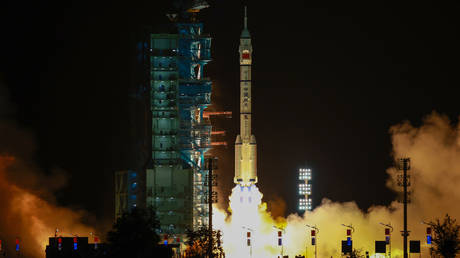
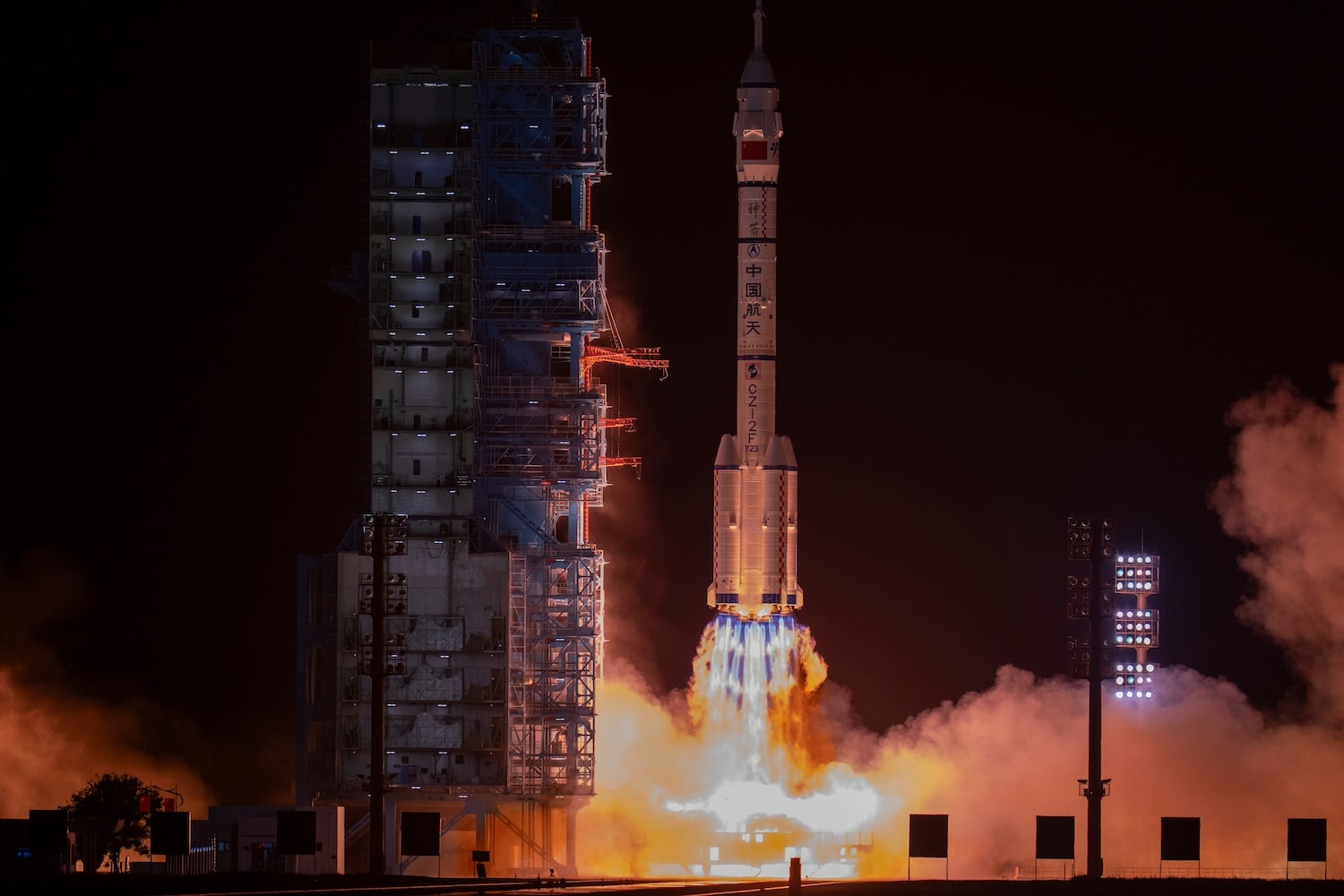
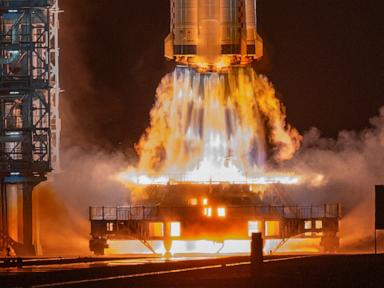
The launch itself happened in the dead of night, a blinding tear of white fire ripping through the dark desert sky at the Jiuquan Satellite Launch Center. For those watching from the ground, the roar is visceral. It rattles your teeth. It fills your chest with a primal terror that makes you want to crawl into the earth.
Inside the capsule, the three astronauts feel something entirely different: a crushing pressure that pins them to their seats as the rocket fights its way out of the atmosphere.
Then, silence.
The engines cut out. The heavy hand of acceleration lifts. Suddenly, the checklists floating on lanyards begin to drift. The human body experiences a brief, euphoric moment of release.
But that euphoria is short-lived. Within hours, the crew docks with the Tiangong station, a multi-module orbital fortress tracing a silent path 250 miles above our heads. For two of the crew members, the clock is already ticking down toward their return. They will conduct experiments, maintain the station, and prepare for the journey home.
For the third, the station is no longer a vehicle. It is a home. A prison. A solitary confinement cell with the most beautiful view in existence.
The Psychology of the Void
Consider the mental fortitude required to look out a window and see the entire world—everyone you have ever loved, every city you have ever known, the very concept of grass and rain—reduced to a blue marble spinning in a sea of ink. You can see it, but you cannot touch it. And you won't touch it for 365 days.
Psychologists who study long-duration spaceflight talk about the "third-quarter effect." It happens long after the initial excitement of the mission has faded, but well before the finish line is in sight. It is a period of profound lethargy, irritability, and existential dread. The food begins to taste like cardboard. The hum of the life support systems becomes a maddening, incessant drone. The faces of your crewmates, once comforting, become reminders of your confinement.
To survive, the yearlong astronaut must rely on an agonizingly strict routine. Every day is a calculated battle against decay.
Two hours of intense cardiovascular and resistance training are mandatory just to keep the bones from dissolving. The exercise machines are loud and awkward, requiring bungee cords and harnesses to strap the floating body down. You sweat profusely, but without gravity, the sweat does not drip. It pools on your skin, forming thick, hot sheets of moisture that you have to scrape off with a towel.
The Silent Pioneer
The Chinese space program is notoriously tight-lipped about the personal lives of its taikonauts. We see them in their pressurized suits, waving to the cameras, pristine and stoic. But behind the heavy glass of the visors are people who missed birthdays, anniversaries, and funerals.
While the world argues over orbital mechanics, geopolitical dominance, and satellite constellations, a human being is floating in a tin can, watching the continents slide by every ninety minutes. He is eating rehydrated pork, drinking recycled sweat, and sleeping vertically strapped to a wall so he doesn't float into the instrument panels during the night.
This is the true cost of exploration. It is paid in the currency of human isolation.
When the Shenzhou 23 eventually returns its first two passengers to the grasslands of Inner Mongolia, they will be pulled from the capsule, blinking into the harsh sunlight, carried by recovery teams because their legs will be too weak to support their own weight.
And high above them, a single set of eyes will watch their descent from a window, turning back to the silent, sterile corridor of the space station to face the remaining months alone. For that solitary traveler, the earth remains a distant dream, a prize waiting at the end of a year without weight.